
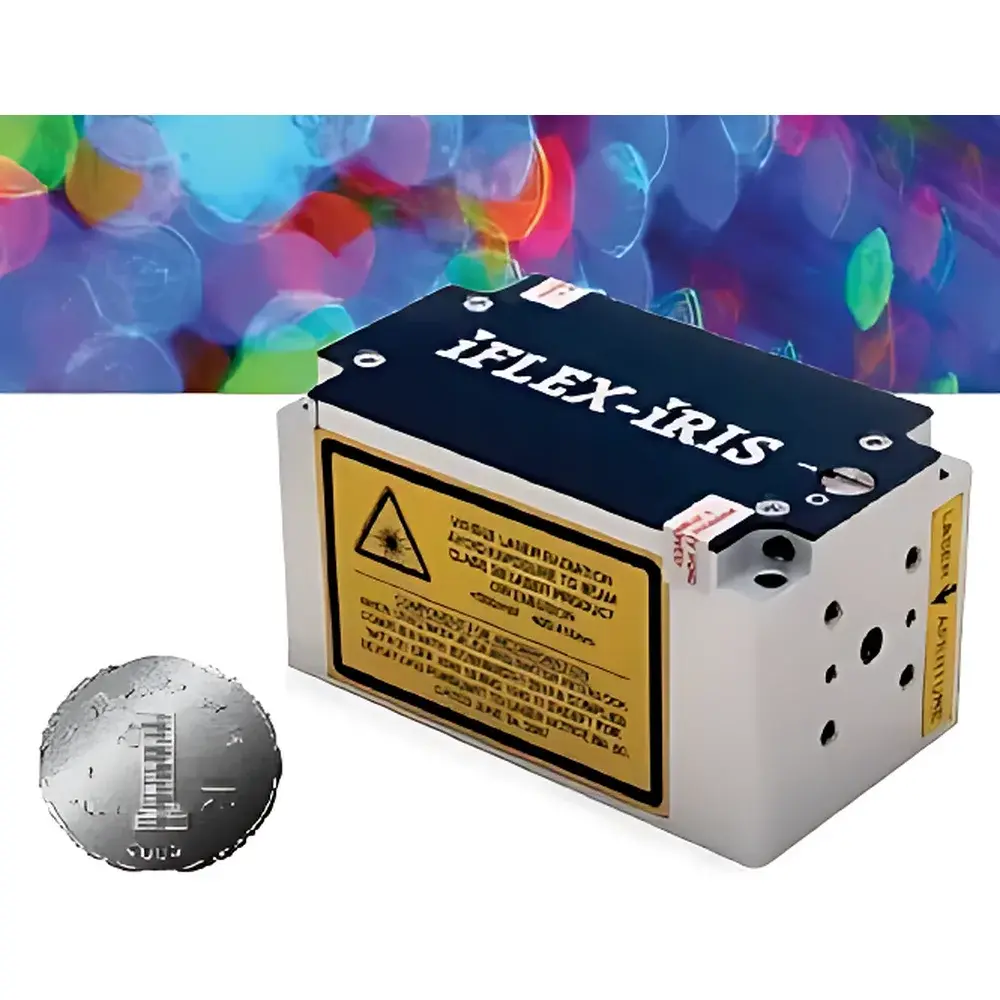
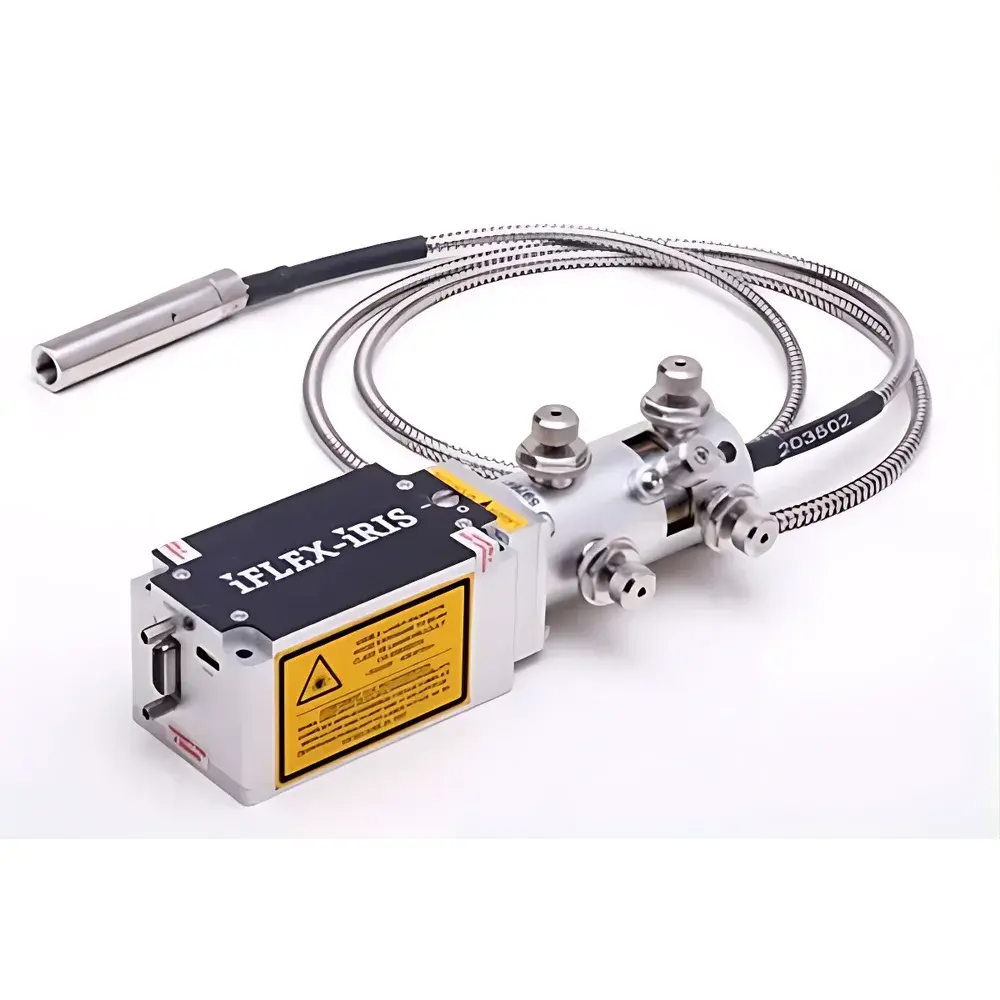
Qioptiq iFLEX-473nm TEM₀₀ Single-Mode Blue Diode Laser System
| Brand | Qioptiq |
|---|---|
| Origin | United Kingdom |
| Model | iFLEX-473nm |
| Wavelength | 473 nm |
| Output Power | 25 mW |
| Beam Mode | TEM₀₀, M² < 1.1 |
| Beam Diameter (at aperture) | 0.7 mm |
| Beam Divergence | Diffraction-limited |
| Polarization Ratio | >200:1 (vertical, ±2°) |
| Pointing Stability | <1 µrad/°C |
| Power Stability (8 h) | <0.5% RMS |
| Intensity Noise | <0.05% RMS (20 Hz – 20 MHz) |
| Dimensions | 70 mm × 40 mm × 38 mm |
| Output | Collimated free-space or single-mode polarization-maintaining fiber-coupled |
| Technology | CLM-stabilized diode laser with active temperature control |
| Custom Options | Adjustable output power, circular or shaped beam profile |
Overview
The Qioptiq iFLEX-473nm is a high-performance, compact, single-longitudinal-mode (SLM) blue diode laser system engineered for demanding optical instrumentation applications requiring exceptional beam quality, long-term power stability, and low intensity noise. Operating at a precisely stabilized wavelength of 473 nm, this laser leverages Qioptiq’s proprietary Closed-Loop Monitoring (CLM) architecture combined with active thermal regulation to suppress mode-hopping and thermal drift—key limitations in conventional semiconductor lasers. Its diffraction-limited, TEM₀₀ output (M² < 1.1) ensures near-perfect Gaussian spatial profile and minimal wavefront distortion, making it suitable for applications where coherence length, focusability, and interference contrast are critical. Unlike generic 473 nm DPSS or multi-mode diode sources, the iFLEX-473nm delivers intrinsic SLM operation without external cavity feedback, eliminating alignment sensitivity and enabling robust OEM integration into space-constrained platforms such as confocal microscopes, flow cytometers, and holographic interferometers.
Key Features
- Stable TEM₀₀ output with M² < 1.1 and diffraction-limited divergence for optimal focusing and spatial coherence
- Ultra-low intensity noise (<0.05% RMS, 20 Hz–20 MHz) and superior power stability (<0.5% over 8 hours), essential for quantitative fluorescence and scattering measurements
- High polarization extinction ratio (>200:1, vertical orientation ±2°) supporting polarimetric and anisotropy-sensitive assays
- Sub-microradian pointing stability (<1 µrad/°C) enabled by monolithic mechanical design and precision thermal management
- Compact footprint (70 × 40 × 38 mm) with modular mounting options for seamless integration into optical breadboards or instrument enclosures
- Flexible delivery: factory-aligned free-space collimated output (0.7 mm diameter) or single-mode polarization-maintaining (PM) fiber coupling with FC/APC connector
- OEM-configurable options including analog/digital modulation input, adjustable output power, and custom beam shaping (circularization, top-hat, line generation)
Sample Compatibility & Compliance
The iFLEX-473nm is designed for use with biological, colloidal, polymeric, and crystalline samples in regulated and research-grade environments. Its stable, low-noise 473 nm output is compatible with common fluorophores excited in the blue spectral region (e.g., Alexa Fluor 430, Cascade Blue, DAPI derivatives) and supports label-free techniques such as dynamic light scattering (DLS) and laser Doppler velocimetry. The laser complies with IEC 60825-1:2014 Class 3B laser safety requirements when operated within specified enclosure and interlock configurations. All units undergo full traceable calibration per ISO/IEC 17025-accredited procedures, and documentation includes test reports for power stability, beam profile, and spectral purity. For GxP-compliant installations, optional 21 CFR Part 11–ready firmware logs and audit trails are available upon request.
Software & Data Management
While the iFLEX-473nm operates as a stand-alone analog/digital-controlled laser source, it integrates natively with industry-standard instrumentation control frameworks—including National Instruments LabVIEW, MATLAB Instrument Control Toolbox, and Python-based PyVISA—via TTL-compatible modulation input and analog voltage control (0–5 V). Optional Qioptiq LaserLink software provides real-time monitoring of internal temperature, drive current, and photodiode feedback signals, supporting predictive maintenance and performance trending. All firmware updates are delivered via secure HTTPS and include SHA-256 signature verification. Configuration files are stored in human-readable JSON format, facilitating version control and audit-ready documentation for GLP/GMP workflows.
Applications
- Confocal and super-resolution fluorescence microscopy requiring high spatial coherence and low photobleaching-induced artifacts
- DNA sequencing platforms utilizing 473 nm excitation for four-color dye sets with minimal crosstalk
- Flow cytometry systems demanding stable blue excitation for simultaneous detection of FITC, PE-Cy5, and Pacific Blue conjugates
- Dynamic light scattering (DLS) and electrophoretic light scattering (ELS) instruments where laser amplitude noise directly impacts size distribution accuracy
- Holographic data storage and optical trapping setups relying on precise beam pointing and phase stability
- Calibration of spectroradiometers, CCD/CMOS quantum efficiency testers, and photodetector linearity references
FAQ
Is the iFLEX-473nm compliant with FDA 21 CFR Part 11 for electronic records and signatures?
Yes—when deployed with optional LaserLink software and validated configuration, the system supports audit trails, electronic signatures, and role-based access control required for regulated pharmaceutical and clinical diagnostics environments.
Can the laser be fiber-coupled to a custom optical path?
Yes—standard configurations include single-mode PM fiber output (SM630 or Panda-type) with FC/APC termination; custom fiber lengths, connectors, and collimation optics are available under OEM agreement.
What is the typical coherence length of the iFLEX-473nm?
With its SLM operation and narrow linewidth (<1 MHz typical), the coherence length exceeds 300 m, enabling high-contrast interferometric applications without external stabilization.
Does the laser support analog modulation for pulsed illumination?
Yes—0–5 V analog input enables linear power modulation up to 500 kHz bandwidth; digital TTL modulation supports on/off switching with <100 ns rise/fall times.
Is thermal management passive or active?
Active thermoelectric cooling (TEC) with closed-loop PID control maintains junction temperature within ±0.02°C, ensuring wavelength and power stability across ambient variations from 15°C to 35°C.





