
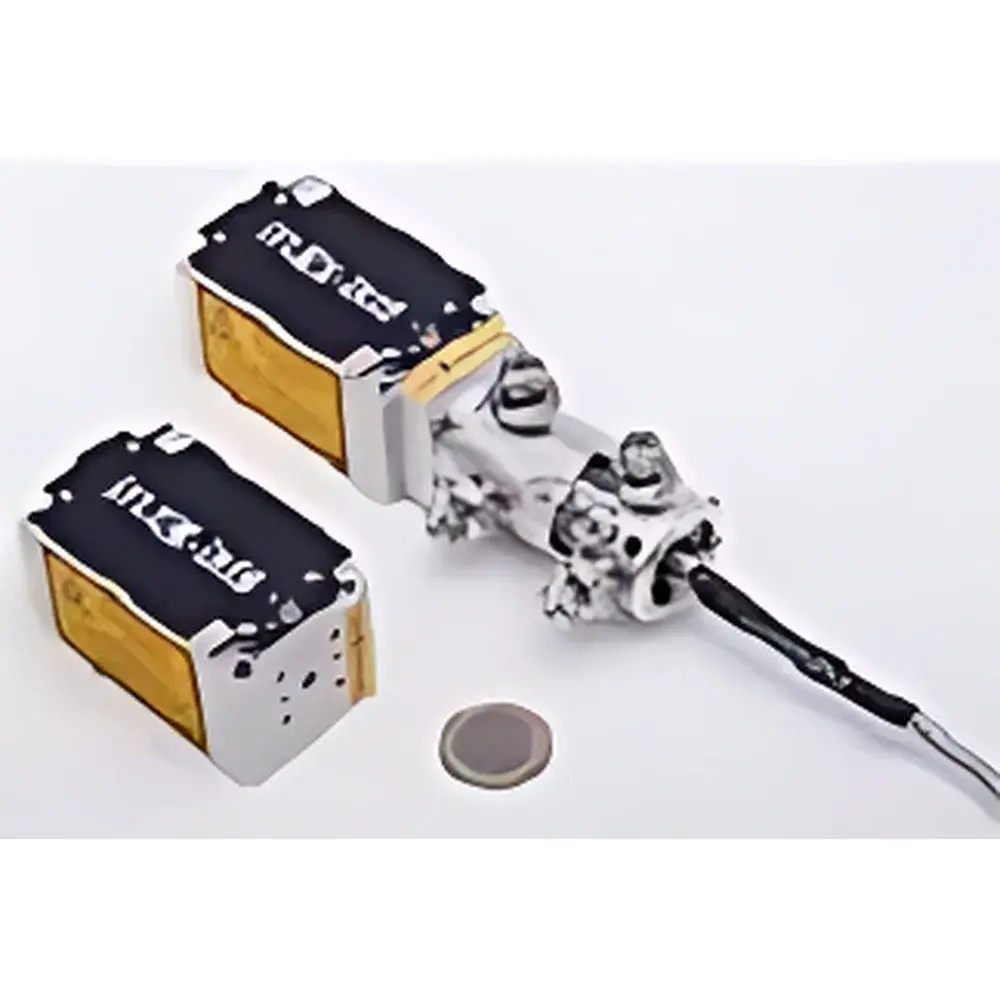
Qioptiq iFLEX-IRIS 561 nm Solid-State Laser System
| Brand | Qioptiq |
|---|---|
| Origin | United Kingdom |
| Type | OEM-Ready Solid-State Laser Source |
| Wavelength | 561 nm |
| Transverse Mode | TEM₀₀ (M² < 1.1) |
| Beam Diameter (@ 1/e²) | 0.7 ± 0.2 mm |
| Pointing Stability | < 1 μrad/°C |
| Polarization Ratio | ≥ 200:1 (Vertical ± 2°) |
| Power Stability (8 h) | < 0.5 % RMS |
| Intensity Noise (20 Hz – 20 MHz) | < 0.05 % RMS |
| Peak-to-Peak Noise (20 Hz – 1 MHz, 561 nm) | < 0.5 % |
| Periodic Noise (1 kHz – 1 MHz) | < 0.05 % |
| CW Power Adjustment Range | 0.1–100% (Off / 50–100% / 15–100% modes) |
| Digital Modulation Bandwidth | DC to 5 MHz |
| Extinction Ratio | 1,000,000:1 |
| Rise/Fall Time | < 100 ns |
| Analog Modulation | 0–5 V input, DC to 5 MHz |
| Dual-Mode Modulation Support | Independent digital fast-switching and analog power control inputs |
| Communication Interface | micro-USB & RS232 |
| Dimensions (L × W × H) | 70 × 40 × 38 mm |
| Output | Collimated Free-Space or Single-Mode Polarization-Maintaining Fiber-Coupled Option |
Overview
The Qioptiq iFLEX-IRIS 561 nm solid-state laser system is a precision-engineered OEM laser source designed for demanding optical applications requiring high spatial coherence, exceptional pointing stability, and long-term power consistency. Operating at the biologically critical 561 nm wavelength—optimal for excitation of fluorescent dyes such as mCherry, tdTomato, and Alexa Fluor 568—the iFLEX-IRIS leverages proprietary CLM™ (Coherent Light Management) technology combined with active thermal stabilization to deliver TEM₀₀ output with M² < 1.1. Unlike conventional diode lasers, this system eliminates mode-hopping and thermal drift through real-time temperature compensation and monolithic cavity design, enabling diffraction-limited beam quality in compact form factor (70 × 40 × 38 mm). The laser supports both free-space collimated output and single-mode polarization-maintaining (PM) fiber coupling, ensuring compatibility with confocal microscopy, flow cytometry, and holographic interferometry platforms where beam fidelity directly impacts signal-to-noise ratio and quantitative reproducibility.
Key Features
- Stable TEM₀₀ output with M² < 1.1 and beam diameter of 0.7 ± 0.2 mm @ 1/e² intensity profile
- Ultra-low pointing instability (< 1 μrad/°C) enabled by rigid mechanical housing and active thermal regulation
- Polarization extinction ratio ≥ 200:1 (vertical orientation, ±2° tolerance), critical for polarization-sensitive assays
- Power stability better than 0.5 % RMS over 8 hours, verified under continuous operation without external feedback
- Negligible intensity noise: < 0.05 % RMS (20 Hz – 20 MHz); < 0.5 % peak-to-peak (20 Hz – 1 MHz) at 561 nm
- Dual modulation architecture: independent digital TTL switching (DC–5 MHz, extinction ratio 10⁶:1, <100 ns rise/fall) and analog 0–5 V control (same bandwidth)
- OEM-integrated communication via micro-USB and RS232 for remote configuration, status monitoring, and firmware updates
- Compact footprint optimized for integration into space-constrained instruments including benchtop cytometers and modular microscope engines
Sample Compatibility & Compliance
The iFLEX-IRIS 561 nm laser is routinely deployed in regulated life science instrumentation where traceability and repeatability are mandated. Its performance aligns with key requirements of ISO 13694 (laser beam parameters), IEC 60825-1 (laser safety classification), and ASTM E275 (fluorescence instrument qualification). When integrated into FDA-regulated systems—such as clinical flow cytometers or GMP-compliant DNA sequencers—the laser’s deterministic modulation response, audit-ready communication logs, and stable output support 21 CFR Part 11 compliance when paired with validated host software. No hazardous substances are used in manufacturing; RoHS 3 and REACH conformity are certified per EU Directive 2011/65/EU.
Software & Data Management
The laser includes embedded firmware supporting bidirectional serial communication (RS232/micro-USB) for full parameter control—including power level, modulation mode, standby state, and internal diagnostics. All operational states are timestamped and reportable, enabling GLP/GMP-aligned data integrity workflows. OEMs may integrate the device using Qioptiq’s documented ASCII command set or leverage the optional SDK for Python/C++ environments. Firmware versioning, error logging, and thermal history tracking are retained across power cycles. No cloud dependency or proprietary runtime is required; all functions operate autonomously once configured.
Applications
- Confocal and super-resolution microscopy: Stable 561 nm excitation enables consistent fluorophore activation across multi-channel acquisitions, minimizing channel crosstalk and photobleaching artifacts.
- Flow cytometry: High extinction ratio and low noise ensure precise discrimination of dimly expressed markers in spectral and imaging cytometers.
- DNA sequencing platforms: Used in Illumina-compatible systems for base-calling illumination where pulse-to-pulse energy consistency affects phasing/pre-phasing metrics.
- Dynamic light scattering (DLS): Low amplitude noise and pointing stability reduce baseline drift in autocorrelation function computation, improving hydrodynamic size distribution accuracy.
- Holographic optical trapping and interferometry: TEM₀₀ coherence length > 10 m supports stable interference fringe formation in dual-beam configurations.
- Fluorescence correlation spectroscopy (FCS): Sub-0.1 % RMS noise floor allows detection of nanomolar analyte concentrations with high temporal resolution.
FAQ
Is the 561 nm output available in both free-space and fiber-coupled configurations?
Yes—standard delivery includes collimated free-space output; single-mode PM fiber coupling (FC/APC or FC/PC) is available as an OEM option with factory alignment and certification.
Can the laser be operated without external cooling or forced air?
Yes—the integrated thermoelectric cooler (TEC) and passive heatsink enable stable operation at ambient temperatures up to +40 °C without auxiliary cooling.
What safety class does this laser meet?
The iFLEX-IRIS 561 nm system is classified as Class 3B under IEC 60825-1 when operated at maximum rated output; full compliance documentation is provided with each unit.
Does the laser support analog and digital modulation simultaneously?
Yes—dual-input modulation architecture permits concurrent use: one port for TTL-based on/off switching, the other for continuous analog power scaling via 0–5 V input.
Are calibration certificates and test reports included?
Each unit ships with a factory test report documenting measured power stability, pointing drift, M², polarization ratio, and noise spectra; NIST-traceable power calibration is available upon request.




