
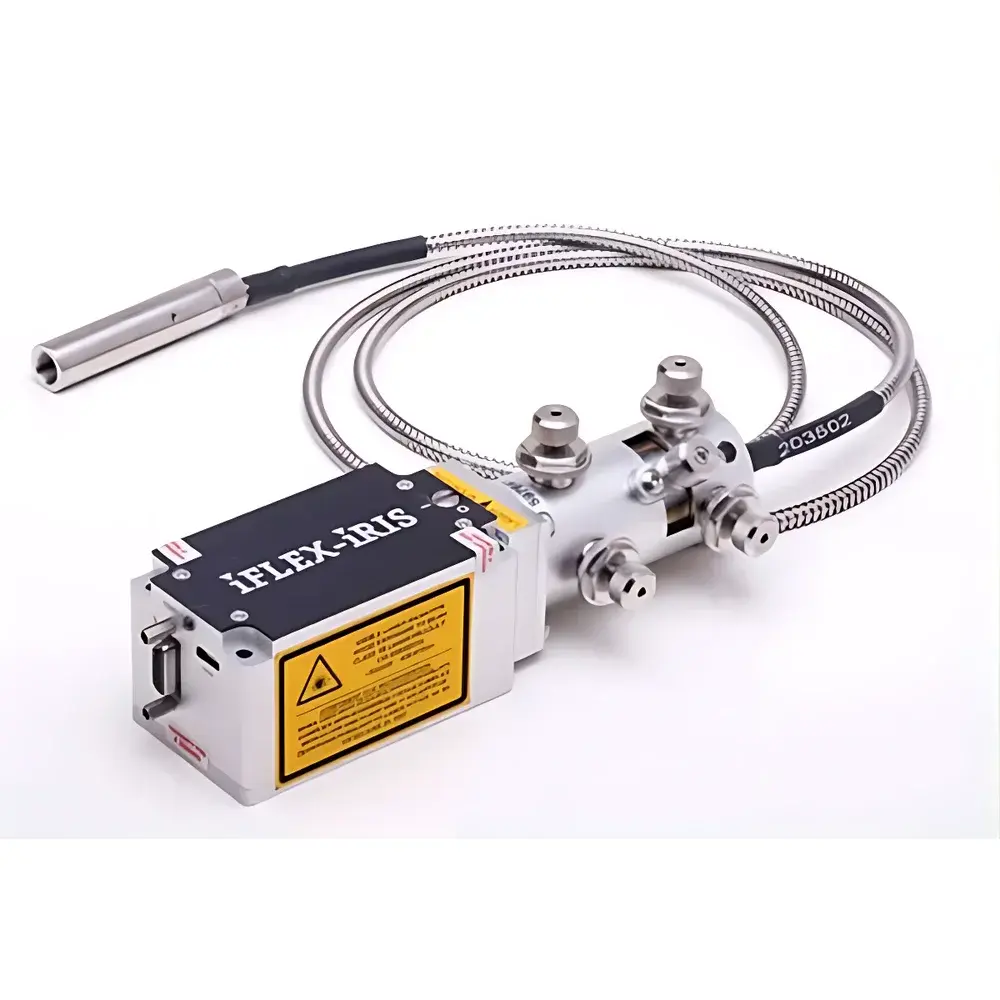
Qioptiq iFLEX-IRIS 594 nm DPSS Laser System
| Brand | Qioptiq |
|---|---|
| Origin | United Kingdom |
| Type | Solid-State DPSS Laser |
| Wavelength | 594 nm |
| Beam Mode | TEM₀₀ (M² < 1.1) |
| Power Stability (8 h) | < 0.5 % |
| RMS Intensity Noise (20 Hz – 20 MHz) | < 0.3 % |
| Beam Pointing Stability | < 1 μrad/°C |
| Polarization Ratio | ≥ 200:1 (Vertical ± 2°) |
| Beam Diameter (@ 1/e²) | 0.7 ± 0.2 mm |
| Divergence | Near diffraction-limited |
| Output | Free-space or single-mode polarization-maintaining fiber-coupled |
| Modulation | Digital (DC–5 MHz, extinction ratio > 10⁶:1, rise/fall < 100 ns) and analog (0–5 V, DC–5 MHz) |
| Dimensions (L×W×H) | 70 × 40 × 38 mm |
| Compliance | CE, RoHS, FDA 21 CFR Part 11-ready firmware architecture (OEM configuration) |
Overview
The Qioptiq iFLEX-IRIS 594 nm DPSS (Diode-Pumped Solid-State) laser system is a high-performance, compact, and thermally stabilized continuous-wave (CW) laser engineered for demanding optical instrumentation applications requiring exceptional beam fidelity, long-term power stability, and ultra-low intensity noise. Operating at the critical 594 nm wavelength—strategically positioned between common green (532 nm) and red (633–640 nm) laser lines—it delivers optimal excitation efficiency for fluorophores such as Texas Red®, mCherry, and Cy3.5, making it especially valuable in multicolor flow cytometry, confocal fluorescence microscopy, and DNA sequencing platforms. The laser employs intracavity frequency-doubling of a Nd:YVO₄ or similar gain medium, combined with Qioptiq’s proprietary CLM (Controlled Laser Mode) technology and active thermal stabilization, to achieve near-perfect Gaussian beam propagation (TEM₀₀) with M² < 1.1 and diffraction-limited divergence. Its integrated collimation optics and optional single-mode polarization-maintaining (PM) fiber coupling ensure consistent spatial mode delivery across instrument integration cycles—critical for alignment-sensitive optical trains in OEM analytical systems.
Key Features
- Ultra-stable CW output at 594 nm with < 0.5 % power drift over 8 hours under ambient temperature fluctuations
- Exceptionally low RMS intensity noise (< 0.3 %, 20 Hz – 20 MHz), enabling high signal-to-noise ratio measurements in dynamic light scattering (DLS) and fluorescence correlation spectroscopy (FCS)
- Beam pointing stability < 1 μrad/°C, minimizing focus drift in long-duration imaging or scanning applications
- High polarization purity (≥ 200:1, vertical orientation ±2°), essential for polarization-resolved detection and interferometric setups
- Dual modulation capability: independent digital (DC–5 MHz, extinction ratio > 10⁶:1, <100 ns rise/fall) and analog (0–5 V input, same bandwidth) inputs for synchronized gating and analog power control
- Compact OEM form factor (70 × 40 × 38 mm) with flexible output options—including free-space, fiber-coupled (SM PM fiber), and custom beam shaping (e.g., top-hat, line generation) upon request
- Firmware architecture supports audit-trail logging and configurable user access levels—aligned with GLP/GMP and FDA 21 CFR Part 11 readiness requirements for regulated laboratory environments
Sample Compatibility & Compliance
The iFLEX-IRIS 594 nm laser is designed for integration into Class 1 or Class 3B optical systems compliant with IEC 60825-1:2014 and EN 60825-1:2014 standards. Its low temporal noise and stable TEM₀₀ profile ensure reproducible excitation of biological samples—including live-cell suspensions in flow cytometers, fixed-tissue sections in confocal microscopes, and colloidal nanoparticles in DLS instruments—without inducing phototoxicity or measurement artifacts. The system conforms to CE marking directives (EMC Directive 2014/30/EU, RoHS 2011/65/EU) and supports traceable calibration documentation per ISO/IEC 17025 requirements when deployed in accredited testing laboratories. Optional factory-installed fiber termination enables seamless interfacing with commercial spectrometers (e.g., Horiba Jobin Yvon, Ocean Insight) and modular optical benches adhering to standard kinematic mounting protocols (e.g., Thorlabs SM1, C-mount).
Software & Data Management
The laser operates via embedded microcontroller firmware accessible through micro-USB or RS232 serial interface. Qioptiq provides a cross-platform SDK (Windows/Linux/macOS) supporting Python, C++, and LabVIEW APIs for remote power control, modulation triggering, status monitoring (temperature, current, interlock state), and error logging. All parameter changes are timestamped and stored in non-volatile memory with configurable retention depth—enabling full experimental traceability required under GLP and ISO 13485 quality management frameworks. Firmware updates are digitally signed and validated prior to installation; audit logs include operator ID, command source (local GUI vs. remote API), and execution timestamp—meeting core FDA 21 CFR Part 11 electronic record and signature criteria. No cloud connectivity is enabled by default; all data remains on-premise unless explicitly configured by the end-user.
Applications
- Multi-parameter flow cytometry: Simultaneous excitation of tandem dyes and red-shifted fluorophores with minimal spectral crosstalk
- Confocal and super-resolution microscopy: Stable illumination for STED, SIM, and lattice light-sheet systems requiring sub-100 nm positional repeatability
- Dynamic light scattering (DLS): Low-noise illumination enabling accurate hydrodynamic radius determination for proteins and exosomes (1–100 nm range)
- Laser holography and interferometry: Coherent, low-phase-noise output suitable for quantitative phase imaging and digital holographic microscopy
- DNA sequencing-by-synthesis platforms: Precise excitation of reversible terminators in Illumina-compatible chemistries
- OEM instrumentation: Embedded light engine for portable Raman spectrometers, biosensors, and point-of-care diagnostic devices requiring SWaP-C (Size, Weight, Power, and Cost) optimization
FAQ
Is the 594 nm output available in both free-space and fiber-coupled configurations?
Yes. Standard delivery includes free-space collimated output; single-mode polarization-maintaining fiber coupling (FC/APC or SMA905) is available as an OEM option with guaranteed modal purity and insertion loss < 3 dB.
What is the minimum pulse width achievable with digital modulation?
The laser supports TTL-compatible digital modulation down to 100 ns pulse width with full extinction (>10⁶:1), verified via fast photodiode + oscilloscope validation per IEC 61228 Annex B.
Can the laser be integrated into a GMP-regulated manufacturing environment?
Yes. Firmware supports configurable audit trails, electronic signatures, and role-based access control—fully compatible with validation protocols for medical device production per ISO 13485 and pharmaceutical QC labs operating under USP and EU Annex 11 guidelines.
Does Qioptiq provide calibration certificates traceable to NPL or NIST?
Upon request, factory calibration reports (wavelength, power, beam profile, noise spectrum) are issued with uncertainty budgets traceable to UK’s National Physical Laboratory (NPL) standards; NIST-traceable equivalents available for North American deployments.
Is thermal derating applied above 30 °C ambient?
The laser maintains full rated output up to 35 °C ambient; above this, maximum power is linearly reduced per internal thermal sensor feedback to preserve diode lifetime and mode stability—derating curve supplied in OEM integration manual.




