
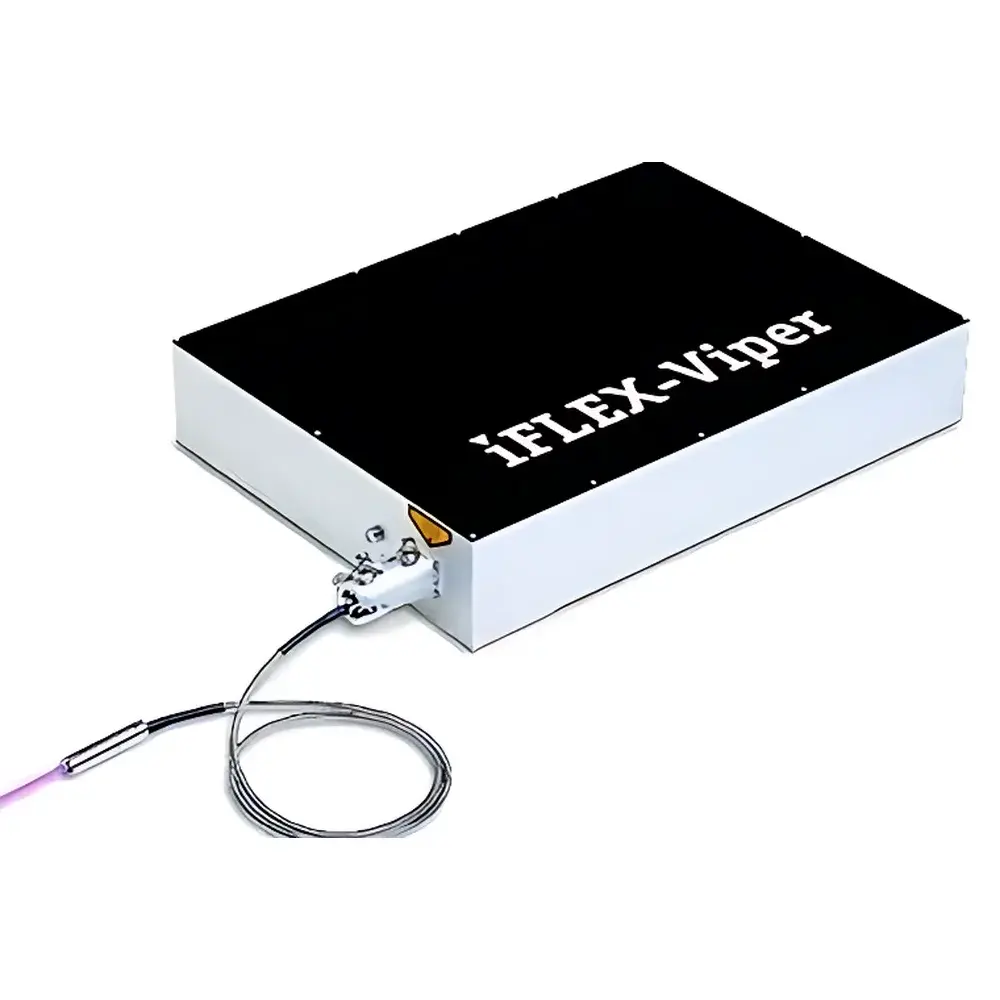
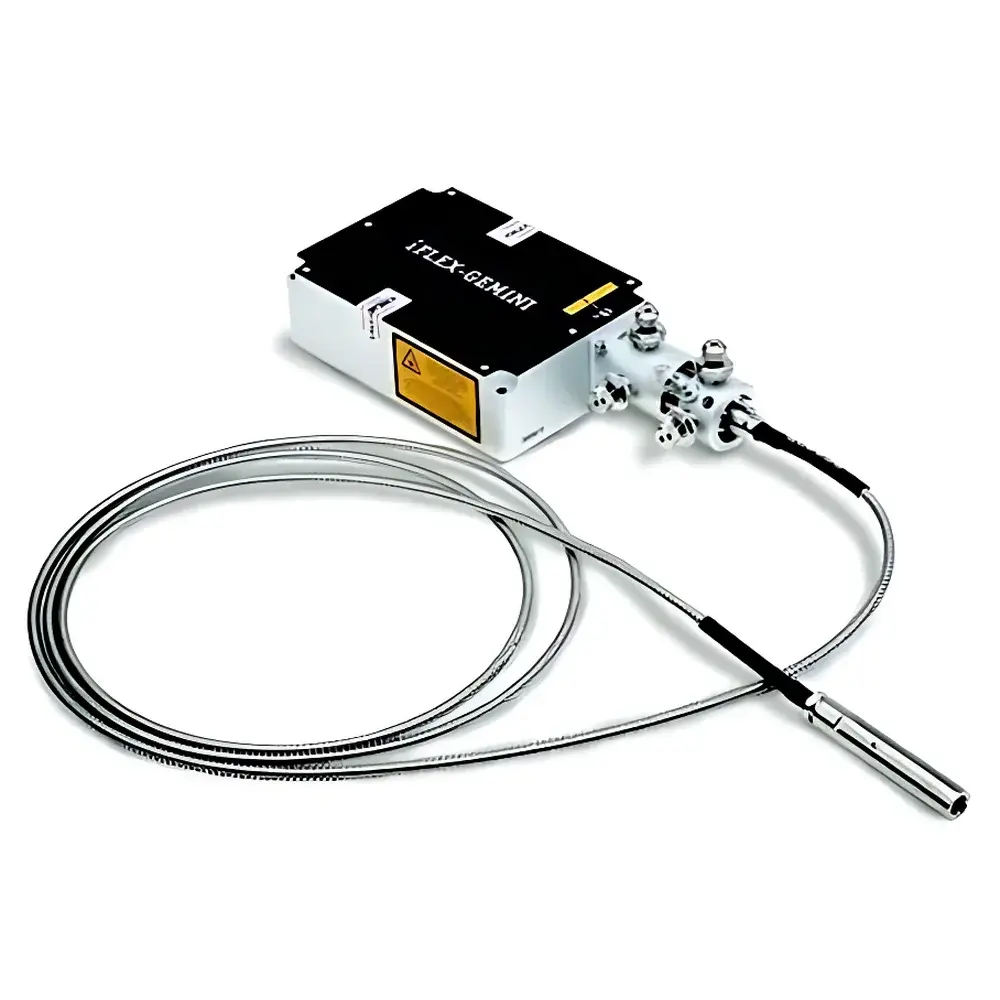
Qioptiq iFLEX Series High-Stability Low-Noise Semiconductor Laser Module
| Brand | Qioptiq |
|---|---|
| Origin | UK |
| Model | iFLEX |
| Core Technology | Single-Mode Polarization-Maintaining Diode Laser Source |
| Beam Quality (M²) | <1.1 |
| Beam Pointing Stability | <1 µrad/°C |
| Power Stability (8 h) | <0.5% RMS |
| Amplitude Noise (RMS, 10 Hz–10 MHz) | <0.05% |
| Compatibility | kineFLEX Fiber Delivery System |
| OEM Customization | Beam Splitting / Combining / Shaping Available |
| Optical Architecture | Integrated KineMATIX™ Precision Optomechanics |
Overview
The Qioptiq iFLEX Series is a high-performance, OEM-optimized semiconductor laser module engineered for applications demanding exceptional power stability, ultra-low amplitude noise, and diffraction-limited beam quality. Based on single-mode, polarization-maintaining (PM) diode technology, the iFLEX leverages Qioptiq’s proprietary KineMATIX™ optomechanical architecture to deliver sub-microradian beam pointing stability and M² < 1.1 performance—critical for interferometric metrology, confocal microscopy, adaptive optics alignment, and ophthalmic diagnostics. Unlike generic laser modules, the iFLEX is not merely a light source but a fully stabilized photonic subsystem: its thermally compensated design minimizes drift across ambient temperature fluctuations, while active current and temperature regulation ensure <0.5% power deviation over 8-hour continuous operation. The module operates in CW mode with wavelength options spanning visible to near-infrared (e.g., 405 nm, 488 nm, 532 nm, 640 nm, 785 nm), all rigorously qualified for long-term reliability under industrial and regulated laboratory environments.
Key Features
- Ultra-low amplitude noise: <0.05% RMS (10 Hz–10 MHz bandwidth), enabling high-fidelity signal detection in lock-in amplification and heterodyne interferometry
- Exceptional thermal stability: beam pointing drift <1 µrad/°C, achieved via monolithic PM fiber coupling and passive athermal mounting
- Diffraction-limited output: M² < 1.1 guarantees minimal spatial mode distortion and optimal focusability in high-NA optical systems
- Plug-and-play integration: designed for direct compatibility with Qioptiq’s kineFLEX® single-mode PM fiber delivery platform, eliminating free-space alignment complexity
- OEM-flexible architecture: supports factory-integrated beam splitting (1×2, 1×4), wavelength combining (WDM), and Gaussian-to-top-hat beam shaping via micro-optic elements
- Compliance-ready construction: RoHS-compliant materials, CE-marked per EN 60825-1:2014 (Class 3B/4 laser safety), and traceable calibration documentation available upon request
Sample Compatibility & Compliance
The iFLEX series is compatible with biological specimens, reflective metrology targets, and optically transparent substrates used in semiconductor inspection and precision surface profiling. Its low-noise, stable output ensures reproducible signal-to-noise ratios in time-resolved fluorescence lifetime imaging (FLIM), optical coherence tomography (OCT), and dynamic light scattering (DLS). From a regulatory standpoint, the module meets essential requirements for integration into Class I or Class II medical devices under ISO 13485 design controls. When deployed in GMP-compliant analytical instrumentation (e.g., flow cytometers or particle sizers), the iFLEX supports audit-ready documentation packages—including IQ/OQ protocols, traceable power calibration certificates, and failure mode effect analysis (FMEA) reports—aligned with FDA 21 CFR Part 11 data integrity expectations.
Software & Data Management
While the iFLEX operates as a stand-alone analog-controlled module (TTL/RS-232 interface standard; optional USB-C or EtherCAT support), it integrates seamlessly into host instrument control frameworks via Qioptiq’s open-command-set SDK. This enables synchronized triggering with camera acquisition, galvo scanning, or piezo stage motion—critical for structured illumination and multi-modal imaging workflows. All firmware updates, parameter logging (power, TEC temperature, diode current), and real-time health monitoring are accessible through ASCII-based serial commands. For regulated environments, optional firmware features include electronic signature-enabled configuration locking and timestamped operational logs compliant with ALCOA+ principles (Attributable, Legible, Contemporaneous, Original, Accurate, Complete, Consistent, Enduring, Available).
Applications
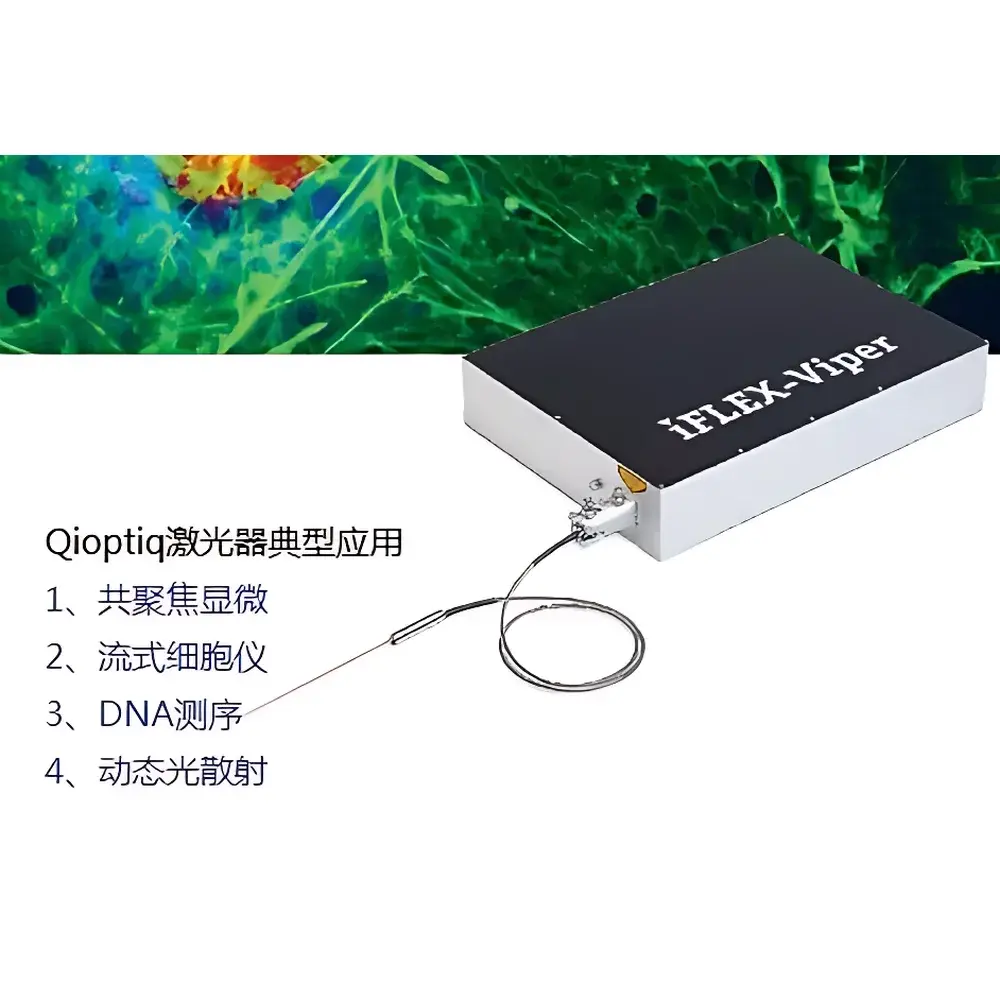
- High-resolution confocal and super-resolution microscopy (STED, STORM), where beam pointing stability directly impacts lateral localization precision
- Ophthalmic biometry and retinal imaging systems requiring shot-noise-limited illumination for axial resolution below 5 µm
- Interferometric displacement sensors and vibrometers operating at sub-nanometer sensitivity thresholds
- Flow cytometry platforms integrating multiple excitation wavelengths via iFLEX-WDM combiners with <0.1 dB insertion loss uniformity
- Gravitational wave detector alignment systems and space-qualified optical benches requiring radiation-hardened packaging variants
- Nanoimprint lithography alignment lasers, where M² < 1.1 and <0.5% power drift prevent overlay error accumulation during multi-layer patterning
FAQ
Is the iFLEX compatible with third-party fiber delivery systems?
Yes—while optimized for kineFLEX® PM fiber pigtails (FC/APC or SMA905 connectors), custom coupling to non-Qioptiq fibers is supported with collimation and mode-matching specifications provided in the OEM Integration Manual.
What is the typical warm-up time to achieve full power stability?
Less than 15 minutes from cold start; <0.1% power variation is achieved within 5 minutes under active thermal regulation.
Can iFLEX modules be operated in pulsed mode?
Standard units are CW-only; however, Qioptiq offers iFLEX-Pulse variants with TTL-triggered modulation up to 50 MHz repetition rate and <1 ns rise/fall times—subject to wavelength and power level constraints.
Do you provide calibration certificates traceable to NPL or NIST standards?
Yes—certificates of conformance with measurement uncertainty budgets are available upon order, including spectral power distribution, beam centroid position, and polarization extinction ratio (PER > 25 dB).
What is the expected lifetime under continuous operation at rated power?
MTTF exceeds 50,000 hours at 25°C case temperature, validated per Telcordia GR-468-CORE accelerated life testing protocols.



