
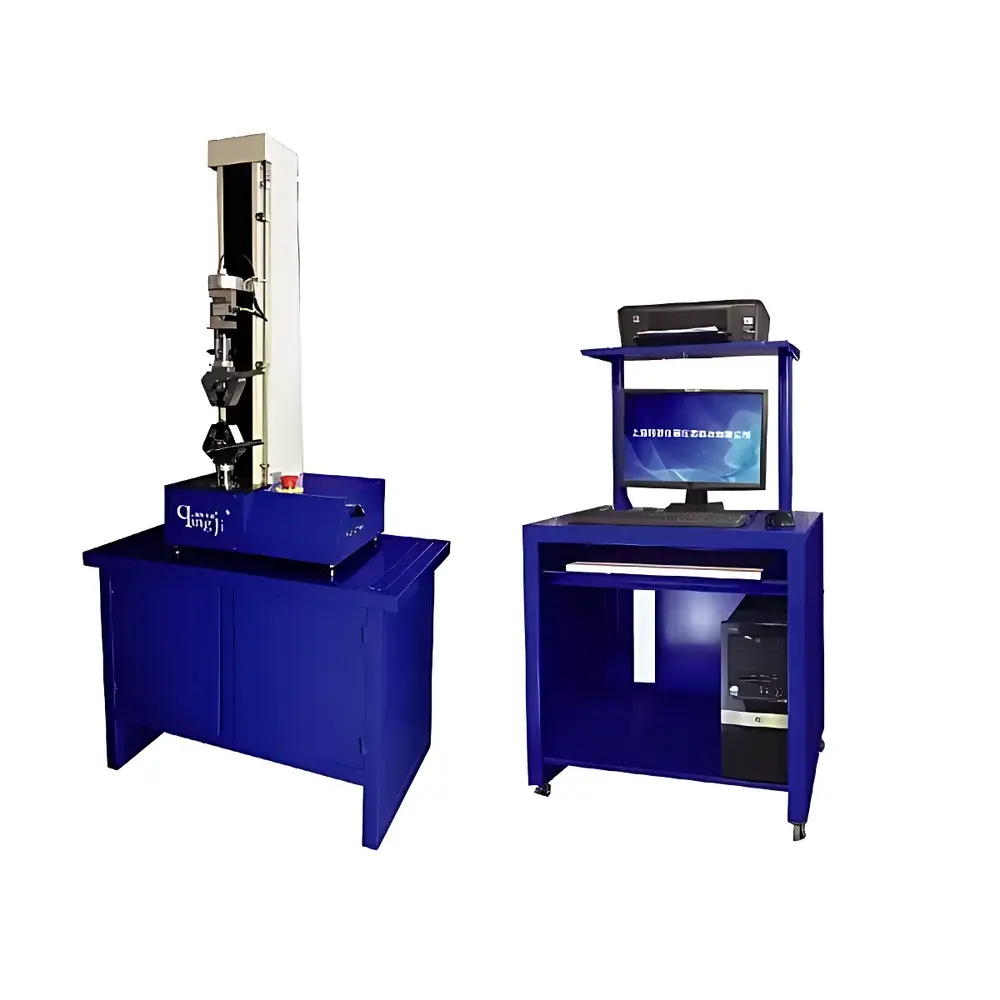
QJ210 Advanced Digital Tensile Testing Machine
| Origin | Shanghai, China |
|---|---|
| Manufacturer Type | Authorized Distributor |
| Origin Category | Domestic (PRC) |
| Model | QJ210 |
| Quotation | USD 4,200 (FOB Shanghai) |
| Instrument Type | Electromechanical Tensile Tester |
| Max Test Load | 2.5 kN |
| Adjustable Load Range | 0.05–2.5 kN (full-scale programmable) |
| Force Accuracy Class | ISO 7500-1 Class 1 |
| Stroke | 500 mm |
| Displacement Resolution | ±0.5% of reading |
Overview
The QJ210 Advanced Digital Tensile Testing Machine is an electromechanical universal testing system engineered for high-reproducibility static mechanical property evaluation of thin flexible materials—particularly release liners, pressure-sensitive adhesives, films, foils, and coated papers. It operates on the principle of controlled uniaxial tensile loading via a precision servo-motor-driven crosshead, with force measurement based on calibrated strain-gauge load cells and displacement tracking via high-resolution rotary encoders. Designed to meet the dimensional and operational constraints of QC laboratories and R&D facilities, the QJ210 integrates a compact monolithic frame (430 × 315 × 855 mm), low mass (40 kg), and modular control architecture—enabling rapid deployment without dedicated foundations or vibration isolation. Its compliance with ISO 7500-1 (force measurement), ISO 527 (plastics tensile testing), ISO 2921 (rubber tension set), ASTM D882 (thin plastic sheeting), ASTM D3330 (adhesive peel), and GB/T 2792 (peel strength of pressure-sensitive tapes) ensures traceable, auditable test execution across global regulatory environments.
Key Features
- Full-range programmable load capacity from 50 N to 2.5 kN (0.05–2.5 kN), eliminating manual range switching and preserving resolution across all test points
- High-fidelity data acquisition at 100 Hz sampling rate, with 500,000-count internal force resolution and no internal range segmentation
- Dual-speed crosshead actuation: precise low-speed positioning (0.01 mm/min) and rapid return (up to 1000 mm/min), both fully programmable and repeatable within ±0.5% of set speed
- Integrated electronic limit switches and overload protection (110% FS cut-off) ensure operator safety and hardware integrity during abnormal load events
- Modular control interface supporting both standalone LCD operation (with real-time curve plotting and parameter configuration) and full PC-based control via USB/RS232
- Optimized test space: 150 mm effective width and 300 mm vertical clearance accommodate standard specimen grips and environmental accessories (e.g., humidity chambers, extensometers)
- Industrial-grade powder-coated steel frame with baked enamel finish, designed for long-term dimensional stability and resistance to laboratory solvents and abrasion
Sample Compatibility & Compliance
The QJ210 accommodates specimens up to 150 mm wide and 500 mm total travel length, making it suitable for standardized strip tensile tests (ASTM D638, ISO 527-2), 90° and 180° peel tests (ASTM D3330, ISO 8510-2), and loop tack or probe tack configurations using optional fixtures. Grip types include pneumatic parallel-jaw, wedge-action, and roller-type clamps—each certified for ≤2.5 kN holding force under dynamic loading. All test methods implemented through its firmware and software comply with GLP documentation requirements, including audit-trail-enabled user login, timestamped test logs, and immutable raw-data export (CSV, XML). The system supports calibration certificate generation per ISO/IEC 17025 requirements when used with accredited external force calibration services.
Software & Data Management
The QJ210 is bundled with QT-TestSuite v3.2—a Windows-based control and analysis platform compliant with FDA 21 CFR Part 11 for electronic records and signatures. It provides configurable test templates aligned with ASTM, ISO, and GB standards; real-time stress–strain, force–displacement, and peel-force–distance visualization; automatic calculation of modulus, yield point, elongation at break, and peel adhesion energy; and customizable report generation with embedded metadata (operator ID, calibration date, environmental conditions). Raw data files retain full 16-bit resolution and are stored in vendor-neutral formats compatible with MATLAB, Python (pandas), and LIMS integration via ODBC drivers. Software updates and firmware patches are distributed quarterly via secure HTTPS portal with version-controlled changelogs.
Applications
- Peel strength validation of silicone-coated release liners used in medical adhesive tapes and label stock manufacturing
- Tensile property mapping of biodegradable polymer films (PLA, PHA) under controlled humidity conditions
- Quality conformance testing of aluminum foil laminates for pharmaceutical blister packaging per USP
- Adhesion performance benchmarking of acrylic PSA formulations across temperature gradients (−10°C to +60°C with optional thermal chamber)
- Mechanical screening of nonwoven substrates in hygiene product development (wet/dry tensile, burst strength correlation)
- Outgoing inspection of automotive interior trim bonding layers per VDA 230-206 specifications
FAQ
Does the QJ210 support ASTM D903 peel testing for fabric-to-fabric adhesion?
Yes—the machine’s programmable speed profile and high-torque servo motor enable stable 180° peel rates of 300 mm/min as specified in ASTM D903, when paired with the optional dual-arm peel fixture.
Can test data be exported directly into an enterprise LIMS?
Yes—QT-TestSuite includes native ODBC connectivity and structured CSV/XML export options compatible with major LIMS platforms including LabWare, Thermo Fisher SampleManager, and Siemens Opcenter Quality.
Is ISO/IEC 17025-compliant calibration available for the load cell?
Yes—certified third-party calibration services (traceable to NIM China or UKAS-accredited labs) are available upon request, with full uncertainty budgets and certificate of conformity included.
What maintenance intervals are recommended for daily QC use?
Routine verification of force accuracy and displacement linearity is recommended every 90 operating days; annual full recalibration and mechanical inspection are advised per ISO 17025 clause 6.4.10.
Are extensometer interfaces supported for strain measurement below 1% elongation?
Yes—the QJ210 features a dedicated analog input channel for contact or non-contact extensometers (e.g., clip-on LVDT or digital image correlation systems), enabling modulus determination per ISO 527-1 Annex B.



