
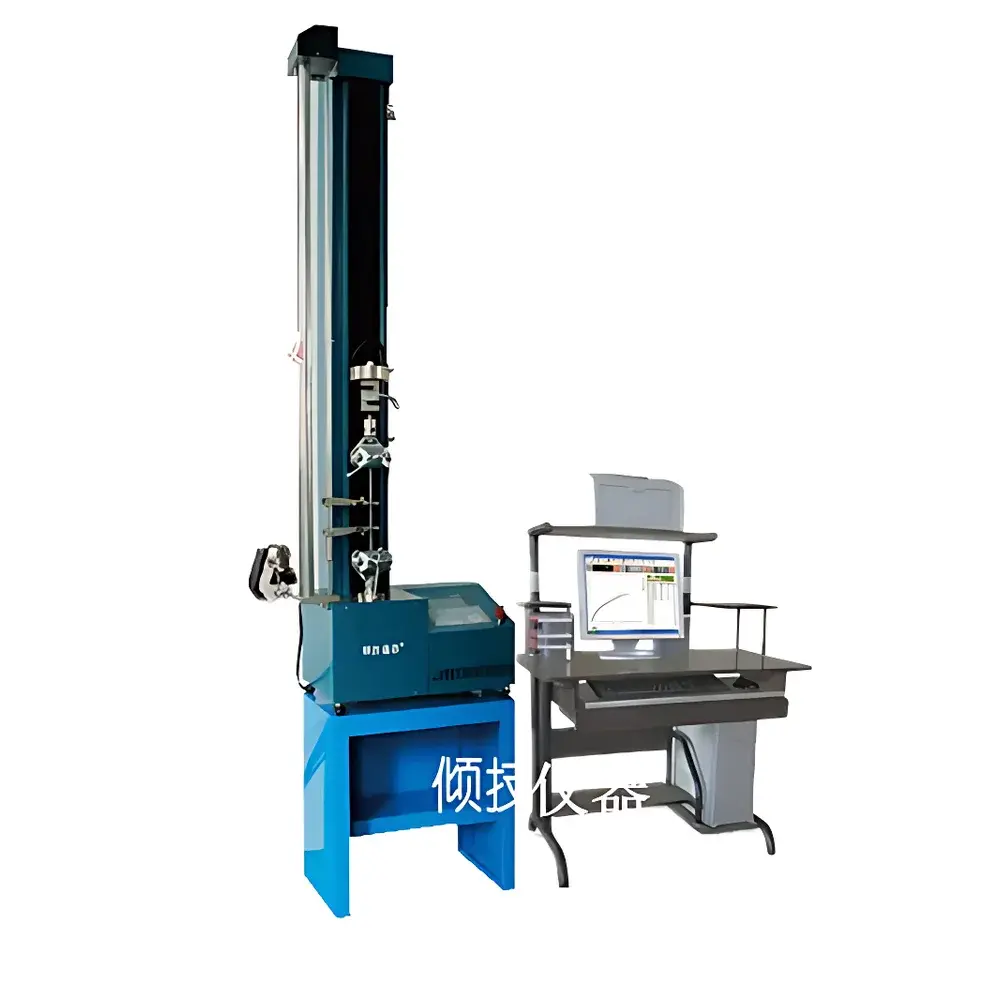
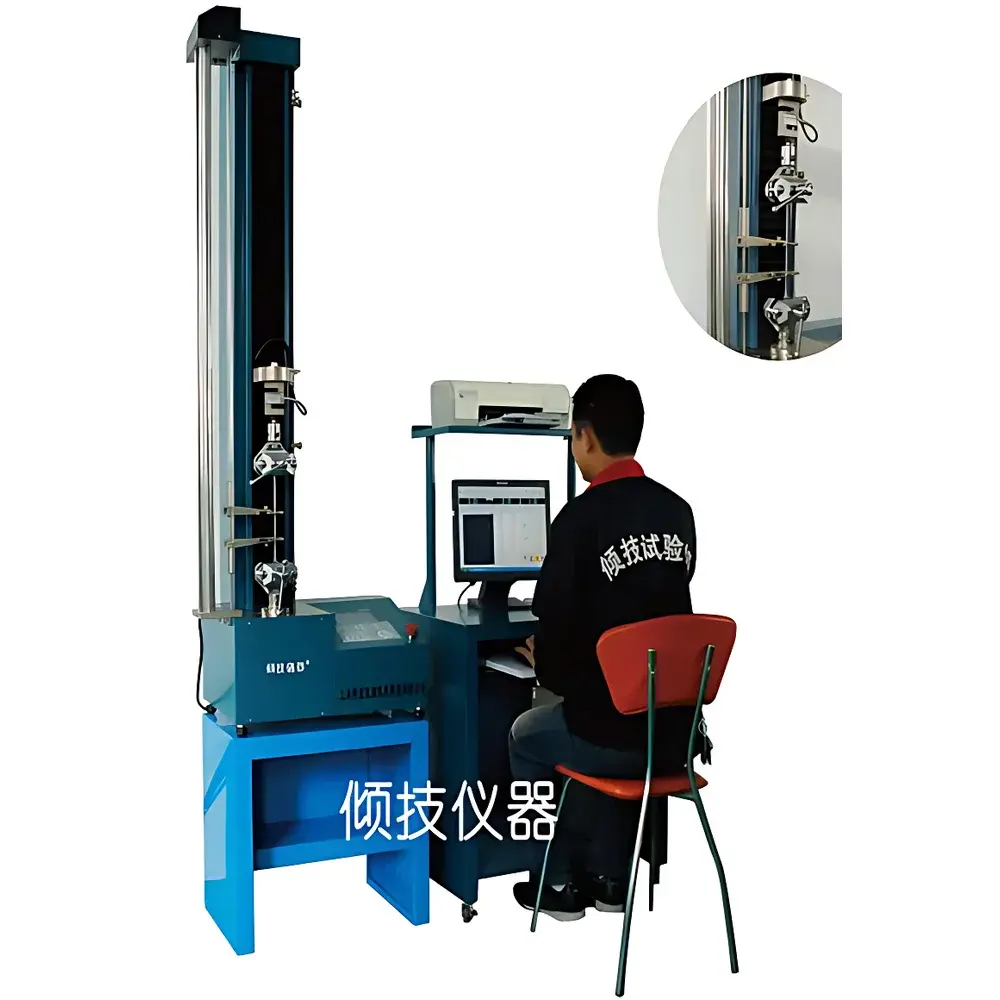
QJ210A Universal Testing Machine for Interlaminar Bond Strength and Plywood Evaluation
| Brand | Qinsen |
|---|---|
| Model | QJ210A |
| Type | Electromechanical Universal Testing Machine |
| Max Load Capacity | 5000 N (configurable) |
| Load Cell Accuracy | 0.01% FS |
| Force Measurement Accuracy | < ±1% |
| Crosshead Travel | 800 mm (extendable) |
| Effective Width | 150 mm |
| Test Speed Range | 1–300 mm/min |
| Speed Accuracy | ±1% |
| Displacement Accuracy | ±1% |
| Strain Measurement Accuracy | ±1% |
| Safety Features | Electronic Limit Switches, Emergency Stop Button |
| Weight | ~85 kg |
| Control System | Windows-based software with real-time data acquisition and automated test execution |
| Compliance | Designed to support ASTM D1037, ISO 12048, EN 319, GB/T 17657, and other wood-based panel and adhesive bond strength standards |
Overview
The QJ210A Universal Testing Machine is an electromechanical force-testing platform engineered for precise quantification of interlaminar bond strength in plywood, particleboard, MDF, and other engineered wood composites — as well as tensile, shear, peel, and cleavage strength of structural adhesives used in aerospace, automotive, construction, and electronics encapsulation. It operates on the principle of controlled uniaxial loading under displacement- or load-controlled servo regulation, enabling reproducible mechanical characterization according to standardized test protocols. The system applies calibrated axial force via a high-resolution load cell and synchronized crosshead motion, capturing real-time force-displacement response curves essential for evaluating adhesive cohesion, substrate failure modes (adhesive vs. cohesive vs. mixed), and delamination onset thresholds.
Key Features
- High-fidelity servo-controlled actuation system featuring a digital AC servo motor and precision ball-screw transmission, delivering stable speed control across the full 1–300 mm/min range with ±1% velocity accuracy.
- Ultra-low-drift load cell with 0.01% full-scale resolution, supporting configurable maximum capacities up to 5000 N to accommodate both thin-film adhesive coupons and thick laminated panels.
- Modular gripping interface compatible with pneumatic, wedge-action, and custom fixtures — including specialized double-lap shear jigs, block-shear fixtures per ASTM D905, and interlaminar tension (ILTT) grips compliant with ISO 12048.
- Integrated Windows-based control software with intuitive GUI for test method setup, real-time curve visualization, automatic peak detection, and multi-curve overlay comparison.
- Rugged cast-iron frame with reinforced column structure ensures minimal deflection (<0.05 mm under max load), critical for maintaining alignment during high-stiffness composite testing.
- Dual safety architecture: hardware-level electronic limit switches prevent over-travel, while software-enforced soft limits and emergency stop circuitry comply with IEC 61800-5-2 functional safety requirements.
Sample Compatibility & Compliance
The QJ210A accommodates specimens ranging from 10 × 10 mm adhesive lap joints to full-size 500 × 500 mm plywood panels (within 150 mm effective width constraint). It supports standardized geometries defined in ASTM D1037 (wood-based panels), ASTM D905 (block shear for adhesives), ISO 12048 (interlaminar tensile strength of plywood), EN 319 (bond strength of wood-based panels), and GB/T 17657 (Chinese national standard for wood-based panel testing). Data output meets GLP documentation requirements, with timestamped raw data files (.csv/.txt), audit-ready test reports (PDF), and optional 21 CFR Part 11-compliant user access logs and electronic signatures when deployed in regulated manufacturing environments.
Software & Data Management
The embedded control suite runs natively on Windows OS and provides deterministic real-time sampling at ≥1 kHz. All test parameters — including preload conditioning, ramp rate, hold duration, and break detection criteria — are programmable via intuitive dialog boxes. Post-test analysis includes automatic calculation of ultimate strength, modulus of elasticity (tangent/secant), elongation at break, energy absorption (area under curve), and failure classification tags. Export formats include CSV for statistical process control (SPC) integration, XML for LIMS interoperability, and image-embedded PDF reports suitable for internal QA review or third-party certification submissions. Optional add-ons include automated report generation templates aligned with ISO/IEC 17025 laboratory accreditation requirements.
Applications
- Interlaminar bond strength evaluation of hardwood and softwood plywood per ISO 12048 and GB/T 9846.
- Shear strength testing of phenolic, melamine-urea-formaldehyde, and polyurethane adhesives in structural timber assemblies.
- Tensile lap-shear performance of epoxy, acrylic, silicone, and polyimide adhesives used in PCB encapsulation and MEMS packaging.
- Peel resistance assessment of pressure-sensitive tapes and laminated films per ASTM D903.
- Quality assurance screening of batch-to-batch adhesive consistency in high-volume production lines.
- Research-grade mechanical profiling of bio-based adhesives and nanocomposite bonding interfaces.
FAQ
What standards does the QJ210A support for plywood interlaminar testing?
ASTM D1037, ISO 12048, EN 319, and GB/T 17657 — all implemented via preloaded test methods with auto-calculated pass/fail logic based on specimen dimensions and material class.
Can the system perform cyclic or fatigue testing?
No — the QJ210A is configured for static monotonic loading only; dynamic or low-cycle fatigue capability requires upgrade to the QJ212 series with hydraulic actuation and waveform generator modules.
Is calibration traceable to national metrology institutes?
Yes — factory calibration certificates include NIST-traceable load cell verification and dimensional verification per ISO 7500-1 Class 1 requirements.
What maintenance intervals are recommended for long-term accuracy?
Load cell recalibration every 12 months; routine inspection of grip alignment and screw lubrication every 200 operational hours; annual verification of encoder linearity and crosshead parallelism.
Does the software support multi-user role-based access control?
Standard version supports password-protected operator/admin profiles; 21 CFR Part 11 compliance package adds electronic signature workflows, change audit trails, and disabled data deletion privileges.



