
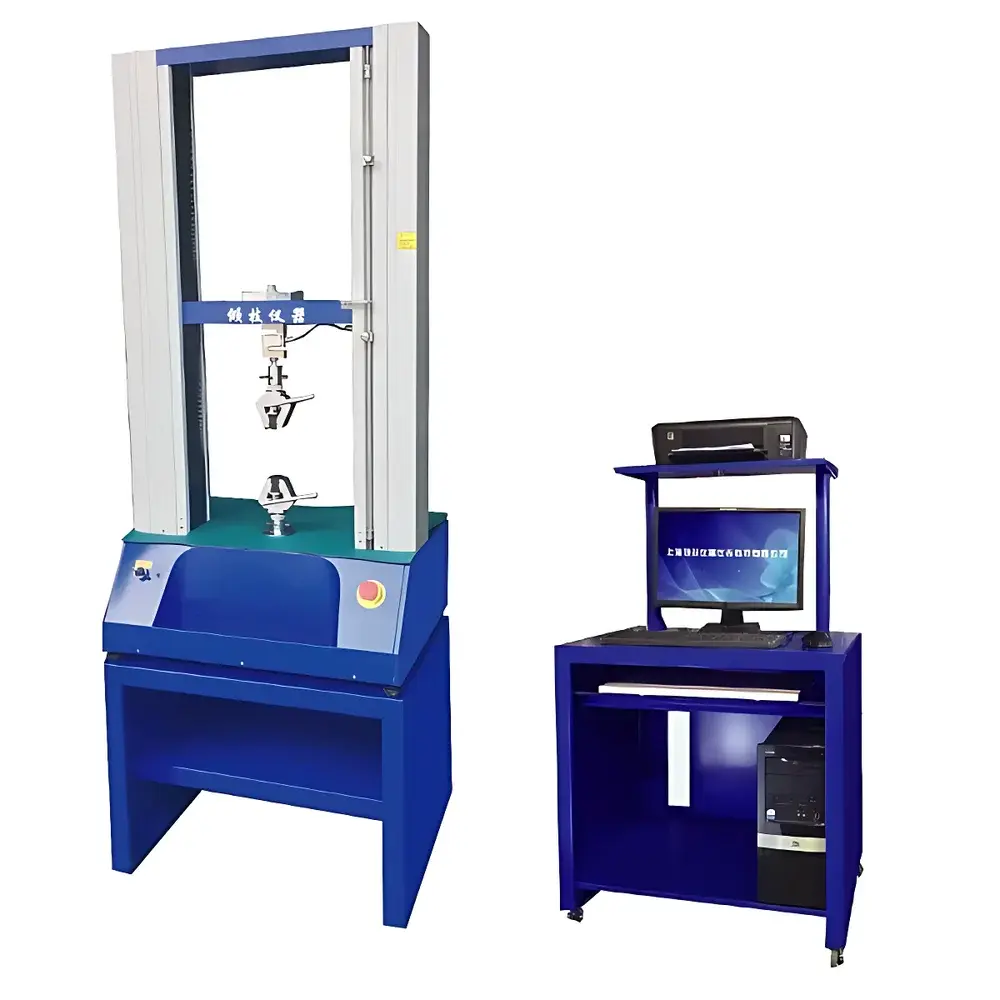
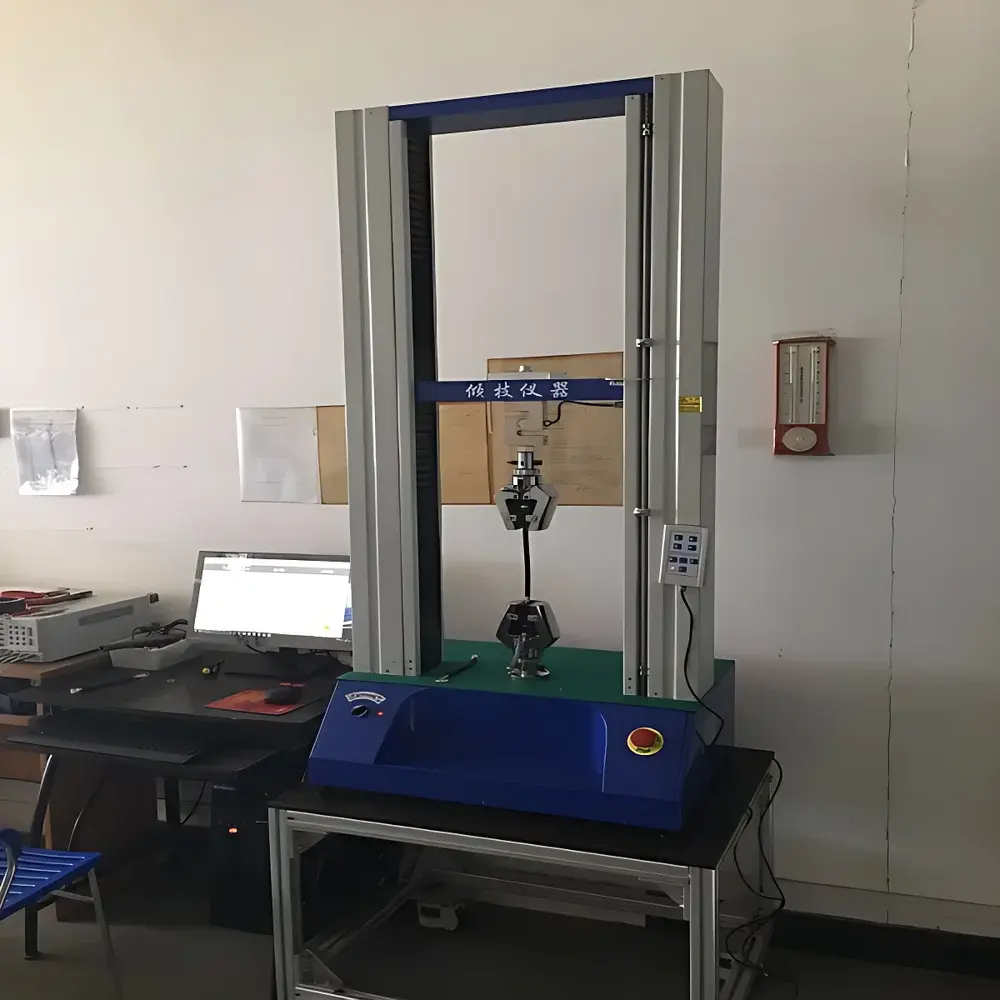
QJ211S Aluminum Weld Joint Tensile Testing Machine
| Origin | Shanghai, China |
|---|---|
| Manufacturer Type | Authorized Distributor |
| Origin Category | Domestic (China) |
| Model | QJ211S |
| Price | USD 7,700 (approx.) |
| Instrument Type | Electromechanical Tensile Testing Machine |
| Maximum Test Load | 10 kN |
| Force Measurement Range | 0.2%–100% of Full Scale (FS) |
| Force Accuracy | ±0.5% of reading |
| Test Stroke | 500 mm |
| Displacement Resolution | 1 µm (based on 500,000-count load cell resolution) |
| Effective Test Width | 320 mm |
| Crosshead Speed Range | 0.01–500 mm/min (standard configuration: 300 mm/min) |
| Speed Accuracy | ±0.5% of set value |
| Displacement Measurement Accuracy | ±0.5% of reading |
| Deformation Measurement Accuracy | ±0.5% of reading |
| Motor Power | 400 W |
| Net Weight | 145 kg |
Overview
The QJ211S Aluminum Weld Joint Tensile Testing Machine is a precision electromechanical universal testing system engineered for quantitative mechanical characterization of aluminum welds and related metallic joints under uniaxial tensile loading. Designed in accordance with fundamental principles of materials mechanics—including Hooke’s law, yield point detection, ultimate tensile strength (UTS), elongation at break, and stress–strain curve derivation—the instrument employs a high-stiffness dual-column frame, servo-controlled AC motor drive, and a 500,000-count digital load cell to deliver stable force transduction across its full 10 kN capacity. Its architecture supports time-dependent mechanical evaluation—critical for assessing weld integrity under sustained or cyclic loads—and accommodates real-time acquisition of load, displacement, and extension data synchronized at up to 1 kHz sampling rate. The system operates under Windows-based control software compliant with GLP documentation requirements, enabling traceable test execution, electronic signatures, and audit-ready data export.
Key Features
- High-precision force measurement with ±0.5% accuracy across the entire 0.2–100% FS range—no range switching required due to single-range, high-resolution 500,000-count load cell
- Adjustable crosshead speed from 0.01 to 500 mm/min (standardized at 300 mm/min), calibrated to ±0.5% of set value for consistent strain-rate control
- 500 mm vertical test stroke with dual-speed (fast/slow) manual jog control and programmable automatic return to home position post-test
- Integrated electronic limit switches and over-load protection (triggered at 110% of rated capacity) ensure operator and equipment safety
- Modular fixture interface compatible with ASTM E8/E21, ISO 6892-1, GB/T 228.1, and JIS Z 2241-compliant tensile grips, bend fixtures, puncture platens, and peel clamps
- Real-time dynamic curve plotting with multi-curve overlay, zoom, traverse, and annotation functions; all data stored in timestamped .csv and .xlsx formats
Sample Compatibility & Compliance
The QJ211S is validated for tensile evaluation of aluminum alloy weldments—including butt, fillet, and lap joints fabricated via MIG, TIG, or laser welding—using standardized specimen geometries per ASTM E8M (metric) and ISO 6892-1:2019. It supports flat sheet specimens up to 320 mm wide and accommodates thicknesses from 0.5 mm to 12 mm when paired with appropriate wedge-action or pneumatic grips. All test protocols align with international regulatory frameworks: data integrity meets FDA 21 CFR Part 11 requirements for electronic records and signatures; reporting templates conform to ISO/IEC 17025 calibration traceability standards; and mechanical verification follows ISO 7500-1 Class 0.5 certification criteria. Optional accessories include extensometers (contact and non-contact), environmental chambers (−40°C to +200°C), and video extensometry modules for full-field strain mapping.
Software & Data Management
The embedded Windows 10-compatible control suite provides ISO 17025-aligned test method definition, sequence automation, and metadata tagging (operator ID, sample ID, ambient temperature/humidity, calibration certificate number). Each test generates a digitally signed PDF report containing raw force–displacement curves, calculated parameters (YS, UTS, %Elongation, modulus), statistical summaries (n ≥ 3), and pass/fail flags against user-defined acceptance thresholds. Audit trails record all parameter changes, data edits, and export actions with timestamps and user authentication. Export formats include CSV (for MATLAB/Python analysis), XML (LIMS integration), and encrypted PDF-A (long-term archival). Software updates are delivered via secure HTTPS portal with version-controlled release notes and validation documentation.
Applications
- Qualification testing of aluminum weld joints per AWS D1.2 Structural Welding Code – Aluminum
- Process validation for automotive body-in-white (BIW) assembly lines using 5xxx/6xxx series alloys
- Failure mode analysis of heat-affected zones (HAZ) in laser-welded battery enclosures
- Mechanical screening of dissimilar metal welds (e.g., Al–Cu, Al–steel) in aerospace structural components
- R&D support for friction stir welding (FSW) parameter optimization and microstructure–property correlation studies
- Quality assurance in railcar manufacturing where EN 15085-2 compliance mandates documented tensile performance of welded joints
FAQ
Does the QJ211S comply with ASTM E8/E21 and ISO 6892-1 for tensile testing of aluminum alloys?
Yes—the system is configured and verified to meet the force accuracy, speed control, and data recording requirements specified in both standards.
Can the machine perform compression or flexural tests out-of-the-box?
Compression and three-point bend testing are supported via optional fixtures and software method templates; standard delivery includes only tensile-capable grips.
Is third-party calibration certification included with purchase?
A factory-issued ISO/IEC 17025-accredited calibration certificate (covering load, displacement, and speed) is provided; annual recalibration services are available under maintenance contract.
What level of technical support is offered during the one-year warranty period?
Remote diagnostics, firmware/software updates, application consultation, and on-site installation/commissioning by certified engineers are included.
How is data security and user access managed in the software?
Role-based permissions (Administrator, Operator, Viewer), password-protected method editing, and encrypted local database storage ensure compliance with internal QA policies and external audit requirements.



