
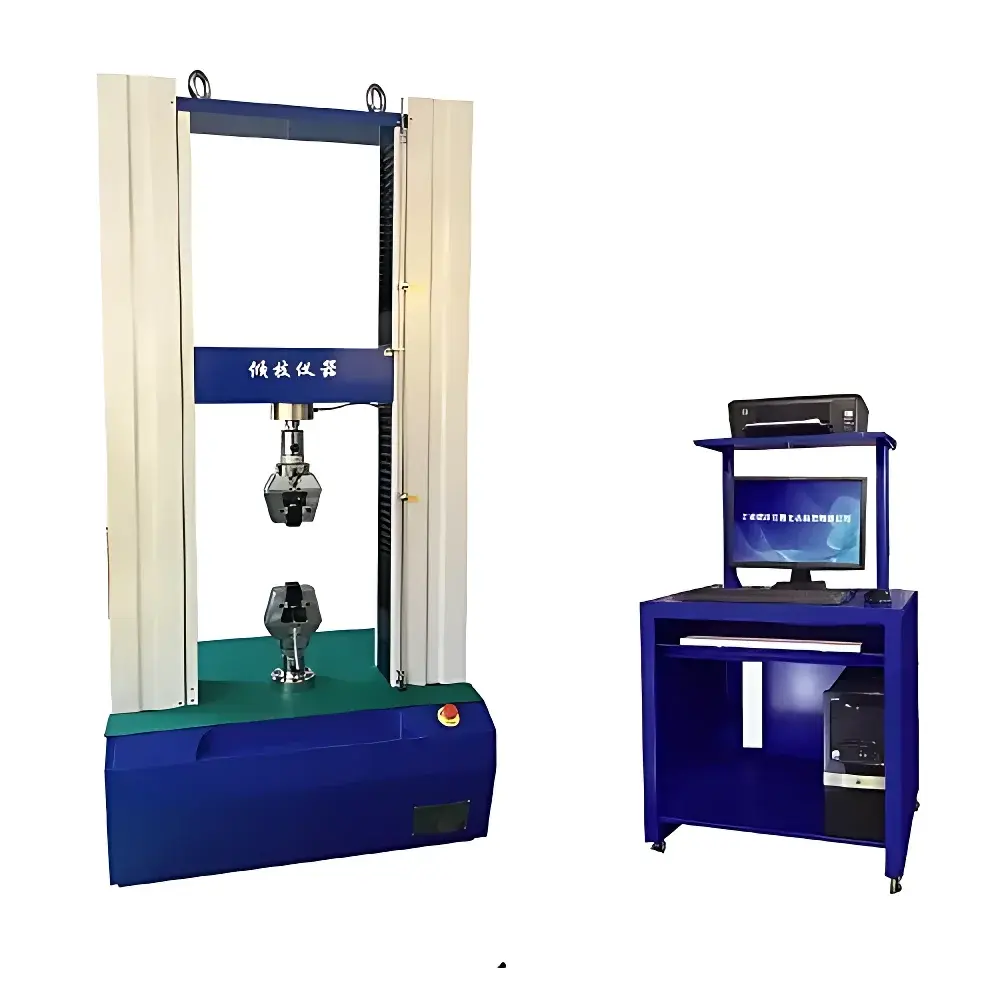
QJ212 Universal Testing Machine for Metallic Materials Physical Property Evaluation
| Origin | Shanghai, China |
|---|---|
| Manufacturer Type | Authorized Distributor |
| Origin Category | Domestic (China) |
| Model | QJ212 |
| Price | USD 8,400 (approx.) |
| Instrument Type | Electromechanical Universal Testing Machine |
| Load Capacity | 50 kN / 100 kN / 200 kN / 300 kN / 500 kN (interchangeable within 500 kN range) |
| Accuracy Class | 0.5 |
| Effective Test Width | 520 mm |
| Max Tensile Travel | 800 mm |
| Speed Range | 0.01–1000 mm/min (standard configuration: 300 mm/min) |
| Speed Accuracy | ±0.5% of indicated value |
| Force Resolution | 500,000 counts (full-scale, no internal range switching) |
| Force Measurement Range | 0.02–100% of selected load cell capacity |
| Displacement & Strain Accuracy | ±0.5% of indicated value |
| Transducer | High-precision strain gauge sensor (USA-sourced) |
| Controller | Panasonic全数字交流伺服控制系统 |
| Control Mode | Full-digital closed-loop system supporting constant stress, constant strain, and constant displacement control |
| Safety Protection | Software-based fault diagnosis, electronic travel limit, overload protection at 110% of rated load |
| Fixture Customization | User-specific mechanical grips and tooling available upon request |
| Power Supply | 2–5 kW motor |
| Dimensions (W×D×H) | 1000 × 680 × 2450 mm |
| Weight | ~1450 kg |
Overview
The QJ212 Universal Testing Machine is an electromechanical materials testing system engineered for precision mechanical characterization of metallic specimens under uniaxial loading conditions. Designed in accordance with the fundamental principles of static mechanical testing—namely, controlled application of tensile, compressive, flexural, shear, peel, tear, puncture, and low-cycle fatigue loads—the QJ212 delivers traceable, repeatable force-displacement data compliant with internationally recognized test methodologies. Its architecture integrates a high-rigidity dual-column frame, a servo-controlled crosshead drive system, and a full-scale digital closed-loop control architecture, enabling rigorous adherence to ASTM E4, ASTM E8/E8M, ISO 6892-1, ISO 7500-1, JIS Z2241, DIN 50125, and GB/T 228.1 standards. The machine supports real-time acquisition and visualization of stress–strain curves, load–extension profiles, and time-dependent mechanical responses—all natively rendered under Windows-based software with dynamic curve interpolation and post-test data refinement capabilities.
Key Features
- Interchangeable load cells (50 kN to 500 kN) mounted on a single platform, eliminating recalibration requirements when switching capacities
- Force resolution of 500,000 counts across the full measurement range—no auto-ranging or internal gain switching ensures consistent resolution at all load levels
- Panasonic全数字交流伺服 controller delivering precise speed regulation (0.01–1000 mm/min) with ±0.5% speed accuracy and minimal velocity ripple
- Dual-mode crosshead movement: rapid positioning (for setup) and fine-tuned testing speed (for data capture), both programmable via software interface
- Integrated electronic limit switches and real-time software diagnostics prevent overtravel and mechanical collision during automated test sequences
- Overload protection triggered at 110% of nominal load cell capacity—hardware- and software-redundant safeguarding
- Modular fixture interface compatible with standardized wedge-action, pneumatic, hydraulic, and custom-designed grips per specimen geometry and standard requirement
- Windows-native test software with audit-trail logging, user-level access control, and export-ready data formatting (CSV, XML, PDF, image)
Sample Compatibility & Compliance
The QJ212 accommodates flat, round, notched, threaded, and sheet-type metallic specimens—including structural steels, aluminum alloys, titanium grades, stainless steels, and nickel-based superalloys—within its 520 mm effective test width and 800 mm vertical stroke envelope. Specimen alignment is facilitated by self-centering jaw faces and optional extensometer mounting brackets (e.g., clip-on, video, or laser-based). All hardware and firmware comply with CE Machinery Directive 2006/42/EC and electromagnetic compatibility (EMC) Directive 2014/30/EU. Software functionality supports 21 CFR Part 11-compliant electronic records when configured with user authentication, audit trail, and electronic signature modules—making it suitable for GLP/GMP-regulated environments where traceability and data integrity are mandated.
Software & Data Management
The embedded Windows-based test software provides synchronized multi-channel acquisition (force, displacement, strain, time) at configurable sampling rates up to 1 kHz. Real-time curve rendering allows live overlay of multiple test runs, differential analysis between batches, and interactive scaling, zooming, and annotation. Post-test operations include automatic yield point detection (0.2% offset, tangent, or proportional limit methods), ultimate tensile strength (UTS), modulus of elasticity, elongation at break, reduction in area, and fracture toughness estimation (where applicable). Exported datasets retain native metadata—including operator ID, calibration certificate ID, environmental conditions (optional sensor input), and test parameter history—ensuring full compliance with ISO/IEC 17025 documentation requirements.
Applications
- Tensile property verification per ASTM E8/E8M and ISO 6892-1 for incoming raw material certification
- Compression testing of castings, forgings, and sintered components per ASTM E9
- Three-point and four-point bending evaluation of welded joints and extruded profiles per ASTM D790 and ISO 178
- Peel and tear resistance assessment of clad metals and brazed assemblies per ASTM D1876 and ISO 11339
- Low-cycle fatigue (LCF) screening of turbine blades and pressure vessel materials using programmed load–displacement waveforms
- Quality assurance testing in automotive, aerospace, energy, and rail manufacturing supply chains requiring ISO/TS 16949 or AS9100 traceability
FAQ
Is the QJ212 compliant with ISO/IEC 17025 calibration requirements?
Yes—the system supports third-party calibration validation per ISO/IEC 17025:2017 Annex A.4, with documented uncertainty budgets for force, displacement, and strain measurements available upon request.
Can the machine be integrated into a laboratory information management system (LIMS)?
Yes—via OPC UA or TCP/IP API interfaces, the QJ212 supports bidirectional data exchange with major LIMS platforms including LabWare, Thermo Fisher SampleManager, and STARLIMS.
What is included in the standard warranty and service coverage?
The QJ212 carries a 12-month comprehensive parts-and-labor warranty from commissioning date. Lifetime technical support and extended service contracts—including preventive maintenance, remote diagnostics, and on-site calibration—are available globally through authorized service partners.
Are extensometers supported for high-accuracy strain measurement?
Yes—the machine features dedicated mounting points and analog/digital signal inputs for contacting and non-contacting extensometers meeting ASTM E83 Class B-1 or ISO 9513 Class 0.5 specifications.



