
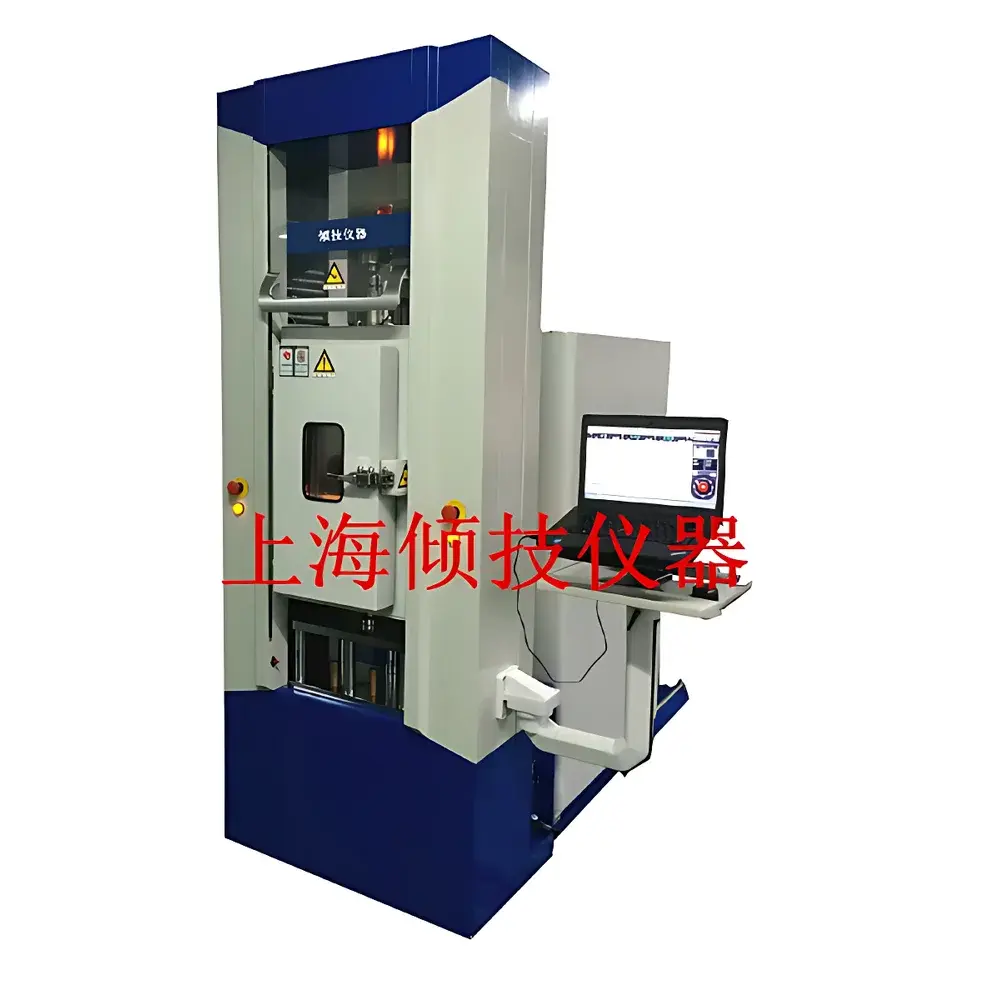
QJ216 Microcomputer-Controlled High-Low Temperature Environmental Test Chamber with Integrated Universal Testing Machine
| Key | Origin: Shanghai, China |
|---|---|
| Manufacturer Type | Authorized Distributor |
| Model | QJ216 |
| Price | USD 8,100 (FOB Shanghai) |
| Load Capacity | 40 kN |
| Force Resolution | ±1/250,000 full scale (constant across entire range) |
| Effective Test Width | 500 mm |
| Max. Tensile Stroke | 600–800 mm (configurable) |
| Speed Range | 0.001–1000 mm/min |
| Speed Accuracy | ±1% of indicated value |
| Displacement Accuracy | ±0.2% of indicated value |
| Strain Measurement Accuracy | ±0.2% of indicated value |
| Crosshead Control | Dual-speed (fast/slow) motorized lift with jog function |
| Safety Protection | Electronic travel limit switches, overload protection (110% of rated load), emergency stop circuit |
| Power Supply | 1.5 kW, 3-phase 380 V AC |
| Dimensions (W×D×H) | 960 × 650 × 2000 mm |
| Weight | 1200 kg |
Overview
The QJ216 Microcomputer-Controlled High-Low Temperature Environmental Test Chamber with Integrated Universal Testing Machine is an engineered solution for evaluating mechanical performance of materials under precisely regulated thermal conditions. Unlike standalone environmental chambers or ambient-temperature testers, this integrated system couples a high-capacity universal testing machine (UTM) with a climatic chamber capable of sustained operation across extended temperature ranges — typically –70 °C to +150 °C (optional extended ranges available upon configuration). The system operates on the principle of servo-controlled electromechanical force application, combined with real-time environmental conditioning, enabling ASTM D638, ISO 527, ISO 6892-1, JIS Z 2241, and DIN 53455-compliant tensile, compression, flexural, peel, tear, shear, puncture, and low-cycle fatigue testing — all while maintaining specimen temperature stability within ±1.0 °C during dynamic loading.
Key Features
- Integrated architecture: Fully synchronized UTM and environmental chamber share a common control platform, eliminating timing drift and data misalignment between thermal profile and mechanical response.
- High-fidelity force measurement: 40 kN load cell with ±1/250,000 full-scale resolution, maintained uniformly across zero-to-full-load range — no auto-ranging artifacts or resolution loss at low forces.
- Precision motion control: Servo-driven crosshead with programmable speed profiles (0.001–1000 mm/min), calibrated to ±1% accuracy per ISO 2041; dual-speed lift mechanism supports rapid positioning and fine adjustment.
- Thermal integrity during test: Chamber design incorporates insulated viewing window, forced-air circulation, and PID-regulated heating/cooling circuits to ensure uniform temperature distribution (±1.5 °C spatial deviation) across the active test zone.
- Robust mechanical frame: Heavy-duty welded steel construction (1200 kg total mass), reinforced base plate, and vibration-damped mounting interface minimize parasitic deflection and improve repeatability in high-stiffness material testing.
- Comprehensive safety architecture: Redundant electronic limit switches, hardware-based overload cutoff (triggered at 110% of 40 kN), emergency stop with hardwired circuit breakers, and automatic return-to-home post-test sequence.
Sample Compatibility & Compliance
The QJ216 accommodates standard and custom specimens up to 500 mm wide and 800 mm tall within the conditioned zone, supporting flat, cylindrical, and irregular geometries via interchangeable grips (tensile wedge, compression platens, bend fixtures, pneumatic clamps — sold separately). It meets structural requirements for ISO/IEC 17025-accredited laboratories performing mechanical property validation under GLP and GMP frameworks. Thermal control subsystem complies with IEC 60068-3-5 (environmental testing guidance) and ASTM E145 (specification for gravity-convection and forced-ventilation ovens). Mechanical testing functions are traceable to NIST standards via factory calibration certificates (included), and support audit-ready documentation per FDA 21 CFR Part 11 when paired with validated software modules.
Software & Data Management
Control and analysis are executed via Windows-based proprietary software compliant with Windows 10/11 LTSB editions. The interface provides real-time synchronized plotting of force–displacement, stress–strain, and temperature–time curves, with overlay capability for comparative batch analysis. All raw data (including timestamped environmental logs, encoder pulses, and analog sensor outputs) are stored in binary-structured .tdms files — compatible with MATLAB, Python (via PyTDMS), and LabVIEW for third-party processing. Curve manipulation tools include point-wise deletion, segment interpolation, modulus calculation (tangent, secant, chord), yield point detection (0.2% offset method), and fracture energy integration. Audit trail functionality records user actions, parameter changes, and calibration events — configurable for GLP-compliant electronic signatures and locked report generation.
Applications
- Automotive: Validation of polymer composites, adhesives, and elastomeric seals at sub-zero start-up temperatures and under-hood thermal extremes.
- Aerospace: Qualification of carbon-fiber-reinforced polymers (CFRPs) and titanium alloys under cryogenic tensile loading per ASTM D3039 and MIL-STD-810H.
- Electronics: Reliability assessment of solder joints, flexible printed circuits (FPCs), and encapsulants across thermal cycling profiles (e.g., JEDEC JESD22-A104).
- Medical Devices: Mechanical integrity testing of biodegradable sutures, hydrogel implants, and polymer stents under simulated physiological temperatures (37 °C) and sterilization-conditioned states.
- Academic Research: In-situ thermomechanical characterization of shape-memory alloys, phase-change materials, and thermoplastic elastomers using custom ramp-hold-load protocols.
FAQ
Does the system support automated thermal cycling synchronized with mechanical loading?
Yes — the controller allows nested programming of temperature ramps, dwell periods, and mechanical load sequences within a single test method, with interlock logic preventing unsafe transitions.
Can third-party environmental chambers be retrofitted to existing UTMs?
No — the QJ216’s chamber is mechanically and electrically integrated into the load frame; retrofitting is not supported due to alignment tolerances, thermal expansion compensation, and signal grounding requirements.
What calibration documentation is provided at shipment?
Each unit ships with NIST-traceable calibration certificates for load cell, displacement transducer, and chamber temperature sensors, valid for 12 months from date of manufacture.
Is remote diagnostics supported?
Yes — optional Ethernet-enabled service port allows secure remote access by authorized engineers for firmware updates, diagnostic logging, and parameter verification under ITAR-compliant network policies.
Are test fixtures included in the base configuration?
Standard wedge-action tensile grips (0–5 mm thickness) and parallel compression platens (100 mm diameter) are supplied; specialized fixtures require separate quotation based on ASTM/ISO geometry specifications.



