
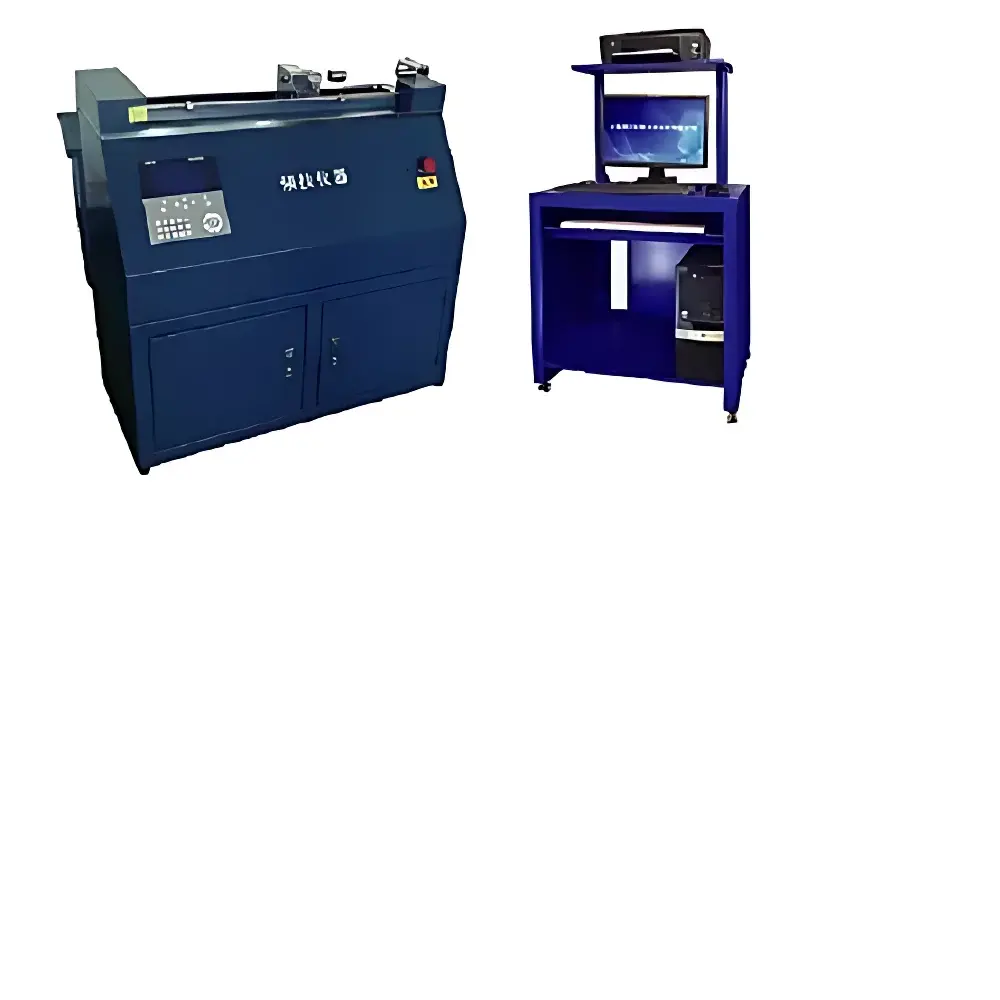
QJ310 Insulated Terminal Tensile Testing Machine
| Origin | Shanghai, China |
|---|---|
| Manufacturer Type | Authorized Distributor |
| Origin Category | Domestic (PRC) |
| Model | QJ310 |
| Price | USD 4,200 (FOB Shanghai) |
| Instrument Type | Electromechanical Tensile Testing Machine |
| Maximum Test Load | 2.5 kN or 5.0 kN (selectable) |
| Load Measurement Range | 0.2%–100% of Full Scale |
| Load Accuracy | ±0.5% FS |
| Stroke | 500 mm |
| Displacement Resolution | 0.001 mm (20-bit A/D, 500,000-count resolution) |
| Load Cell Accuracy | ±0.01% FS |
| Speed Range | 0.001–300 mm/min (programmable in closed-loop mode) |
| Effective Test Space (H) | ≥200 mm |
| Power Supply | AC 220 V ±10%, 50/60 Hz |
| Dimensions (W×D×H) | 600 × 300 × 300 mm |
| Net Weight | ~40 kg |
Overview
The QJ310 Insulated Terminal Tensile Testing Machine is an electromechanical universal testing system engineered for precise mechanical characterization of electrical interconnect components under controlled tensile, peel, and pull-off loading conditions. Designed specifically for quality assurance and R&D validation in wire harness assembly, automotive electronics, lighting fixtures, and consumer appliance manufacturing, the instrument operates on a servo-controlled ball-screw actuation principle with real-time closed-loop force and displacement feedback. Its architecture complies with fundamental mechanical test standards including ISO 7500-1 (static calibration of force-proving instruments), ASTM E4 (load verification of testing machines), and ISO 5893 (tensile testing machine requirements). The system delivers traceable, repeatable measurements essential for compliance with IEC 60512 (electrical connectors), UL 486 (wire connectors), and IPC-A-610 (acceptability of electronic assemblies).
Key Features
- High-rigidity structural frame with precision-ground ball screw drive and hardened chrome-plated guide columns, ensuring minimal deflection and long-term dimensional stability during cyclic loading.
- Dual-range load cell options (2.5 kN / 5.0 kN) featuring temperature-compensated strain gauge technology and factory-calibrated to ±0.01% full-scale accuracy per ISO 376.
- Real-time dynamic display via 7-inch high-resolution TFT LCD interface showing synchronized force-displacement curves, peak load, yield point, elongation at break, and modulus calculation.
- Programmable speed control from 0.001 mm/min to 300 mm/min with <±0.2% speed regulation accuracy across full range—critical for low-speed peel tests and high-speed terminal retention validation.
- Integrated USB and RS-232 interfaces enabling direct connection to Windows-based PCs; supports export of raw data (CSV, TXT) and automated report generation compliant with GLP documentation requirements.
- Modular fixture mounting platform compatible with standardized wedge grips, pneumatic clamps, and custom-designed terminal pull-test jigs per DIN 46228 and SAE J1709 specifications.
Sample Compatibility & Compliance
The QJ310 accommodates a broad spectrum of insulated terminal geometries—including crimped wire-to-terminal joints, molded plastic housings, PCB-mounted connectors, LED lamp bases, and adhesive-bonded electronic subassemblies. Its minimum grip separation of 200 mm and 500 mm maximum stroke support both short-stroke pull-out tests (e.g., IEC 60352-2 crimp retention) and extended peel evaluations (e.g., ISO 8510-2 tape adhesion). All hardware and firmware comply with CE marking directives (2014/30/EU EMC, 2014/35/EU LVD), RoHS 2011/65/EU material restrictions, and meet basic safety requirements outlined in EN 61000-6-2/6-4 for industrial environments.
Software & Data Management
Bundled PC software provides full test method configuration, real-time curve overlay, statistical batch analysis (mean, SD, CV%), pass/fail thresholding, and audit-trail-enabled report generation. Data files include embedded metadata: operator ID, timestamp, environmental conditions (optional sensor input), calibration certificate ID, and instrument serial number—supporting 21 CFR Part 11 readiness when deployed in regulated QA/QC labs. Export formats include PDF (with digital signature), Excel-compatible CSV, and XML for integration into LIMS or MES platforms.
Applications
- Quantitative evaluation of crimp joint integrity per UL 486A-B and IPC/WHMA-A-620.
- Peel strength measurement of insulation coatings on wire leads (ASTM D903).
- Pull-out force assessment of press-fit terminals in PCBs (IEC 60352-5).
- Retention force testing of insulated spade/lug connectors under thermal cycling preconditioning.
- Adhesive bond strength validation for encapsulated LED modules (JEDEC JESD22-B117A).
- Quality gate testing for automotive harness suppliers requiring PPAP submission packages.
FAQ
What standards does the QJ310 support for terminal pull testing?
The system is configured to execute test protocols aligned with IEC 60512-2-1, UL 486E, and SAE J2044, with preloaded method templates and configurable pass/fail criteria.
Is calibration certification included with delivery?
Yes—a NIST-traceable factory calibration certificate (ISO/IEC 17025 accredited lab) is provided with each unit, covering load, displacement, and speed verification.
Can the machine perform cyclic fatigue testing?
While primarily designed for static and quasi-static tests, optional firmware upgrade enables limited step-cycle programming (up to 999 cycles) with dwell time control and load reversal detection.
What maintenance intervals are recommended?
Lubrication of ball screw and guideways every 6 months; annual recalibration of load cell and encoder; routine verification of grip alignment and jaw surface wear per ASTM E1012.
Is technical support available outside China?
Yes—global distributor network provides local language engineering support, remote diagnostics, and on-site service contracts in North America, EU, and APAC regions.
Related Products



