
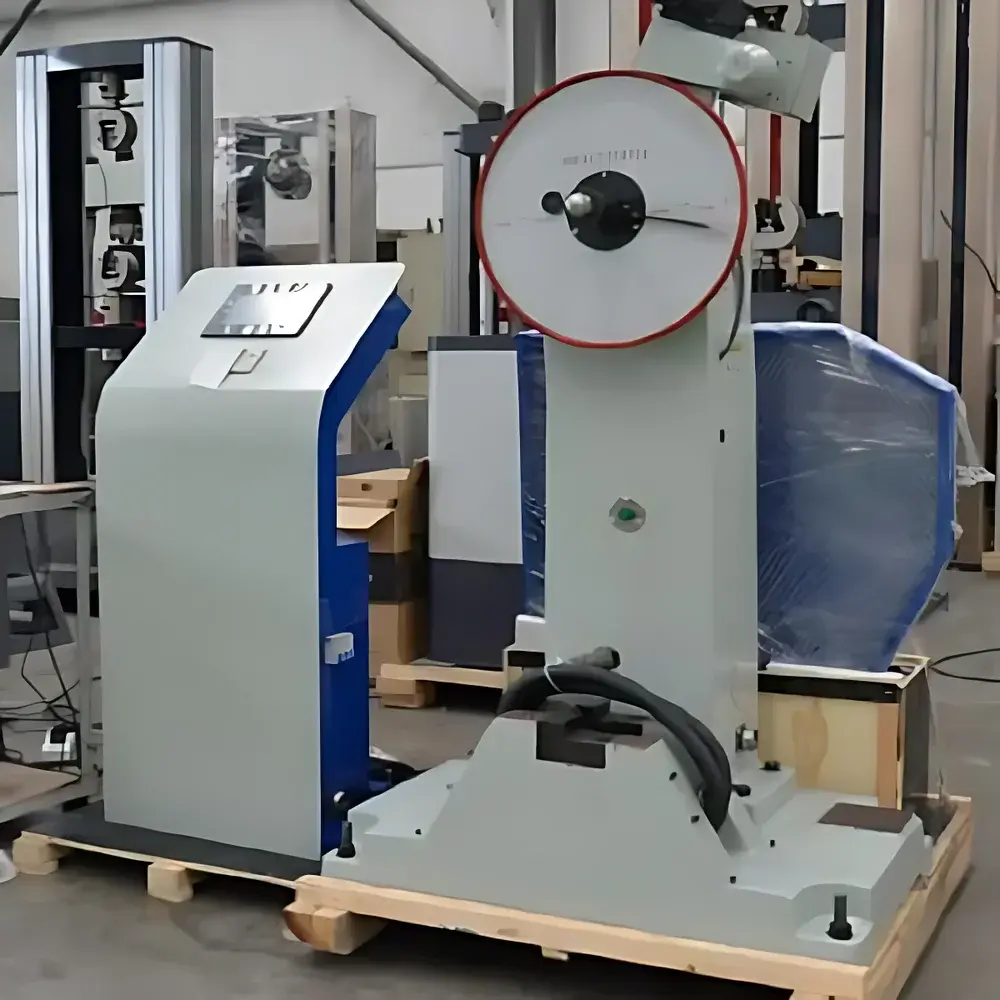
QJBCS Manual Pendulum Impact Testing Machine
| Origin | Shanghai, China |
|---|---|
| Manufacturer Type | Authorized Distributor |
| Origin Category | Domestic (PRC) |
| Model | QJBCS |
| Quotation | USD 4,200 (FOB Shanghai) |
| Instrument Type | Pendulum Impact Tester |
| Impact Energy | 150 J, 300 J, 450 J |
| Impact Velocity | ~5.2 m/s |
| Pendulum Torque (Impact Constant) | 150 J, 300 J, 450 J |
| Load Cell Accuracy | ±1% FS |
| Maximum Pendulum Lift Height | ≤2000 mm |
| Pendulum Angle | 150° |
| Striking Edge Radius | R2–R2.5 mm |
| Striking Edge Thickness | 16 mm |
| Anvil Span | 40 mm |
| Overall Dimensions (L×W×H) | 1000 × 830 × 1520 mm |
| Net Weight | ~300 kg |
Overview
The QJBCS Manual Pendulum Impact Testing Machine is a precision-engineered mechanical testing system designed for determining the Charpy impact toughness of metallic materials in accordance with ISO 148-1, ASTM E23, and GB/T 229–2020 standards. It operates on the classical principle of gravitational potential energy conversion: a calibrated pendulum is manually raised to a defined height (up to 2000 mm), released, and allowed to strike a notched specimen supported on a rigid anvil. The energy absorbed during fracture—calculated from the difference between initial and residual swing angles—is directly quantified as impact energy (in joules). This method provides critical data on material ductile-to-brittle transition behavior, notch sensitivity, and structural integrity under dynamic loading conditions. The machine’s robust cast-iron frame, hardened steel anvils, and precisely machined pendulum assembly ensure high mechanical stability and long-term repeatability across multiple test cycles.
Key Features
- Three selectable impact energy ranges (150 J, 300 J, 450 J) enabled by interchangeable pendulum configurations, each with corresponding impact constants verified per GB/T 808–2002 and ISO 148-2 calibration requirements.
- Manual pendulum lifting mechanism with friction-based braking system—designed for operational simplicity, minimal maintenance, and intrinsic safety in educational labs and QC environments where automation is not required.
- Precision-machined striking edge conforming to ISO 148-1 specifications: radius R2–R2.5 mm, thickness 16 mm, and sharpness tolerance maintained within ±0.1 mm.
- Fixed anvil span of 40 mm, compliant with standard Charpy V-notch and U-notch specimen geometry per ASTM E23 and GB/T 229.
- High-stiffness base structure and vibration-damped foundation interface minimize energy loss due to frame deflection, contributing to measurement reproducibility within ±1% full-scale error.
- Integrated angular position sensing and mechanical scale readout allow direct visual verification of pre- and post-impact pendulum angles—essential for manual verification and GLP-compliant recordkeeping.
Sample Compatibility & Compliance
The QJBCS supports standardized Charpy specimens (10 mm × 10 mm × 55 mm) with either V-notch (45°, depth 2 mm) or U-notch (5 mm radius) geometries. It accommodates minor dimensional variants (e.g., subsize 7.5 mm or 5 mm cross-sections) via optional adapters, though energy values must be normalized per ASTM E23 Annex A3. All mechanical components—including anvils, supports, and pendulum shaft bearings—are manufactured to ISO 2768-mK general tolerances and surface-hardened to ≥58 HRC. The system complies with national verification regulation JJG 145–2014 (China) and meets essential safety and metrological requirements for Class 2 impact testers per ISO 148-2:2016. While not equipped with digital audit trails, its mechanical design facilitates traceable calibration using certified reference pendulums and NIST-traceable angle gauges.
Software & Data Management
As a manually operated mechanical tester, the QJBCS does not incorporate embedded electronics or proprietary software. Test results are recorded manually in laboratory notebooks or entered into LIMS-compatible spreadsheets. Users may integrate external digital calipers, high-speed photogates (for velocity validation), or USB-connected load cells for supplementary force-time profiling—though such enhancements fall outside the base configuration. For regulated environments requiring electronic records, the instrument can be paired with third-party data acquisition systems compliant with FDA 21 CFR Part 11 (when validated per organizational SOPs), provided timestamped operator identification and change-control logs are implemented externally.
Applications
This tester is routinely deployed in metallurgical laboratories, foundry QA departments, and academic materials science programs for evaluating: fracture resistance of carbon steels, low-alloy steels, and stainless grades across temperature gradients; comparative assessment of heat-treated vs. as-rolled microstructures; quality control of weld metal and HAZ (heat-affected zone) regions; validation of cryogenic toughness in pipeline steels (per API RP 5L3); and educational demonstration of ductile-brittle transition curves. Its mechanical reliability and straightforward operation make it especially suitable for routine production testing where throughput, cost-efficiency, and regulatory transparency outweigh the need for automated data capture.
FAQ
Is the QJBCS compliant with ASTM E23 and ISO 148-1?
Yes—the machine’s geometry, striking edge profile, anvil span, and energy calibration protocol align fully with both standards when used with certified Charpy specimens and verified pendulum constants.
Can it test subsize specimens?
Yes, with optional support fixtures; however, reported energy values must be scaled according to ASTM E23 Annex A3 and clearly annotated in test reports.
What maintenance is required?
Biannual inspection of bearing play, anvil wear, and pendulum axis alignment; annual recalibration of impact constants using traceable reference pendulums is recommended for ISO/IEC 17025-accredited labs.
Does it support temperature-controlled testing?
No—the base unit does not include environmental chambers; low-temperature or elevated-temperature testing requires integration with external bath systems and specimen conditioning protocols.
Is technical support available after purchase?
Yes—comprehensive installation assistance, operator training, and lifetime access to mechanical schematics and spare parts (e.g., strikers, anvils, bushings) are included in the service package.



