
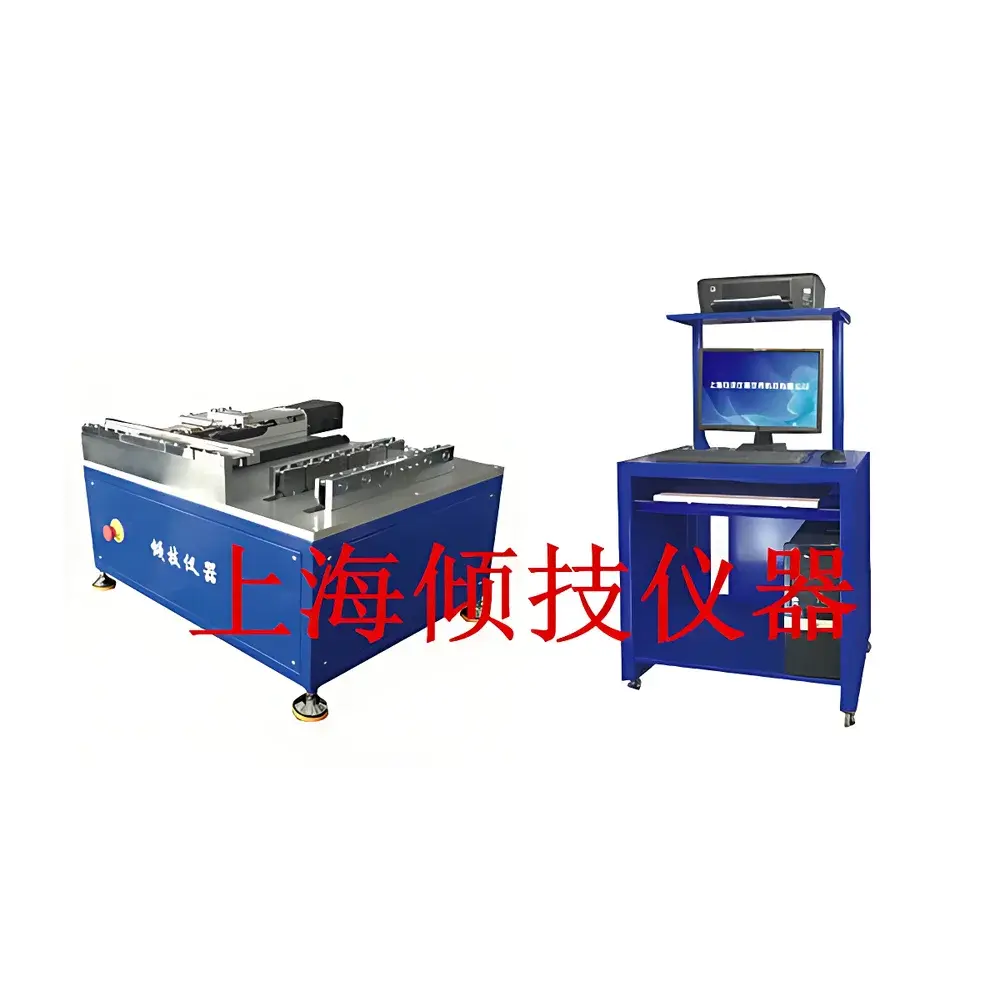
QJICWQ Dynamic Bending-Torsion Fatigue Testing Machine
| Brand | Qinsun |
|---|---|
| Origin | Shanghai, China |
| Manufacturer Type | Authorized Distributor |
| Origin Category | Domestic (China) |
| Model | QJICWQ |
| Price | USD 6,800 (FOB Shanghai) |
| Dimensions (L×W×H) | 670 × 380 × 220 mm |
| Weight | 70 kg |
| Power Supply | AC 220 V ±5%, 35 W |
| Bending Speed | 29 rpm |
| Cycle Count Range | 1–9,999 cycles |
| Angular Displacement | ±15° (±1° tolerance, bidirectional) |
| Load Accuracy | ±1% of reading (2–100% FS) |
| Load Dynamic Fluctuation | ≤2% |
| Actuator Stroke | ±50 mm (customizable), displacement accuracy ±0.5% |
| Waveform Options | sine, square, triangle, trapezoidal, sawtooth, half-sine, half-triangle, random, user-defined, and external analog input |
| Frequency Range | 0.01–80 Hz (standard) |
| frequency resolution | 0.001 Hz |
| Control Modes | force, displacement, and strain closed-loop |
| Closed-Loop Control Frequency | 10 kHz |
| Controller | Qinsun Full-Digital Hydraulic Servo Controller |
| Compliance | ISO 14520-1, ASTM E466, ISO 1099, GB/T 2611–2013, GB/T 3075–2018 |
Overview
The QJICWQ Dynamic Bending-Torsion Fatigue Testing Machine is a precision-engineered electro-hydraulic servo system designed for high-fidelity cyclic mechanical characterization of small-scale components under combined bending and torsional loading. Operating on the principle of controlled sinusoidal or programmable waveform actuation, it applies dynamic loads via a high-bandwidth hydraulic actuator synchronized with real-time feedback from integrated load cells and rotary encoders. The system is specifically configured to meet the mechanical test requirements defined in ISO/IEC 16649-1 for contactless smart cards (e.g., EMV-compliant IC cards), where standardized bending fatigue (up to ±15°) and torsional fatigue (bidirectional rotation at 29 rpm) must be executed over precisely defined cycle counts (1–9,999). Its architecture supports both static tensile/compressive testing and dynamic fatigue protocols, making it suitable for R&D labs, quality assurance departments, and third-party certification bodies validating mechanical durability per international standards.
Key Features
- Full-digital hydraulic servo control with 10 kHz closed-loop update rate ensures exceptional waveform fidelity and phase stability across the operational frequency range (0.01–80 Hz standard, extendable to 1000 Hz).
- Triple-mode closed-loop control (force, displacement, strain) enables seamless transition between control schemes without manual recalibration—critical for multi-stage fatigue protocols involving preload, ramp, dwell, and cycling phases.
- Programmable waveform generator supports 10+ native waveforms—including sine, square, triangle, trapezoidal, sawtooth, half-cycle variants, and externally triggered analog inputs—allowing replication of real-world service loads such as impact, vibration harmonics, or stepwise torque transients.
- Integrated angular displacement measurement with ±1° tolerance guarantees compliance with ISO/IEC 16649-1 bending amplitude specifications; bidirectional 15° torsion is mechanically constrained and verified via optical encoder feedback.
- Ruggedized frame design (670 × 380 × 220 mm footprint, 70 kg mass) minimizes resonance interference during high-frequency operation and ensures long-term dimensional stability under repeated thermal and mechanical stress.
- Low-power consumption (35 W nominal) and compact form factor enable benchtop deployment in ISO Class 5 cleanrooms or space-constrained QA laboratories without dedicated HVAC or floor reinforcement.
Sample Compatibility & Compliance
The QJICWQ accommodates specimens up to 85 mm in length and 25 mm in width, with standardized fixtures for ISO/IEC 7816-form factor smart cards, RFID tags, thin polymer laminates, and miniature electronic modules. Fixturing is modular and tool-free, supporting rapid changeover between bending-only, torsion-only, and coupled bending-torsion configurations. The system complies with ISO 1099 (metallic materials — fatigue testing — axial force-controlled method), ASTM E466 (conducting force-controlled constant amplitude axial fatigue tests), and GB/T 3075–2018 (Chinese national standard for metal fatigue testing). All test data are timestamped, digitally signed, and traceable to NIST-traceable calibration certificates—supporting GLP/GMP audit readiness and FDA 21 CFR Part 11 compliance when paired with validated software configuration.
Software & Data Management
Control and analysis are performed via Qinsun’s proprietary TestMaster v4.2 software suite, running on Windows 10/11 x64 platforms. The software provides real-time oscilloscope-style visualization of load, displacement, and angular position channels with configurable sampling rates up to 20 kHz. Automated test sequencing includes pre-test verification (zero-load calibration, fixture alignment check), cycle-based termination logic, and pass/fail evaluation against user-defined thresholds (e.g., stiffness degradation >15%, cycle count deviation >±0.5%). Raw data export is supported in ASCII CSV, HDF5, and MATLAB .mat formats; metadata embedding includes operator ID, environmental conditions (optional sensor integration), and instrument firmware revision. Audit trails record all parameter changes, test starts/stops, and calibration events—fully compliant with ISO/IEC 17025 documentation requirements.
Applications
- Mechanical validation of contactless smart cards per ISO/IEC 16649-1 (bending endurance at ±15°, torsion at 29 rpm, 1–9,999 cycles).
- Fatigue life assessment of flexible printed circuits (FPCs), thin-film sensors, and MEMS packaging under combined flexural-torsional stress states.
- Dynamic modulus and damping characterization of thermoplastic elastomers, polyimide films, and biodegradable polymers used in wearable electronics.
- Pre-certification testing for automotive key fobs, medical implant housings, and IoT edge devices subjected to repetitive handling-induced mechanical stress.
- Research into crack initiation and propagation mechanisms in micro-scale adhesives and laminated composites under out-of-phase bending-torsion loading.
FAQ
What standards does the QJICWQ explicitly support for smart card testing?
It is configured to execute ISO/IEC 16649-1 Annex A (bending fatigue) and Annex B (torsional fatigue) with hardware-enforced amplitude and speed limits.
Can the system perform static tensile or compression tests alongside fatigue protocols?
Yes—the same actuator and controller support quasi-static modes up to 10 kN (with optional load cell upgrade) and comply with ISO 7500-1 Class 1 accuracy requirements.
Is remote monitoring or integration with MES/LIMS systems possible?
TestMaster v4.2 includes OPC UA server functionality and RESTful API endpoints for bidirectional data exchange with enterprise manufacturing execution or laboratory information management systems.
What is the recommended calibration interval and traceability basis?
Annual calibration is advised; load cells and encoders are certified to ISO/IEC 17025 by CNAS-accredited labs, with full uncertainty budgets provided per calibration report.
Does the system include safety interlocks and emergency stop compliance?
Yes—it features dual-channel hardware-based E-stop circuitry meeting IEC 61800-5-2 SIL2 requirements, plus guarded access zones and automatic load unloading upon door opening or communication timeout.
Related Products



