
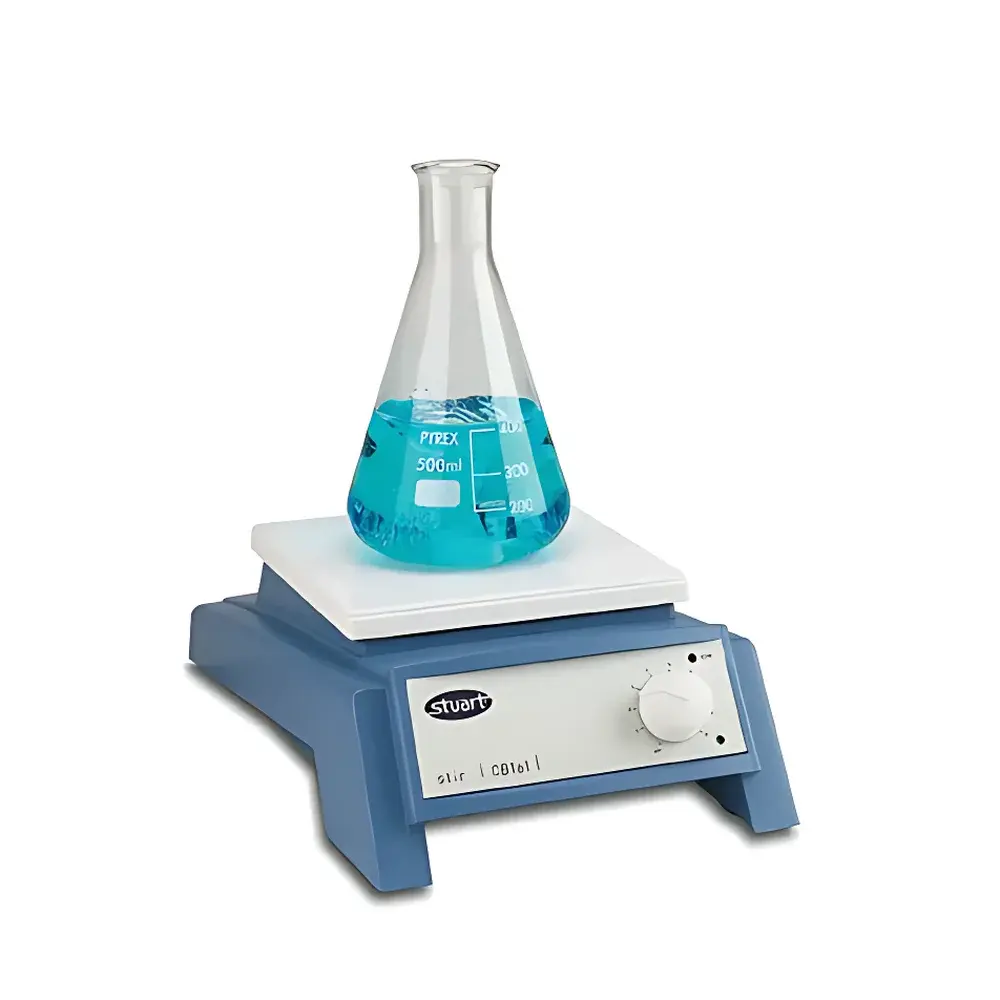
Stuart CB161 & SB161 Standard Magnetic Stirrers
| Brand | Stuart |
|---|---|
| Origin | United Kingdom |
| Model | CB161, SB161 |
| Stirring Speed Range | 100–1500 rpm |
| Max. Stirring Volume | 15 L |
| Hotplate Dimensions | 160 × 160 mm |
| Platform Material | CB161 — Glass-Ceramic |
| Power Supply | 230 V / 50 Hz, 50 W |
| Dimensions (W × D × H) | 190 × 300 × 110 mm |
| Net Weight | 3.4 kg |
| Compliance | CE, RoHS, UKCA |
Overview
The Stuart CB161 and SB161 are benchtop magnetic stirrers engineered for precision, safety, and long-term reliability in routine laboratory environments. Designed according to fundamental electromagnetic coupling principles, these units generate a rotating magnetic field beneath the platform surface to drive PTFE-coated magnetic stir bars within vessels—enabling homogeneous mixing without mechanical shaft penetration. Both models operate within a defined speed range of 100–1500 rpm and support stirring volumes up to 15 L when used with standard accessories (e.g., SR2 support rod and two 25 mm PTFE stir bars). The absence of moving external components minimizes maintenance requirements and eliminates contamination risks associated with overhead stirrers or gear-driven systems. Their compact footprint (190 × 300 × 110 mm) and low power consumption (50 W) make them suitable for continuous operation in QC labs, teaching facilities, and preparatory workstations where space and energy efficiency are prioritized.
Key Features
- Two platform variants: CB161 features a chemically inert, thermally stable glass-ceramic surface resistant to strong acids, bases, and organic solvents; SB161 employs a custom-engineered stainless-steel platform optimized for enhanced magnetic flux density and rotational torque transfer.
- Inclined aluminum base design directs potential spills away from user proximity and improves ergonomics during vessel placement and removal.
- Dedicated thermal protection circuitry prevents overheating under extended operation or load fluctuations—critical for unattended overnight protocols.
- Corrosion-resistant internal electronics ensure operational integrity in humid or chemically aggressive ambient conditions typical of fume hood installations.
- Consistent edge cooling on the CB161’s white glass-ceramic surface allows visual detection of localized thermal anomalies or reagent color changes during reactions.
- Both units comply with CE, UKCA, and RoHS directives, reflecting adherence to EU and UK regulatory frameworks for electrical safety and environmental impact.
Sample Compatibility & Compliance
The CB161 and SB161 accommodate standard laboratory glassware—including beakers, Erlenmeyer flasks, and jacketed reactors—up to 15 L capacity when paired with appropriate stir bar geometry and viscosity ranges (typically < 500 mPa·s for optimal coupling). Their non-contact stirring mechanism avoids cross-contamination between samples and eliminates wear-related calibration drift common in mechanical stirrers. For regulated environments, the devices support GLP-compliant documentation workflows through manual log entries; while they do not include built-in audit trails or electronic signatures, their stable performance characteristics align with ISO/IEC 17025 method validation requirements for mixing consistency in sample preparation steps.
Software & Data Management
These analog-controlled stirrers operate via front-panel rotary dials with tactile feedback and LED indicators—designed for intuitive, tool-free operation without software dependencies. No proprietary firmware, drivers, or cloud connectivity is required. All parameter settings (speed only) are manually adjusted and retained solely through mechanical position memory. This architecture ensures deterministic behavior, immunity to cybersecurity vulnerabilities, and full compatibility with air-gapped laboratory networks. For laboratories requiring traceable operation records, integration with external data loggers or supervisory control systems (e.g., via optional analog voltage output modules) can be implemented at the system level.
Applications
- Buffer and reagent preparation in molecular biology and clinical diagnostics labs
- Solubility testing and dissolution profile development per USP & Ph. Eur. guidelines
- Catalyst suspension and homogeneous reaction initiation in synthetic chemistry
- Standardization of titrant solutions prior to volumetric analysis
- Cell culture media equilibration and pH adjustment in bioprocessing support areas
- Teaching demonstrations of fluid dynamics and mass transfer principles in undergraduate curricula
FAQ
Do the CB161 and SB161 include heating functionality?
No—these are non-heating magnetic stirrers. They provide rotational agitation only. For combined heating/stirring applications, refer to Stuart’s hotplate stirrer series (e.g., SP130800 or SHM20).
What stir bar sizes are recommended for maximum 15 L capacity?
A pair of 25 mm PTFE-coated stir bars is supplied as standard. For viscous or high-volume applications, longer bars (e.g., 40–50 mm) may be used with the SR2 support rod (300 mm × 12.5 mm), provided vessel geometry permits stable rotation.
Is calibration required or supported?
Speed calibration is not user-serviceable. Stuart specifies speed accuracy as ±5% of setpoint across the 100–1500 rpm range, verified during factory testing. No recalibration interval is mandated under normal use conditions.
Can these units be operated inside a CO₂ incubator or cold room?
Operation is limited to ambient temperatures between +10 °C and +40 °C and relative humidity ≤80% non-condensing. Enclosed or temperature-controlled enclosures require prior validation of airflow and condensation management.



