
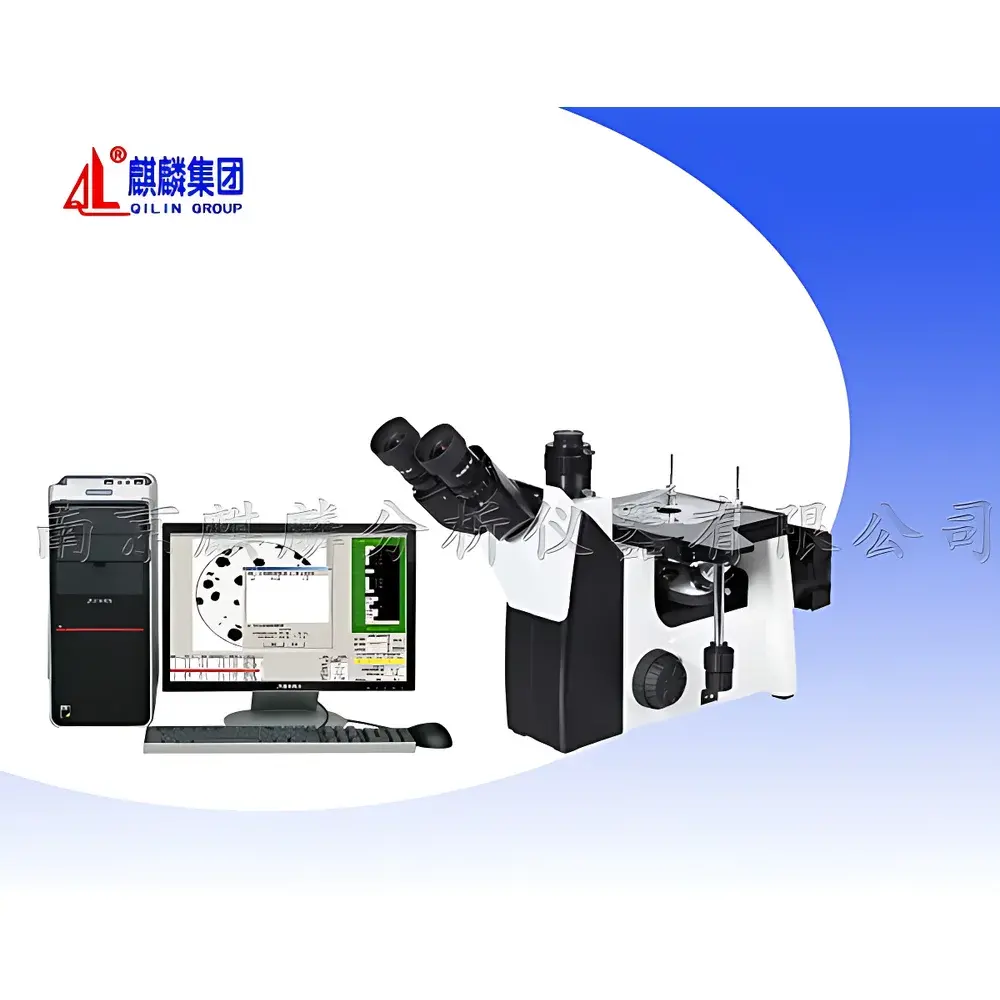
QL-4XC Metallurgical Digital Image Analysis System
| Brand | Qilin / QL |
|---|---|
| Origin | Jiangsu, China |
| Manufacturer Type | Authorized Distributor |
| Product Origin | Domestic (China) |
| Model | 4XC |
| Price Range | USD $1,400 – $7,200 |
| Configuration | Inverted |
| Integrated Image Analysis Software | Yes |
| Total Magnification Range | 100× – 1250× |
| Eyepieces | 10×, 12.5× wide-field |
| Objective Lenses | 10×, 40×, 100× (oil immersion), with optional 20× and 50× objectives |
Overview
The QL-4XC Metallurgical Digital Image Analysis System is an inverted metallurgical microscope engineered for high-fidelity microstructural characterization of metallic and alloyed materials. Designed around a robust Couette-type optical path with Köhler illumination and infinity-corrected optics, it delivers consistent contrast, flat-field imaging, and chromatic aberration correction across the entire field of view—critical for quantitative metallographic evaluation. Its inverted configuration places the objective lenses beneath the specimen stage, enabling unobstructed observation of bulk samples, large cross-sections, or specimens with irregular topography without height-dependent focusing constraints. This architecture is especially advantageous in industrial QA/QC labs where rapid sample turnover and reproducible positioning are essential. The system integrates seamlessly with a high-resolution monochrome or color digital camera (typically 5–12 MP, USB 3.0 interface), supporting real-time acquisition, live histogram monitoring, and hardware-triggered exposure control—all calibrated to NIST-traceable intensity standards.
Key Features
- Inverted optical design with 30° inclined trinocular head, adjustable interpupillary distance (55–75 mm) and diopter compensation (±5 D) for ergonomic extended use
- Quadruple nosepiece accommodating four parfocal, infinity-corrected plan achromat objectives: PL 10× (NA 0.25), PLL 40× (NA 0.65), PL 100× oil (NA 1.25); optional 20× (NA 0.40) and 50× (NA 0.75) objectives available
- Wide-field eyepieces (10×/22 mm FOV and 12.5×/16 mm FOV) with rubberized eye cups and anti-fungal coating
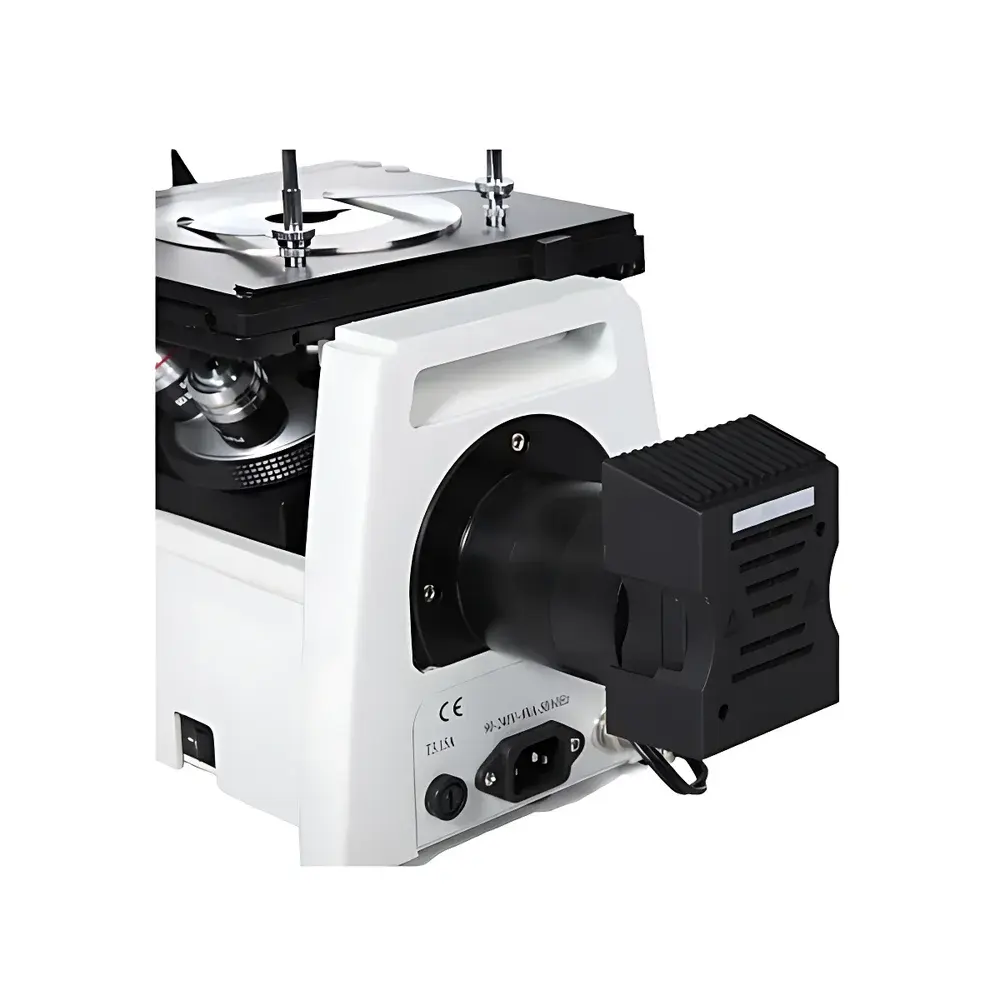
- High-stability mechanical stage with 76 × 50 mm travel range, vernier scale resolution of 0.1 mm, and specimen clamp compatible with standard metallographic mounts (up to 50 mm diameter)
- LED-based transmitted/reflected Köhler illumination system with adjustable intensity (0–100%), heat-absorbing filter, and neutral density filters for glare-free brightfield/darkfield imaging
- Rigid cast-aluminum base with reinforced swing-arm support, low center-of-gravity construction, and vibration-damping rubber feet for stable operation on standard lab benches
Sample Compatibility & Compliance
The QL-4XC accommodates standard metallographic specimens (polished/mounted sections up to 50 mm in diameter and 30 mm in height), including ferrous alloys, non-ferrous metals (Al, Cu, Ti, Mg), sintered powders, weld zones, and coated substrates. It supports ASTM E3, E407, E112 (grain size), E1245 (inclusion rating), ISO 643, ISO 9042, and GB/T 13298–2015 sample preparation protocols. All optical components comply with ISO 10110 surface quality specifications (scratch-dig 60–40). The integrated image analysis software conforms to GLP data integrity requirements—including audit trail logging, user access controls, electronic signatures (per FDA 21 CFR Part 11 Annex 11), and secure export of raw TIFF/RAW files with embedded metadata (exposure time, magnification, calibration date, operator ID).
Software & Data Management
The QL-4XC Image Analysis Suite is a Windows-based application built on a modular architecture compliant with ISO/IEC 17025 documentation standards. It includes over 300 validated measurement and classification modules covering grain size (ASTM E112, Heyn linear intercept), phase area fraction (ISO 9042), inclusion rating (ASTM E45, JK Standard), precipitate dispersion, porosity quantification, and layer thickness profiling. Three standardized evaluation modes are implemented: (1) Automated Rating—algorithm-driven thresholding, segmentation, and statistical classification against embedded reference databases; (2) Assisted Rating—parameter extraction (e.g., aspect ratio, Feret diameter, circularity) for manual expert review; (3) Comparative Rating—side-by-side overlay of captured images against ISO/ASTM standard micrograph libraries with similarity scoring (SSIM index ≥0.92). All reports generate PDF/Excel outputs with embedded calibration certificates, measurement uncertainty estimates (k=2), and full traceability to instrument configuration logs.
Applications
This system is routinely deployed in foundry QC laboratories for cast microstructure verification (e.g., graphite nodule count in ductile iron per ISO 945-1), heat treatment validation (martensite/austenite phase balance in tool steels), failure analysis (crack propagation path mapping), additive manufacturing post-process evaluation (powder melt pool morphology, lack-of-fusion defect detection), and R&D environments studying creep-resistant superalloys or aluminum-lithium aerospace composites. It serves as a primary metrology platform for ISO/IEC 17025-accredited testing labs performing third-party material certification and fulfills technical requirements for AS9100 Rev D Clause 8.5.1 (process validation) and IATF 16949 Section 8.5.1.2 (metallographic process control).
FAQ
Is the QL-4XC compatible with third-party image analysis software such as ImageJ or MATLAB?
Yes—the system exports uncompressed 16-bit TIFF and RAW formats with complete EXIF metadata, enabling direct import into open-source or custom-developed analysis pipelines.
Does the software support multi-user role-based permissions and audit trail generation?
Yes—administrator, analyst, and reviewer roles are configurable with password protection, session logging, and immutable audit trails compliant with FDA 21 CFR Part 11 and EU Annex 11 requirements.
What calibration standards are supplied with the system?
A NIST-traceable stage micrometer (0.01 mm division), graticule eyepiece (10×), and certified reference micrographs (ASTM E112, E45) are included, with annual recalibration services available via authorized service centers.
Can the system perform darkfield, polarized, or differential interference contrast (DIC) imaging?
Darkfield capability is supported via optional condenser upgrade; polarized light imaging requires external analyzer/polarizer kit (not included); DIC is not natively supported due to optical path constraints of the inverted platform.
What is the warranty coverage and service response time for international customers?
Standard warranty: 24 months parts and labor; extended service plans include remote diagnostics, on-site calibration (within 72 business hours in major industrial zones), and firmware update notifications via secure customer portal.




