
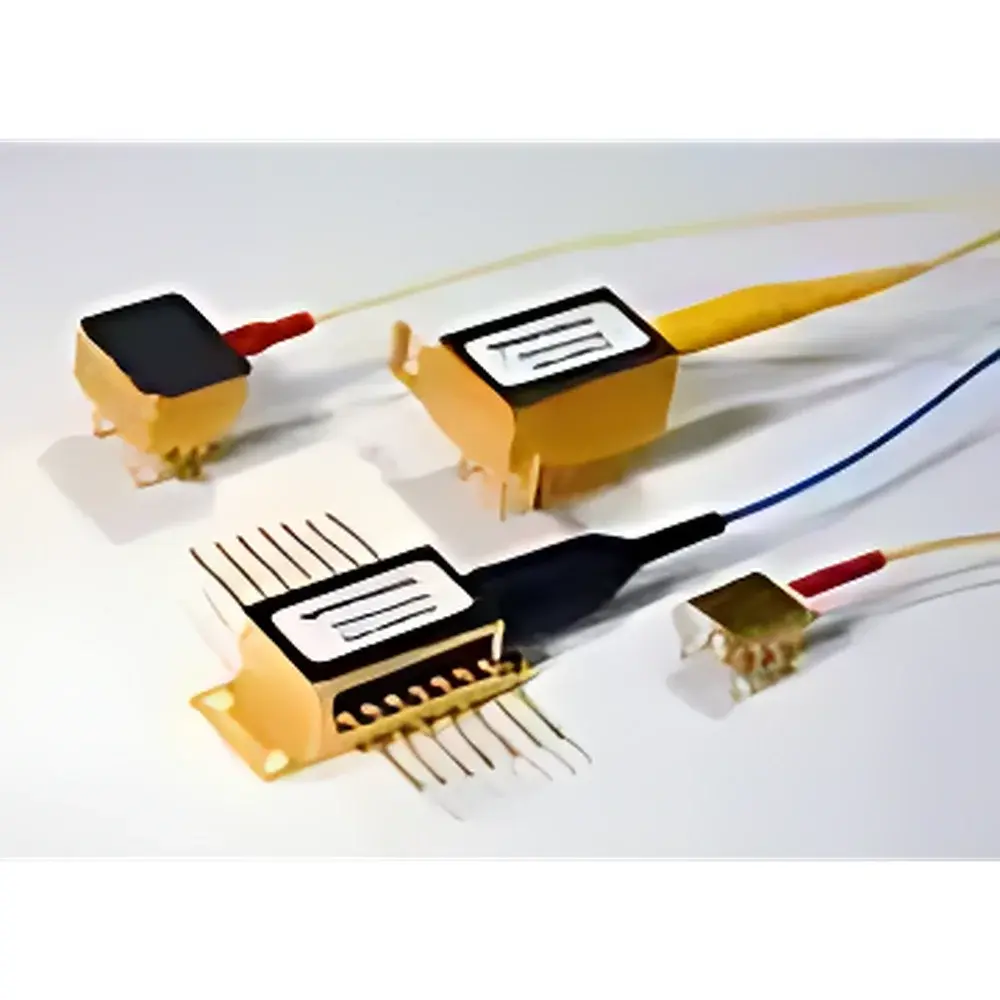
Qphotonics Single-Mode Laser Diodes (FP, DFB, FBG, and DBR Types) – 395–1650 nm Wavelength Range
| Brand | Qphotonics |
|---|---|
| Origin | USA |
| Type | Single-mode laser diode |
| Wavelength range | 395–1650 nm |
| Output power | 1 mW to 1200 mW |
| Spectral linewidth | 0.01–10 nm (depending on type) |
| Package options | 14-pin DIL, 14-pin butterfly, coaxial, mini-DIL |
| Integrated components | Thermistor, TEC, monitor photodiode |
| Fiber coupling | SMF-28 with FC/PC or FC/APC connector |
| Operating mode | CW or pulsed |
Overview
Qphotonics Single-Mode Laser Diodes are precision semiconductor light sources engineered for high spectral purity, narrow linewidth, and exceptional wavelength stability across a broad operational range—from 395 nm in the violet-blue region to 1650 nm in the extended near-infrared. These devices leverage fundamental semiconductor physics and advanced epitaxial growth techniques to deliver reproducible single-transverse-mode (TEM00) output essential for interferometry, optical coherence tomography (OCT), fiber sensing, spectroscopy, and quantum optics applications. Unlike multimode emitters, single-mode laser diodes operate under strict longitudinal mode control—achieved via Fabry–Pérot (FP), distributed feedback (DFB), fiber Bragg grating (FBG), or distributed Bragg reflector (DBR) cavity architectures—ensuring minimal mode-hopping and low relative intensity noise (RIN). All units are fabricated in ISO 9001-certified U.S. facilities and undergo rigorous burn-in and spectral characterization prior to shipment.
Key Features
- Wide wavelength coverage: 395–1650 nm, spanning UV-visible, NIR, and telecom bands (O-, E-, S-, C-, L-, and U-bands)
- Multiple cavity types: FP (broad gain spectrum, cost-effective), DFB (single-mode, 50 dB), and DBR (wavelength-agile, multi-section design)
- Flexible packaging: 14-pin DIL (compact, low-cost integration), 14-pin butterfly (TEC + thermistor + monitor PD for active stabilization), coaxial (low-noise analog modulation), and mini-DIL (space-constrained OEM use)
- Fiber-coupled output: Polarization-maintaining (PM) or standard single-mode fiber (SMF-28) with FC/PC or FC/APC terminations; typical coupling efficiency >50% (higher for PM variants)
- Integrated monitoring and thermal control: Built-in thermistor (±0.5 °C accuracy), TEC (±0.1 °C setpoint stability), and rear-facet photodiode (0.1–10 µA/mW responsivity) enable closed-loop current/temperature regulation
- Compliance-ready operation: Designed to meet IEC 60825-1:2014 Class 3B/4 laser safety requirements; compatible with FDA 21 CFR Part 11–compliant software environments when used in regulated analytical systems
Sample Compatibility & Compliance
These laser diodes are optimized for use with silica-based single-mode optical fibers (e.g., SMF-28, HI1060, PM980), integrated photonic circuits (PICs), and free-space optical benches requiring diffraction-limited beams. Their narrow spectral bandwidth and low spatial coherence minimize speckle noise in imaging and metrology setups. All devices comply with RoHS 2011/65/EU directives and are CE-marked for EMC (EN 55032:2015) and safety (EN 60825-1:2014). For GLP/GMP-regulated laboratories, traceable calibration reports—including wavelength accuracy (±0.5 nm for FP, ±0.05 nm for DFB/FBG), power stability (±1% over 8 h), and spectral purity (SMSR >45 dB)—are available upon request. Units intended for medical device integration meet ISO 13485:2016 manufacturing controls.
Software & Data Management
Qphotonics provides vendor-agnostic driver libraries (C/C++, Python, LabVIEW) supporting USB- and RS-232–based communication for current source and TEC control. The included QLaser Control Suite enables real-time monitoring of photodiode current, junction temperature, and output power—with configurable logging intervals (10 ms–10 s) and CSV export for post-acquisition analysis. When integrated into automated test systems, the diodes support audit-trail generation compliant with FDA 21 CFR Part 11 requirements (electronic signatures, user access levels, immutable event logs). Firmware updates preserve backward compatibility and include enhanced thermal derating algorithms for extended lifetime (>20,000 h MTTF at rated conditions).
Applications
- Optical Sensing: Fiber Bragg grating interrogation, tunable diode laser absorption spectroscopy (TDLAS), cavity ring-down spectroscopy (CRDS), and photoacoustic gas detection
- Biophotonics: Flow cytometry excitation (405 nm, 488 nm, 633 nm), confocal microscopy illumination, fluorescence lifetime imaging (FLIM), and OCT light sources (1310 nm, 1550 nm)
- Telecom & Datacom: DWDM component testing, transceiver characterization, optical time-domain reflectometry (OTDR), and coherent receiver local oscillator (LO) sources
- Quantum Technologies: Cold atom trapping (780 nm, 852 nm), ion qubit manipulation (397 nm, 422 nm), and entangled photon pair generation via SPDC pumping
- Industrial Metrology: Laser interferometry, displacement sensing, and precision alignment in semiconductor lithography tools
FAQ
What is the difference between FP, DFB, and FBG laser diodes?
Fabry–Pérot (FP) lasers emit multiple longitudinal modes within the gain bandwidth and are suited for non-spectrally critical applications. Distributed Feedback (DFB) lasers incorporate a grating directly in the active layer, enabling single-mode operation with linewidths 55 dB) and mechanical robustness—ideal for harsh-environment sensing.
Can these lasers be operated in pulsed mode?
Yes—most models support direct current modulation up to 500 MHz (DFB/DBR) or 200 MHz (FP) with appropriate drivers. Pulse widths down to 1 ns are achievable using external gating; rise/fall times are specified per datasheet and depend on package parasitics and drive impedance.
Do you provide wavelength calibration certificates?
Each unit shipped with a factory test report includes measured center wavelength (at 25 °C, rated current), spectral width (FWHM), SMSR (for DFB/FBG), output power, and threshold current. NIST-traceable calibration is available as an optional service (ISO/IEC 17025 accredited lab).
Are custom wavelengths or packaging options available?
Qphotonics maintains a library of >300 standard configurations; custom wavelengths (within material system limits), tailored fiber pigtails (e.g., PM, HI1060, or specialty fibers), and modified pinouts are supported under OEM agreements with minimum order quantities.
What thermal management is required for continuous operation?
Butterfly-packaged units include integrated TECs and require a stable ±12 V, 2 A power supply for thermal control. DIL packages rely on external heatsinking; thermal resistance from junction-to-case is typically 8–15 K/W—adequate heatsink design (e.g., 5 cm² copper base with forced air) ensures junction temperatures remain below 60 °C at full output.




