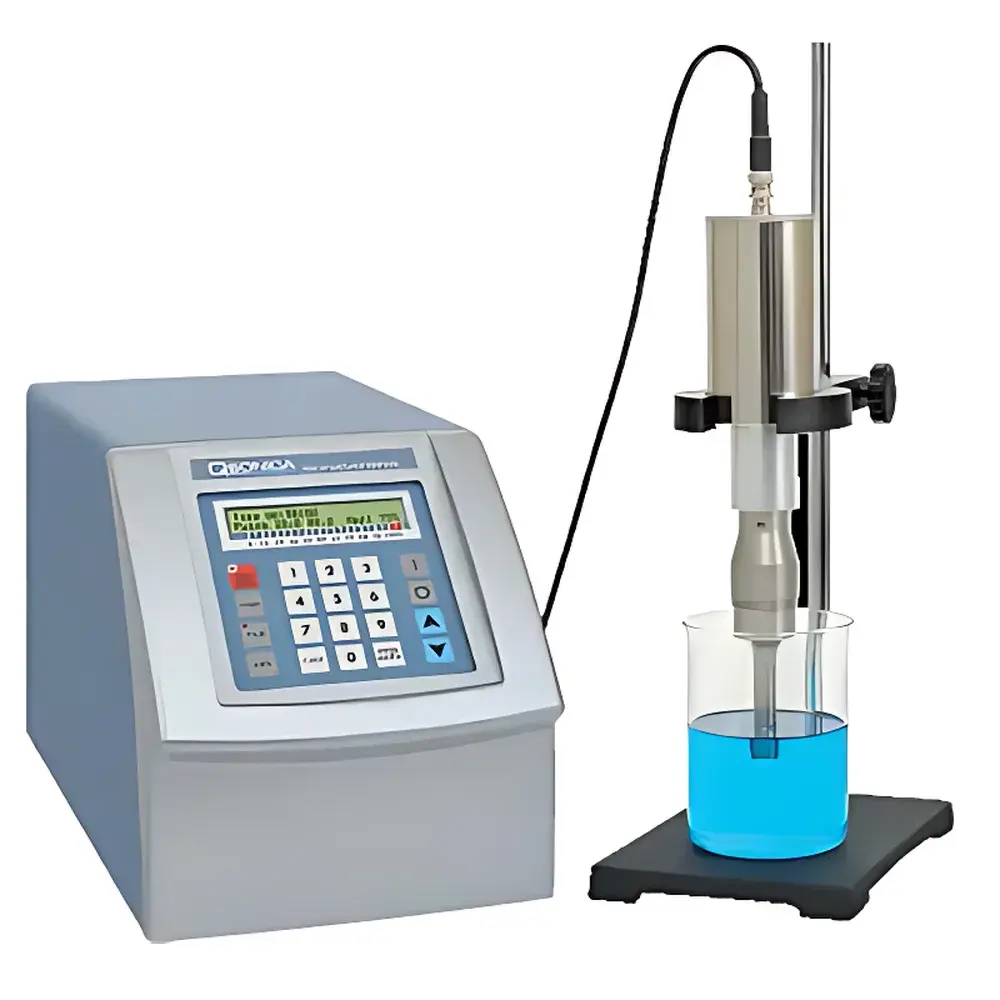
Qsonica Q500 Benchtop Ultrasonic Sonicator
| Brand | Qsonica LLC |
|---|---|
| Origin | USA |
| Model | Q500 |
| Instrument Type | Ultrasonic Cell Disruptor |
| Ultrasonic Power Output | 500 W |
| Operating Frequency | 20 kHz |
| Temperature Range | 1–121 °C |
| Sample Volume Capacity | 5 µL – 1000 mL (batch) / 0.5–20 L/min (flow-through) |
| Throughput | 1–384 samples per run |
| Pulse Duration Adjustment | 1 s – 1 min |
| Continuous Operation Limit | 10 hr |
| Probe Amplitude Range | 30–320 µm (model-dependent) |
| Standard Probe Diameter Options | 1.6 mm, 3.2 mm, 6.4 mm, 12.7 mm, 19.1 mm, 25.4 mm |
| Probe Types | Replaceable-tip, Solid-tapered, High-amplitude, Flow-through, and Cup-horn configurations |
Overview
The Qsonica Q500 Benchtop Ultrasonic Sonicator is an engineered solution for controlled, scalable cell lysis, nanoparticle dispersion, DNA shearing, emulsification, and homogenization in life science and bioprocessing laboratories. Based on piezoelectric transduction at a fixed resonant frequency of 20 kHz, the system converts electrical energy into high-intensity mechanical vibrations transmitted directly to liquid media via titanium alloy probes. This cavitation-driven mechanism generates localized pressure differentials exceeding 1000 atm, inducing microjet formation and shear forces sufficient to disrupt membranes, dissociate protein complexes, and reduce particle agglomerates without significant thermal degradation—provided pulse parameters and cooling strategies are appropriately applied.
Key Features
- Precise digital control of amplitude (20–100% of maximum), time (0.1 s–10 hr), and pulse duty cycle (1 s ON / 1 s OFF up to 1 min ON / 1 min OFF)
- Real-time digital display of elapsed time, delivered power (W), and cumulative energy (J)
- Integrated overload protection circuitry prevents transducer damage during impedance mismatch or probe stall
- Optional footswitch (FS-3Q700 or Q500) enables hands-free operation for repetitive workflows or biosafety-critical applications
- Modular probe architecture supports interchangeable tip geometries—including replaceable-tip, solid-tapered, high-amplitude, and flow-through variants—for optimized energy transfer across volume ranges from 5 µL to 1000 mL
- Available cup-horn configuration (431C2) enables non-contact processing of up to 220 × 2 mL tubes simultaneously, eliminating cross-contamination risk and enhancing operator safety with hazardous or pathogenic samples
- Compatible with external recirculating chillers (e.g., via jacketed flow cell 4583) to maintain sample temperature within 1–121 °C operational envelope
Sample Compatibility & Compliance
The Q500 accommodates diverse biological matrices—including bacterial, yeast, mammalian, and plant cells—as well as synthetic colloids, liposomes, and polymeric suspensions. Probe selection is guided by viscosity, particulate load, and required shear intensity: smaller-diameter probes (1.6–6.4 mm) suit low-volume, high-sensitivity applications (e.g., chromatin immunoprecipitation prep); larger diameters (12.7–25.4 mm) support high-throughput lysate generation or continuous-flow processing. All titanium probes comply with ASTM F136 for surgical-grade implantable alloys. The instrument meets IEC 61000-6-3 (EMC emissions) and IEC 61000-6-2 (immunity) standards. When operated under validated SOPs with audit-trail-enabled software (e.g., Q-Soft v5.x), the system supports GLP and GMP environments aligned with FDA 21 CFR Part 11 requirements for electronic records and signatures.
Software & Data Management
While the Q500 operates natively via front-panel controls, optional Q-Soft software (sold separately) provides PC-based protocol management, real-time parameter logging, and export of timestamped energy/time/power datasets in CSV or XML format. Software-defined methods can be locked, version-controlled, and assigned to user profiles—enabling traceability across shifts and operators. Exported data integrates with LIMS platforms via standard ODBC drivers. Audit trails record all parameter changes, user logins, and method executions, satisfying regulatory expectations for reproducibility and accountability in QC/QA labs.
Applications
- Cell disruption for recombinant protein extraction (E. coli, Pichia, CHO)
- Mechanical shearing of genomic DNA for NGS library preparation
- Preparation of subcellular fractions (mitochondria, nuclei, membrane vesicles)
- Nanoparticle deagglomeration and uniform dispersion in drug delivery formulations
- Emulsification of oil-in-water systems for cosmetic and nutraceutical development
- Rapid homogenization of tissue biopsies prior to RNA isolation
- Enhanced solvent extraction efficiency in natural product isolation workflows
FAQ
What probe type is recommended for processing viscous lysates?
For viscosities >100 cP, use solid-tapered probes (e.g., 4209 or 4310) with 25.4 mm diameter and water-jacketed flow cell 4583 to ensure stable amplitude delivery and thermal management.
Can the Q500 perform sonication under sterile conditions?
Yes—autoclavable titanium probes (all standard models) and disposable probe sleeves (available upon request) enable aseptic operation. Cup-horn processing (431C2) further eliminates direct probe contact with samples.
Is calibration traceable to NIST standards?
Amplitude calibration is performed using laser vibrometry against NIST-traceable reference transducers; certificate available upon request for ISO/IEC 17025-accredited service.
How does pulse mode improve reproducibility in sensitive applications?
Pulsing allows heat dissipation between cycles, minimizing cumulative thermal load—critical for preserving epitope integrity in antigen retrieval or preventing RNA degradation during lysis.
What maintenance intervals are recommended for long-term reliability?
Transducer performance verification every 500 operating hours; probe tip inspection before each use; annual full-system validation including amplitude linearity, power accuracy, and thermal cutoff response.
Related Products