
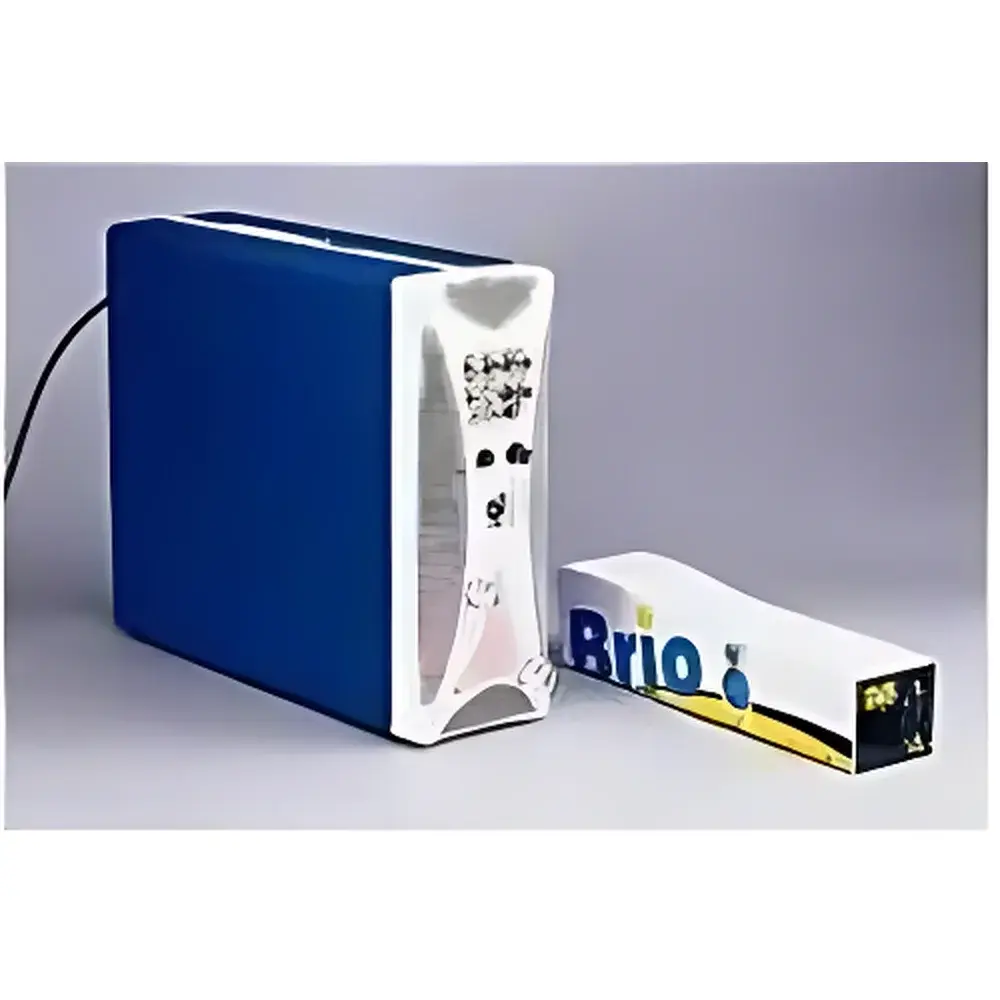
Quantel Brio Series Pulsed Nd:YAG Laser System
| Brand | Quantel |
|---|---|
| Origin | France |
| Model | Brio Series |
| Laser Type | Solid-State Q-Switched Nd:YAG |
| Harmonic Generation | Modular, Plug-and-Play Frequency-Doubling Units |
| Lamp Replacement | Tool-Free Flashlamp Exchange Without Cavity Opening |
| Form Factor | Compact, Benchtop-Ready Module |
| Intended Use | Research & Industrial Laser Applications Requiring Multi-Wavelength Pulsed Output |
Overview
The Quantel Brio Series is a compact, solid-state, Q-switched neodymium-doped yttrium aluminum garnet (Nd:YAG) laser system engineered for high-reliability pulsed operation in demanding laboratory and industrial environments. Operating at the fundamental wavelength of 1064 nm, the Brio integrates modular harmonic generation units—specifically designed for seamless mechanical and optical alignment—to deliver stable, user-selectable output at 532 nm (second harmonic), 355 nm (third harmonic), and 266 nm (fourth harmonic). Its core architecture follows established principles of flashlamp-pumped, electro-optically or passively Q-switched Nd:YAG laser physics, ensuring consistent pulse energy, temporal stability (<10 ns pulse width typical), and beam quality (M² < 2) across all harmonics. Unlike integrated fixed-wavelength systems, the Brio’s modularity enables rapid reconfiguration without realignment or recalibration—making it particularly suitable for multi-experiment workflows, time-resolved spectroscopy, LIBS, laser-induced fluorescence (LIF), and precision micromachining where spectral flexibility and operational uptime are critical.
Key Features
- Compact benchtop form factor (dimensions: ~300 × 180 × 120 mm) with integrated power supply and cooling interface—designed for space-constrained optics tables and OEM integration.
- Modular harmonic generation units featuring pre-aligned, kinematic mounts and polarization-maintaining optical paths; no manual collimation or waveplate adjustment required during installation or wavelength switching.
- Tool-free flashlamp replacement mechanism: lamp cartridge slides into position via front-access bayonet mount, eliminating the need to disassemble the laser head or disturb cavity alignment—reducing maintenance downtime to under 5 minutes.
- Robust thermal management using forced-air convection with intelligent fan speed control, maintaining stable output energy drift < ±3% over 8-hour continuous operation at rated repetition rates (1–20 Hz).
- Integrated digital control interface (RS-232 and USB 2.0) supporting remote triggering, pulse energy monitoring, and diagnostics logging compliant with standard SCPI command sets.
Sample Compatibility & Compliance
The Brio Series is compatible with standard optical components including dielectric mirrors, fused silica lenses, and UV-grade quartz windows across its full harmonic range (266–1064 nm). Its output beam profile meets ISO 11146 requirements for beam propagation analysis, and pulse energy calibration is traceable to NIST-traceable photodiode standards. The system complies with IEC 60825-1:2014 Class 4 laser safety requirements when operated with appropriate interlocks and enclosure integration. For regulated environments—including pharmaceutical process development and academic GLP laboratories—the Brio supports optional audit-trail-enabled firmware (via Quantel’s LaserManager software) to meet data integrity expectations aligned with FDA 21 CFR Part 11 Annex 11 principles.
Software & Data Management
Quantel LaserManager is a Windows-based application providing full system control, real-time pulse energy monitoring, shot counter tracking, and event-logged diagnostics history. It supports automated sequence scripting (e.g., timed harmonic switching, energy ramping, external TTL synchronization), and exports timestamped CSV datasets for post-acquisition analysis in MATLAB, Python (NumPy/Pandas), or LabVIEW. All configuration changes and operational events are recorded with user ID, timestamp, and parameter values—enabling retrospective review during equipment qualification (IQ/OQ/PQ) and internal audits. Optional API libraries (C/C++, .NET, Python bindings) allow deep integration into custom experimental control frameworks.
Applications
- Laser-Induced Breakdown Spectroscopy (LIBS) requiring tunable nanosecond pulses at multiple UV–VIS wavelengths for elemental mapping in geological, metallurgical, and environmental samples.
- Time-resolved fluorescence lifetime imaging (FLIM) and pump-probe spectroscopy where precise timing jitter (<1 ns RMS) and wavelength agility enable multi-channel excitation protocols.
- Optical parametric oscillator (OPO) pumping in ultrafast science setups, leveraging the Brio’s high peak power (>1 MW) and excellent spatial coherence.
- Microfabrication and thin-film ablation in semiconductor R&D, benefiting from stable 266 nm output for high-resolution patterning of polymers and transparent conductive oxides.
- Calibration source for radiometric and photometric instrumentation, supported by factory-measured spectral irradiance data and NIST-traceable energy calibration certificates.
FAQ
Is the Brio Series compatible with third-party OPOs or nonlinear crystals?
Yes—its TEM₀₀ beam profile, M² < 2, and low pointing instability (<10 µrad) meet standard input requirements for commercial OPOs and SHG/THG crystals from vendors including EKSPLA, Continuum, and InnoLas.
Does the system include a built-in energy meter?
No—pulse energy measurement requires an external calibrated pyroelectric or photodiode-based sensor (e.g., Coherent FieldMaxII-TO, Gentec-EO Maestro); however, the Brio provides analog voltage output proportional to pulse energy for real-time feedback integration.
Can the Brio operate continuously at maximum repetition rate without derating?
Yes—when installed in an environment with ambient temperature ≤25°C and adequate airflow, the system sustains full-rated pulse energy at 20 Hz for indefinite periods, as verified per Quantel’s accelerated life testing protocol (IEC 60068-2-64 compliant).
What documentation is provided for regulatory compliance?
Each unit ships with Declaration of Conformity (CE, RoHS), Factory Calibration Report (including energy stability, pulse width, and beam divergence measurements), and optional IQ/OQ protocol templates upon request.






