
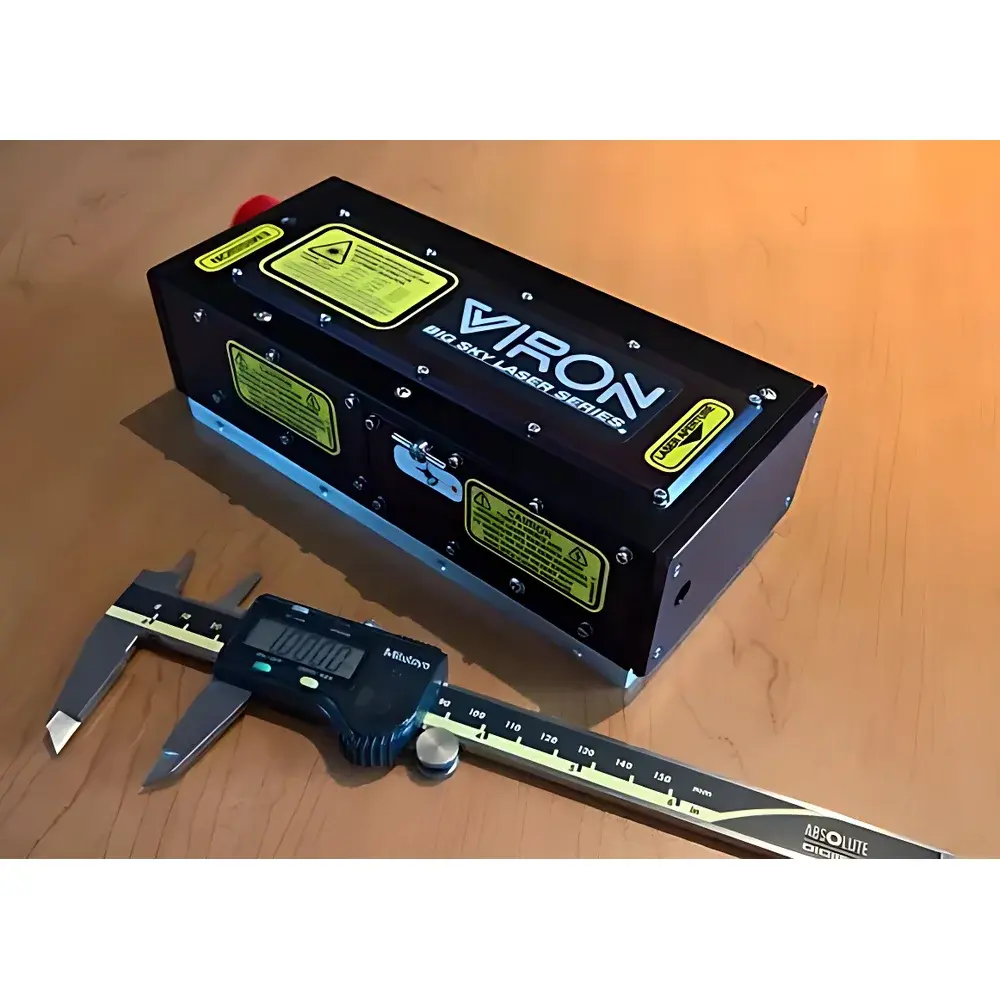
Quantel Viron Series Compact DPSS Laser Systems
| Brand | Quantel |
|---|---|
| Origin | France |
| Model | Viron Series |
| Type | Diode-Pumped Solid-State (DPSS) Q-Switched Nd:YAG Laser |
| Output Wavelengths | 1064 nm (fundamental), 532 nm (frequency-doubled) |
| Repetition Rate | 20 Hz |
| Pulse Energy @ 1064 nm | 30 mJ / 50 mJ |
| Pulse Energy @ 532 nm | 15 mJ (for VRN20-30-G only) |
| Pulse Width | <12 ns |
| Beam Diameter | <3.8 ± 1.2 mm |
| Beam Divergence | <1.5 mrad |
| Dimensions (H×L×W) | 195 × 89 × 59 mm |
| Weight | 1.7 kg |
| Power Supply | 24 V DC |
| Enclosure | Hermetically Sealed, Industrial-Grade Housing |
| Compliance | CE, RoHS, IEC 60825-1:2014 (Class 4 Laser Product) |
Overview
The Quantel Viron Series represents a purpose-engineered evolution in compact, field-deployable diode-pumped solid-state (DPSS) laser technology. Designed and manufactured by Quantel—a French pioneer in solid-state lasers since 1970—the Viron platform integrates Nd:YAG gain medium with high-efficiency diode pumping and robust electro-optical Q-switching to deliver stable, nanosecond-duration pulses at 1064 nm and, via intracavity or external second-harmonic generation, at 532 nm. Unlike conventional laboratory-grade Nd:YAG systems, the Viron Series prioritizes mechanical and thermal stability within a minimized footprint, enabling reliable operation in non-ideal environments—including mobile laboratories, industrial inspection stations, airborne LIDAR test benches, and space-constrained OEM integration scenarios. Its hermetically sealed, convection-cooled architecture eliminates reliance on forced-air or water cooling, while the 24 V DC input simplifies power interface requirements across battery-powered, vehicle-mounted, or remote-sensor platforms.
Key Features
- Compact monolithic design: All-optical path and electronics housed within a single 195 × 89 × 59 mm aluminum chassis—optimized for vibration resistance and thermal equilibrium.
- High wall-plug efficiency: Engineered for >8% optical-to-optical conversion efficiency from 24 V DC input to 1064 nm output, reducing thermal load and enabling extended duty cycles.
- Hermetic sealing: IP54-rated enclosure protects internal optics and pump diodes against dust, humidity, and condensation—validated for continuous operation at 5–40 °C ambient temperature and up to 85% non-condensing relative humidity.
- OEM-ready interface: Standard TTL-compatible trigger input, analog monitor outputs for pulse energy and diode current, and RS-232 serial port for firmware updates and diagnostic readout.
- Beam quality assurance: M² < 1.3 (typ.) at 1064 nm; near-Gaussian spatial profile with low wavefront distortion (<λ/8 RMS over central 80% of beam).
Sample Compatibility & Compliance
The Viron Series is compatible with standard optical components used in time-resolved spectroscopy, LIBS (Laser-Induced Breakdown Spectroscopy), LIDAR calibration, and fluorescence lifetime excitation. Its fixed repetition rate (20 Hz) and consistent pulse-to-pulse energy stability (<±2% RMS over 8 hours, 25 °C ambient) ensure reproducible ablation and signal acquisition. The system conforms to IEC 60825-1:2014 as a Class 4 laser product, with integrated interlock circuitry supporting safe integration into larger instrumentation per EN 61511 (functional safety) and ISO 13849-1 (PL e). It meets CE marking requirements for electromagnetic compatibility (EN 61326-1) and environmental compliance (RoHS Directive 2011/65/EU). No additional regulatory certification is required for integration into FDA-regulated analytical instruments under 21 CFR Part 11, provided system-level audit trails and user access controls are implemented at the host platform level.
Software & Data Management
While the Viron Series operates autonomously without host software, Quantel provides the optional Viron Control Suite—a Windows-based utility for remote configuration, real-time diagnostics, and logging of operational parameters (e.g., diode temperature, pulse energy drift, internal humidity sensor readings). All logged data are timestamped and exportable in CSV format. For automated test systems, the RS-232 command set supports SCPI-like syntax and is compatible with LabVIEW™, Python (pySerial), and MATLAB® instrument control toolboxes. Audit trail functionality—including user login history, parameter change logs, and firmware version tracking—is implemented at the host application layer; the laser itself maintains no persistent storage to preserve long-term reliability and avoid flash memory wear-out.
Applications
- Laser-Induced Breakdown Spectroscopy (LIBS): Stable 30–50 mJ pulses at 1064 nm enable reproducible plasma generation on metallic, ceramic, and geological samples—supporting quantitative elemental analysis in mining, metallurgy, and planetary rovers.
- Time-of-Flight LIDAR Calibration: Sub-12 ns pulse width and low beam divergence (<1.5 mrad) provide precise temporal and spatial references for rangefinder validation and detector response characterization.
- Fluorescence Lifetime Imaging (FLIM) Excitation: Frequency-doubled 532 nm output serves as a stable pump source for TCSPC (time-correlated single-photon counting) systems requiring picosecond-scale jitter tolerance.
- OEM Integration in Portable Analyzers: Its 24 V DC input, sealed housing, and shock-rated construction make it suitable for handheld Raman spectrometers, explosives trace detectors, and battlefield CBRN sensors.
- Academic Teaching Labs: Provides a robust, low-maintenance platform for demonstrating Q-switching dynamics, nonlinear frequency conversion, and laser-material interaction principles.
FAQ
Is the Viron Series compliant with FDA 21 CFR Part 11 for use in regulated pharmaceutical labs?
The laser itself does not store or process GxP-critical data; however, when integrated into a validated analytical instrument, its deterministic trigger behavior and hardware interlocks support Part 11 compliance at the system level—provided the host platform implements electronic signatures, audit trails, and role-based access control.
Can the VRN20-50-G model generate 532 nm output?
No. Only the VRN20-30-G variant includes an integrated SHG crystal for 532 nm output. The VRN20-50-G is optimized for maximum fundamental energy and excludes harmonic generation to maintain pulse stability and thermal management.
What is the recommended warm-up time before achieving rated pulse energy stability?
Less than 15 minutes from cold start at 25 °C ambient; full thermal equilibrium (±0.5% pulse energy variation) is achieved within 30 minutes.
Does the system support external Q-switch triggering?
Yes—TTL-compatible external trigger input accepts 3.3 V or 5 V logic signals with programmable delay (0–100 ms, 1 µs resolution) relative to internal timing reference.
Is fiber coupling available as a factory option?
Standard models feature free-space output only. Fiber coupling (with SMA905 or FC/PC connector, 400 µm core, NA 0.22) is offered as a custom-configured option—subject to beam quality verification and insertion loss compensation in final calibration.




