
Quantum Northwest PAS 1000 Pulsed Laser Photoacoustic Spectroscopy System
| Brand | Quantum Northwest |
|---|---|
| Origin | USA |
| Manufacturer Type | Authorized Distributor |
| Origin Category | Imported |
| Model | PAS 1000 |
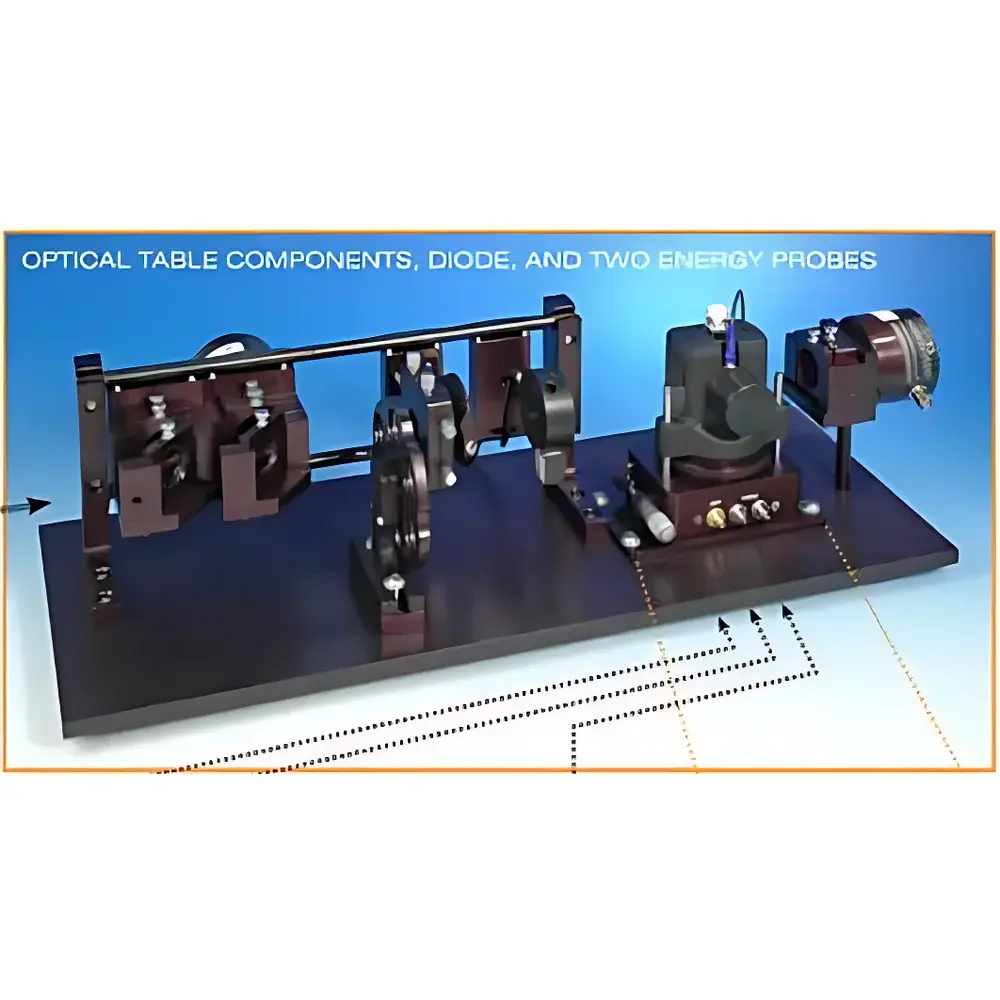
| Core Components | Q-switched solid-state laser system (user-supplied), optical train, energy monitor, fast diode trigger, thermostatted sample cell holder, piezoelectric transducer, low-noise preamplifier, high-bandwidth data acquisition hardware, digital oscilloscope interface |
| Software | PAS-Soft v3.x for real-time acquisition, deconvolution, kinetic modeling, and thermal/expansion coefficient analysis |
Overview
The Quantum Northwest PAS 1000 is a turnkey pulsed laser photoacoustic spectroscopy (PAS) system engineered for quantitative measurement of transient volume changes in optically absorbing media following nanosecond-scale laser excitation. Based on the photoacoustic effect—where rapid localized heating induces thermoelastic expansion—the PAS 1000 detects resulting pressure waves via high-sensitivity piezoelectric transduction. The system operates on the principle that the amplitude, shape, and temporal profile of the acoustic waveform directly reflect photothermal conversion efficiency, heat dissipation kinetics, and molecular relaxation pathways. Unlike steady-state absorption techniques, PAS provides intrinsic background rejection and is insensitive to light scattering, making it ideal for turbid or highly absorbing solutions—including biological chromophores, metalloproteins, and photoactive nanomaterials. Its time-resolved capability supports sub-microsecond resolution, enabling investigation of primary photophysical events such as ligand dissociation in hemoproteins, retinal isomerization in rhodopsin, and electron transfer in photosynthetic reaction centers.
Key Features
- Modular architecture integrating all essential PAS components: optical alignment platform, calibrated energy monitor, synchronized diode trigger (<1 ns jitter), temperature-controlled cuvette holder (±0.02 °C stability over 24 h), broadband piezoelectric transducer (1–15 MHz bandwidth), ultra-low-noise preamplifier (input noise <3 nV/√Hz), and 12-bit, 1 GS/s digitizer with USB 3.0 interface
- FLASH 300/PAS core module: optimized for Q-switched Nd:YAG (1064/532/355 nm) and tunable OPO lasers; includes beam delivery optics, adjustable delay line, and collimated acoustic coupling path
- PAS-Soft software suite compliant with GLP/GMP documentation requirements: supports automated baseline correction, convolution-based waveform deconvolution, multi-exponential kinetic fitting, and export of ASCII/CSV-compatible datasets for third-party analysis (e.g., MATLAB, Origin, Python SciPy)
- Full traceability: integrated timestamping, hardware ID logging, user authentication, and audit trail generation per FDA 21 CFR Part 11 guidelines
- Scalable configuration: base PAS 1000 requires only user-supplied nanosecond-pulsed laser and Windows 10/11 PC; optional add-ons include cryogenic sample stage, flow-through cell adapter, and dual-transducer differential detection mode
Sample Compatibility & Compliance
The PAS 1000 accommodates standard 1-cm quartz cuvettes (10 mm path length), custom micro-volume cells (down to 50 µL), and sealed gas-phase chambers. It supports aqueous, organic, and ionic liquid solvents across −10 °C to +80 °C (with optional chiller). All wetted materials comply with USP Class VI biocompatibility standards. System validation adheres to ASTM E2912–22 (Standard Practice for Photoacoustic Spectroscopy) and ISO 13757:2021 (Optical methods for measuring thermal properties). Instrument design meets IEC 61000-6-3 (EMC emissions) and IEC 61010-1 (safety for laboratory equipment). Full calibration certificates—including transducer sensitivity (V/Pa), energy meter NIST-traceable calibration, and temperature sensor uncertainty (<±0.05 °C)—are provided with each shipment.
Software & Data Management
PAS-Soft v3.x implements a deterministic real-time acquisition engine capable of triggering on laser pulse arrival with sub-nanosecond precision. Data streams are acquired at up to 1 GS/s with 12-bit vertical resolution and stored in hierarchical binary format (HDF5) supporting metadata embedding (sample ID, operator, ambient conditions, laser fluence). Built-in processing tools include FFT-based frequency-domain analysis, time-zero alignment using reference photodiode signal, and iterative deconvolution against instrument response function. Export modules generate publication-ready figures (EPS, TIFF, SVG) and structured reports compliant with journal submission standards (e.g., JACS, Biophysical Journal). Audit logs record every parameter change, file save event, and user login session, ensuring full reproducibility and regulatory readiness.
Applications
- Ultrafast protein dynamics: monitoring heme pocket relaxation in myoglobin after CO photolysis (τ ≈ 100 ps–10 ns)
- Photosynthetic energy transfer: resolving charge separation kinetics in Photosystem II core complexes
- Photothermal nanoparticle characterization: quantifying plasmonic heating efficiency and thermal boundary resistance in Au nanorods
- Photochemical reaction intermediates: identifying transient species in photocatalytic water-splitting systems
- Material science: measuring thermal diffusivity and Grüneisen parameter in thin-film semiconductors and perovskites
FAQ
What laser specifications are required to operate the PAS 1000?
A Q-switched solid-state laser with pulse width ≤10 ns, repetition rate 1–10 Hz, and pulse energy ≥0.1 mJ at 532 nm is recommended. Nd:YAG, Nd:YLF, and tunable OPO systems are fully supported.
Is the system compatible with non-aqueous solvents?
Yes—quartz cuvettes and stainless-steel transducer housings are chemically inert to most organic solvents, including acetonitrile, THF, and chloroform. Solvent compatibility must be verified for long-term exposure.
Can PAS-Soft perform global kinetic analysis across multiple wavelengths?
Yes—when coupled with a tunable laser source and wavelength-stamped acquisition, PAS-Soft supports global target analysis and singular value decomposition (SVD) of wavelength-resolved photoacoustic datasets.
Does the PAS 1000 support GMP-compliant workflows?
Yes—software enforces electronic signatures, role-based access control, and immutable audit trails meeting FDA 21 CFR Part 11 and EU Annex 11 requirements.
What is the minimum detectable volume change?
Under optimal conditions (high-absorbance sample, 10 mJ pulses, averaging 128 traces), the system achieves a volume change detection limit of ~10−12 cm³ (equivalent to sub-picomolar concentration changes in strong absorbers).



