
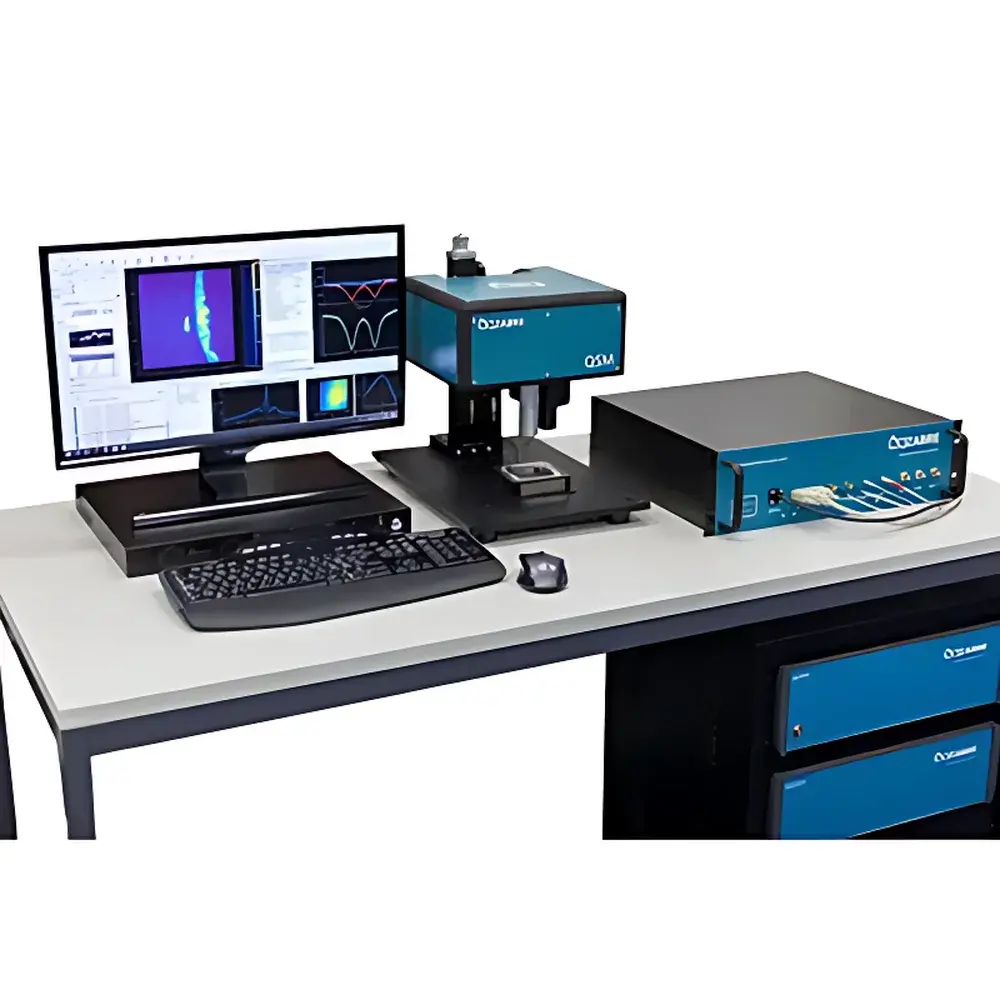
Qzabre QSM Quantum Diamond NV-Center Scanning Magnetometer
| Brand | Qzabre |
|---|---|
| Origin | Switzerland |
| Manufacturer Type | Authorized Distributor |
| Origin Category | Imported |
| Model | QSM |
| Instrument Type | Magnetic Force Microscope (MFM) |
| Positional Drift Rate | 6 nm/h |
| Sample Size | 25 mm diameter (standard) |
| Scan Range | 90 μm × 90 μm × 15 μm (closed-loop, 0.15 nm resolution) |
Overview
The Qzabre QSM Quantum Diamond NV-Center Scanning Magnetometer is a next-generation scanning probe microscope engineered for nanoscale magnetic field imaging with quantitative vector sensitivity. Unlike conventional magnetic imaging techniques—such as Kerr microscopy (~300 nm resolution) or standard MFM (~50 nm)—the QSM leverages the quantum spin properties of nitrogen-vacancy (NV) centers in single-crystal diamond to achieve sub-30 nm magnetic spatial resolution and field sensitivities down to 1–10 µT/Hz1/2. The NV center—a point defect formed by a substitutional nitrogen atom adjacent to a lattice vacancy—exhibits a spin-triplet ground state with zero-field splitting of 2.87 GHz between the mS = 0 and degenerate mS = ±1 states. Under external magnetic fields, the mS = ±1 levels split linearly via the Zeeman effect (Δf = 2γB, where γ ≈ 28 MHz/mT), enabling precise, non-perturbative optical detection of local magnetic fields through optically detected magnetic resonance (ODMR). As a true single-spin sensor, the NV probe introduces negligible magnetic perturbation to the sample—critical for studying delicate spin textures in antiferromagnets, skyrmions, or vortex lattices.
Key Features
- Sub-30 nm magnetic spatial resolution with quantitative field mapping capability
- Multi-modal operation: NV magnetometry, NV quenching, AFM (with Qzabre or Akiyama probes), and MOKE for rapid region-of-interest identification (150 µm FOV)
- Closed-loop XYZ scanning stage: 90 µm × 90 µm × 15 µm range with 0.15 nm step resolution; integrated 6 mm coarse positioning (100 nm resolution)
- Optimized high-NA (0.75) optical path delivering >87% transmission across 600–850 nm—>10% improvement over conventional confocal systems
- Thermal stability: drift rate ≤6 nm/h at ±0.3 °C ambient fluctuation
- Modular probe architecture enabling rapid exchange of NV-diamond tips, conductive AFM cantilevers, or MOKE objectives
- Optional vector electromagnet: generates programmable DC fields up to 75 mT in arbitrary orientation
- Customizable sample stage: supports standard 25 mm diameter substrates or extended 50 mm × 50 mm configurations with optional DC/microwave feedthroughs or heating integration
Sample Compatibility & Compliance
The QSM accommodates a broad range of solid-state magnetic samples—including thin-film heterostructures, epitaxial oxides, 2D materials, and nanostructured metals—without requiring conductive coating or vacuum environments. Its ambient-pressure, room-temperature operation eliminates constraints associated with cryogenic or ultra-high-vacuum systems, while maintaining compatibility with in situ electrical biasing and microwave excitation. All hardware and software components comply with CE marking requirements for electromagnetic compatibility (EMC Directive 2014/30/EU) and low-voltage safety (LVD Directive 2014/35/EU). Data acquisition workflows support audit-ready documentation aligned with GLP principles; time-stamped metadata, raw ODMR spectra, and full parameter logs are preserved per measurement session to facilitate traceability in regulated research environments.
Software & Data Management
The QSM is delivered as a fully integrated turnkey system running Qzabre’s proprietary QuantumScan™ software suite. This platform provides real-time ODMR spectral fitting, vector field reconstruction from multi-axis NV measurements, and synchronized multimodal image correlation (e.g., overlaying NV field maps with topographic AFM data). All acquired datasets—including raw photon counts, microwave frequency sweeps, and position coordinates—are stored in HDF5 format with embedded metadata compliant with FAIR (Findable, Accessible, Interoperable, Reusable) principles. Software supports export to common scientific formats (TIFF, CSV, MATLAB .mat) and includes Python API access for custom analysis pipelines. For laboratories operating under regulatory oversight, optional 21 CFR Part 11-compliant modules provide electronic signatures, role-based user permissions, and immutable audit trails for all instrument control actions and data modifications.
Applications
- Magnetic domain imaging: Quantitative visualization of ferromagnetic and antiferromagnetic domain structures, including domain wall width, chirality, and pinning behavior in multilayer stacks and insulating magnets
- Skyrmion and chiral spin texture analysis: Reconstruction of stray field signatures to distinguish Néel vs. Bloch configurations and resolve edge states in nanostripes or bilayer geometries
- Current density mapping: Nanoscale imaging of DC and pulsed current flow in 2D conductors (e.g., graphene, CNT networks) with spatial resolution down to 22 nm and current sensitivity <5 µA
- Vortex and spin-wave dynamics: Direct observation of gyrotropic motion and eigenmode coupling in magnetic vortices without field-induced perturbation
- Time-resolved magnetic waveform detection: Single-shot acquisition of arbitrary AC/RF field transients (e.g., IC signal propagation, pulse-driven switching) with 20 ns temporal resolution and ~4 µT/Hz1/2 sensitivity
- Multiferroic and strain-coupled systems: Correlative mapping of magnetic, piezoelectric, and thermal responses under combined stimuli
FAQ
What is the fundamental sensing mechanism of the QSM?
The QSM uses the electron spin resonance of nitrogen-vacancy (NV) centers in diamond, detected via optically detected magnetic resonance (ODMR). Magnetic fields shift the NV spin transition frequencies linearly, enabling quantitative, non-invasive field mapping.
Can the QSM operate outside cryogenic environments?
Yes—the system is designed for ambient-temperature, atmospheric-pressure operation. No liquid helium or vacuum infrastructure is required.
How does NV-based magnetometry differ from conventional MFM?
Unlike MFM—which relies on force gradients between a magnetized tip and sample—the QSM measures magnetic fields directly using atomic-scale quantum sensors, eliminating tip-induced artifacts and enabling absolute field calibration.
Is vector magnetic field reconstruction supported?
Yes—by rotating the sample or applying controlled bias fields, the QSM reconstructs full 3D vector field components using multiple NV orientations within the diamond probe.
What level of technical support is provided post-installation?
Qzabre offers remote diagnostics, annual calibration verification, and on-site application training by physicists with expertise in spin physics and nanomagnetism.




