
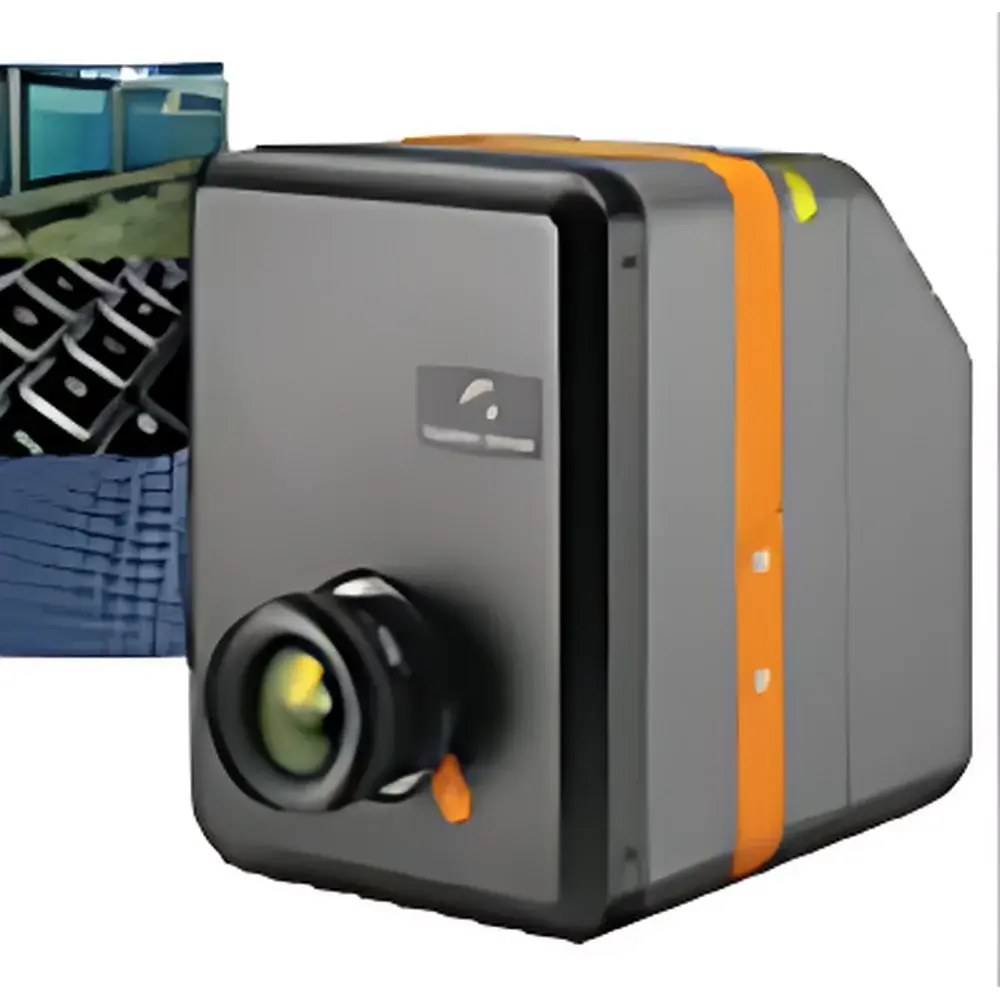
Radiant Zemax PM-I Imaging Colorimeter and Luminance Meter
| Brand | Radiant Zemmax |
|---|---|
| Origin | USA |
| Manufacturer Type | Authorized Distributor |
| Import Status | Imported |
| Model | PM-I |
| Pricing | Available Upon Request |
| CCD Resolution | 3296 × 2472 px (Standard), 4896 × 3264 px (High-Resolution Option) |
| Dynamic Range | 12-bit (4096 grayscale levels) |
| Luminance Range | 0.01 to 10¹⁰ nit (with ND filters) |
| Photometric Accuracy | Illuminance ±3%, Luminance (Y) ±3%, Chromaticity (x,y) ±0.003 |
| Short-Term Repeatability | Illuminance <±0.5%, Luminance <±0.5%, Chromaticity ±0.0006 |
| Measurement Speed (100 cd/m²) | Luminance-only: 0.7 s |
| Luminance + Chromaticity | 3.7 s |
| Lens Options | 20 mm, 35 mm, 50 mm, 100 mm macro |
| Focus & Aperture | Motorized |
| Display | 125 mm diagonal LCD touchscreen (800 × 600) |
| Interface | USB 2.0/3.0, Gigabit Ethernet |
| Dimensions | 181 × 238 × 230 mm (H × W × D) |
| Weight | 4.9 kg |
| Operating Temperature | 0–30 °C |
| Operating Humidity | 20–70% RH (non-condensing) |
Overview
The Radiant Zemax PM-I Imaging Colorimeter and Luminance Meter is a high-precision, production-grade optical measurement system engineered for quantitative spatial photometry and colorimetry of self-luminous and reflective displays. Based on a scientific-grade CMOS/CCD imaging sensor architecture, the PM-I implements calibrated CIE 1931 (x,y) and CIE 1976 (u′,v′) color space mapping alongside absolute luminance (cd/m², nit), illuminance (lux), radiance (W/sr/m²), and irradiance (W/m²) measurements. Its core measurement principle relies on traceable spectral response calibration—using NIST-traceable reference standards—to ensure photopic (V(λ)) and color-matching function fidelity across the visible spectrum (380–780 nm). Designed for integration into automated test stations or benchtop QA workflows, the PM-I delivers metrological rigor required for display manufacturing, automotive HMI validation, and R&D labs where spatial uniformity, defect detection, and chromatic consistency are governed by ISO 9241-307, IEC 62341-6-3, and SAE J1757-2 compliance frameworks.
Key Features
- Two sensor configurations: Standard resolution (3296 × 2472 px) and high-resolution option (4896 × 3264 px), enabling sub-pixel-level Mura analysis and fine-pitch OLED/LCD inspection.
- 12-bit dynamic range (4096 gray levels) with auto-ranging and programmable ND filter control, supporting measurement from ultra-low-brightness indicators (0.01 nit) to high-luminance microLED arrays (up to 10¹⁰ nit).
- Fully motorized optical assembly: Precision electric focus, aperture selection, and lens interchangeability—enabling rapid reconfiguration between near-field (macro) and far-field (telecentric) measurement geometries.
- Integrated 125 mm diagonal LCD touchscreen (800 × 600) for real-time preview, region-of-interest (ROI) definition, live histogram overlay, and on-device pass/fail thresholding without external PC dependency.
- Sub-second acquisition: As fast as 0.7 seconds for luminance-only capture at 100 cd/m²; full tristimulus color + luminance in 3.7 seconds—optimized for inline production throughput.
- Gigabit Ethernet and dual-mode USB (2.0/3.0) interfaces support deterministic data streaming, remote scripting via TCP/IP, and synchronization with motion stages or signal generators using TTL triggers.
Sample Compatibility & Compliance
The PM-I supports spatial characterization of emissive and transmissive devices including OLED, LCD, microLED, Mini-LED, and automotive HUDs. It accommodates flat-panel displays (up to 85″ diagonal at appropriate working distance), curved instrument clusters, and small-area light sources such as status LEDs and backlight units. All photometric and colorimetric calibrations are performed per CIE Publication 127:2007 and conform to ASTM E308-22 for spectral computation. System-level accuracy meets ISO/CIE 11664-4:2019 (colorimetric tolerances) and is validated under GLP-compliant procedures. Full audit trail logging—including calibration certificate metadata, operator ID, environmental conditions (temperature/humidity), and instrument configuration—is maintained in accordance with FDA 21 CFR Part 11 requirements when used with ProMetric Software v4.0+.
Software & Data Management
Controlled via Radiant’s ProMetric Software Suite (v4.x or later), the PM-I enables automated test sequences, statistical process control (SPC) charting, and custom report generation in PDF, CSV, or XML formats. The software includes built-in algorithms for Mura detection (RMS non-uniformity, delta-E mapping), hot/cold pixel identification, bezel reflection analysis, and viewing angle evaluation (via goniometric stage integration). Raw image data is stored in 16-bit TIFF format with embedded EXIF metadata (exposure time, lens ID, calibration timestamp). Data export supports industry-standard protocols including OPC UA and RESTful API endpoints for MES/SCADA integration. Calibration files (.cal) are digitally signed and version-controlled to prevent unauthorized modification.
Applications
- Production-line verification of luminance uniformity, gamma correction, and white-point stability across smartphone, tablet, and monitor panels.
- Automotive cockpit validation: Instrument cluster readability under varying ambient illumination (SAE J1757-2), HUD virtual image quality, and ambient light sensor co-location testing.
- R&D characterization of next-gen emissive technologies—including QD-OLED, tandem OLED, and microLED arrays—where pixel-level chromaticity shift and aging-induced drift must be quantified.
- AR/VR near-eye display testing: Spatial luminance distribution, field-of-view (FOV) edge falloff, and chromatic aberration assessment using calibrated telecentric lenses.
- Lighting product certification: Spatial intensity distribution (LID) mapping for architectural LED modules and automotive headlamps per ECE R149 and SAE J575.
FAQ
What calibration standards are used for factory certification?
All PM-I units ship with NIST-traceable calibration certificates for luminance and chromaticity, performed using calibrated reference lamps and spectral radiometers per ISO/IEC 17025-accredited procedures.
Can the PM-I measure pulsed or PWM-driven displays?
Yes—the system supports synchronized rolling-shutter capture with external trigger input (TTL or LVDS), enabling accurate measurement of flicker-sensitive displays operating at frequencies up to 240 Hz.
Is remote operation supported over network infrastructure?
Yes—full bidirectional control, real-time image streaming, and script execution are available via Gigabit Ethernet using standard TCP/IP sockets and Radiant’s SDK (C++, Python, .NET bindings included).
How often is recalibration recommended?
Annual recalibration is advised for production-critical applications; Radiant offers on-site or depot service with turnaround under 5 business days and full re-certification documentation.
Does the system comply with FDA 21 CFR Part 11 for regulated environments?
When deployed with ProMetric Software v4.2+, the PM-I supports electronic signatures, role-based access control, and immutable audit logs—meeting all technical requirements for Part 11 compliance in pharmaceutical and medical device display validation.



