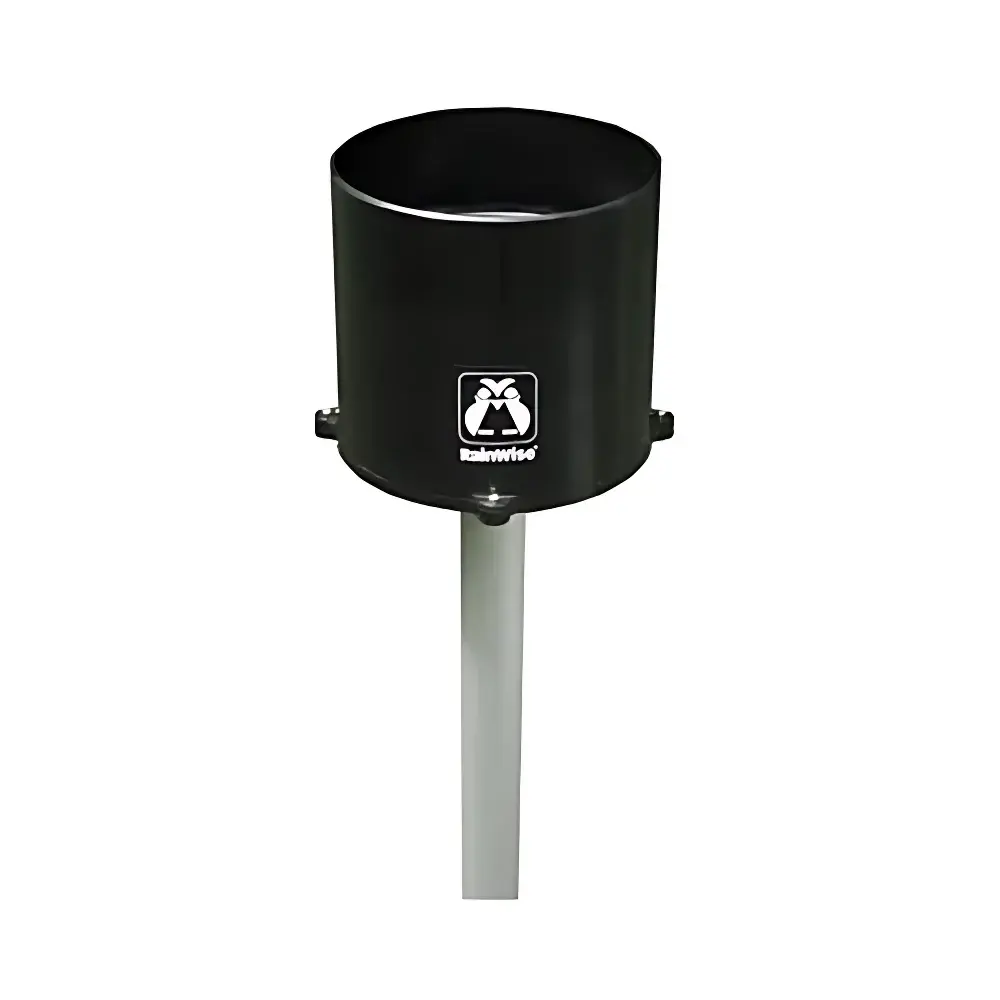
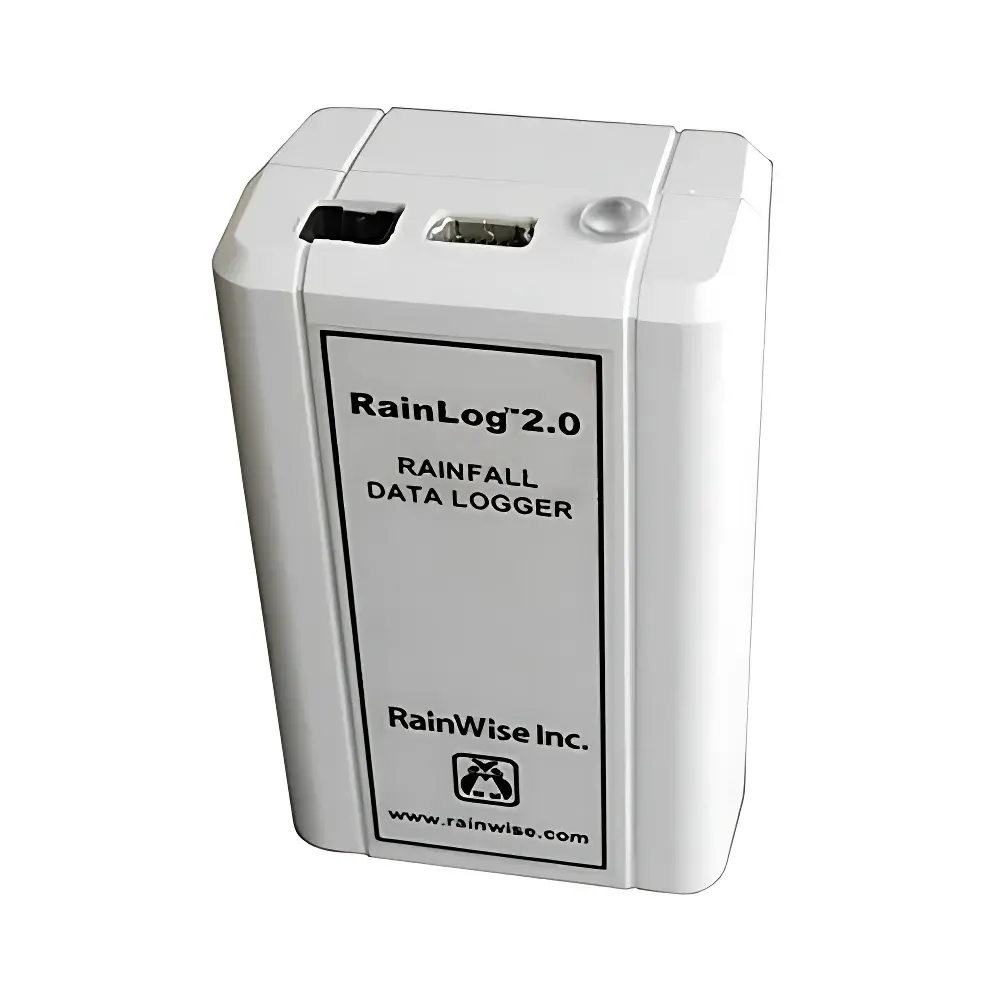
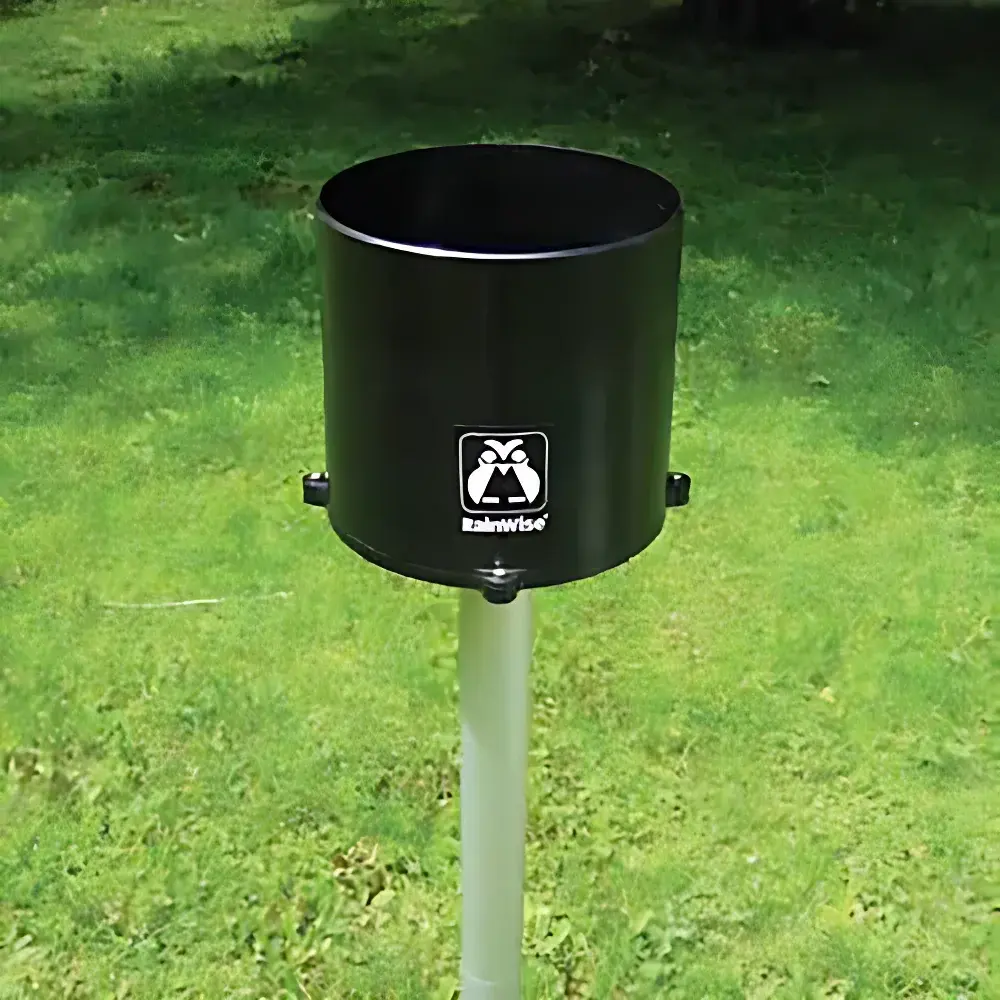
RainWise RainLog Portable Tipping-Bucket Rainfall Data Logger
| Brand | RainWise |
|---|---|
| Origin | USA |
| Model | RainLog |
| Power Supply | 2×AAA batteries (alkaline) or optional CR2477N lithium |
| Data Logging Interval | 60 s |
| Memory | Non-volatile EEPROM |
| Storage Capacity | ≥1 year at 1-min interval |
| Rain Collector | 8-inch tipping-bucket (polypropylene body, reed switch output) |
| Resolution | 0.25 mm per tip |
| Accuracy | ±1.5% at 12.5 mm/h |
| Pulse Output | <0.1 s duration, min. pulse width 10 ms, max. input frequency 100 Hz |
| Clock Accuracy | ±1 min/month |
| Operating Temperature | −40 to +60 °C (lithium), −18 to +55 °C (alkaline) |
| Operating Humidity | 0–100% RH, non-condensing |
| Communication Interface | USB 2.0 (standard), RS-232 (legacy variant) |
| Compliance | Designed for long-term unattended field deployment in accordance with ASTM D3624 and ISO 9060:2017 Class B rain gauge performance expectations |
Overview
The RainWise RainLog is a self-contained, low-power tipping-bucket rainfall data logger engineered for autonomous, year-round operation in remote or semi-permanent meteorological monitoring sites. It integrates a precision 8-inch diameter polypropylene tipping-bucket sensor with an embedded microcontroller-based data acquisition unit, enabling high-fidelity temporal resolution of precipitation events without external power or telemetry infrastructure. The device operates on the fundamental principle of mechanical displacement measurement: each 0.25 mm increment of collected rainfall triggers a calibrated bucket tip, generating a discrete electrical pulse captured and time-stamped by the onboard real-time clock. This pulse-counting architecture ensures traceable, linear accumulation independent of rainfall intensity—within specified dynamic range limits—and supports compliance with international observational standards for manual and automatic rain gauge classification (ISO 9060:2017 Class B, ASTM D3624).
Key Features
- Compact, weatherproof data logger housing designed for internal mounting within the RainCollector rain gauge assembly—minimizing exposure and simplifying field installation.
- Non-volatile EEPROM memory capable of storing over 525,600 timestamped rainfall events (one per minute for 12 months), eliminating data loss during power interruption.
- Low-energy design optimized for extended battery life: two standard AAA alkaline cells provide >12 months of continuous operation; optional high-capacity CR2477N lithium battery extends service life under sub-zero conditions.
- High-reliability reed-switch tipping mechanism with <10 ms minimum pulse width tolerance and 100 Hz maximum pulse handling rate—suitable for intense convective rainfall events.
- Integrated real-time clock with ±1 minute monthly drift specification, supporting accurate event timing for hydrological time-series analysis and storm-sequence reconstruction.
- USB 2.0 interface as standard (with legacy RS-232 support available), enabling direct connection to Windows-based host systems for configuration, firmware updates, and bulk data retrieval.
Sample Compatibility & Compliance
The RainLog system is compatible with all RainWise-branded tipping-bucket assemblies, including the standard RainCollector and industrial-grade RGA series. Its mechanical and electrical specifications align with widely adopted environmental monitoring frameworks: the 0.25 mm resolution and ±1.5% accuracy at 12.5 mm/h meet the performance thresholds defined in ISO 9060:2017 for Class B rain gauges, while its structural integrity and thermal operating envelope satisfy ASTM D3624 requirements for field-deployable precipitation sensors. The device does not require calibration certification for routine use but supports traceable verification through pulse-per-tip validation using certified volumetric dispensers. No regulatory certification (e.g., NIST-traceable calibration certificate) is included by default; however, third-party calibration services are available upon request.
Software & Data Management
Data configuration and retrieval are managed via WL-Loader, a free Windows desktop application distributed by RainWise. WL-Loader provides full control over logging interval, clock synchronization, memory reset, and data export in CSV, TXT, or graphical plot formats (time-series charts with customizable axes and units). For mobile field verification, RLmobile (discontinued but still supported) enabled PDA-based download and basic visualization—though modern deployments rely on USB-connected laptops or ruggedized tablets running Windows OS. All software-generated files retain native timestamping and pulse-count metadata, facilitating integration into larger environmental data management platforms (e.g., NOAA’s MADIS, EPA’s STORET, or custom SCADA systems) via scriptable import workflows. Audit trails are not natively generated; however, file creation timestamps and manual logbook entries may be used to satisfy GLP-aligned documentation practices where required.
Applications
- Long-term climatological monitoring networks requiring unattended, low-maintenance precipitation records across diverse biomes—from arctic tundra to tropical coastal zones.
- Hydrological modeling inputs for watershed-scale runoff estimation, flood forecasting, and reservoir inflow prediction.
- Agricultural water budgeting and irrigation scheduling in research farms and extension programs.
- Urban stormwater infrastructure assessment, including detention basin performance evaluation and sewer overflow event correlation.
- Educational field studies in atmospheric science, environmental engineering, and geography curricula where hands-on instrumentation experience is emphasized.
- Supplemental validation for radar-derived quantitative precipitation estimates (QPE) and satellite-based rainfall products.
FAQ
What is the maximum rainfall intensity the RainLog can accurately measure?
The tipping-bucket mechanism and electronics support reliable pulse capture up to 100 Hz—equivalent to approximately 900 mm/h for a 0.25 mm/tip collector—though sustained intensities above 12.5 mm/h may incur minor undercatch due to aerodynamic and wetting effects inherent to all exposed tipping-bucket designs.
Can the RainLog operate in freezing conditions?
Yes—when equipped with the CR2477N lithium battery, the unit functions continuously from −40 °C to +60 °C. However, ice accumulation on the collector funnel or bucket axis may impair mechanical response; heated or wind-shielded enclosures are recommended for persistent sub-zero deployments.
Is the RainLog compliant with FDA 21 CFR Part 11 or similar electronic record regulations?
No—the RainLog is not designed for regulated GxP environments and lacks electronic signature, audit trail, or user access control features required under 21 CFR Part 11 or EU Annex 11. It is intended for scientific and operational environmental monitoring only.
How is data integrity ensured during power loss or battery replacement?
All measurements are written directly to non-volatile EEPROM memory immediately upon pulse detection. Clock state and configuration parameters are also preserved across power cycles, ensuring no data or timebase corruption during battery changes.
Does the RainLog support wireless telemetry or cellular transmission?
No—wireless capability is not integrated. External telemetry must be implemented via third-party dataloggers (e.g., Campbell Scientific CR1000X) interfaced through the pulse output or RS-232 port.