
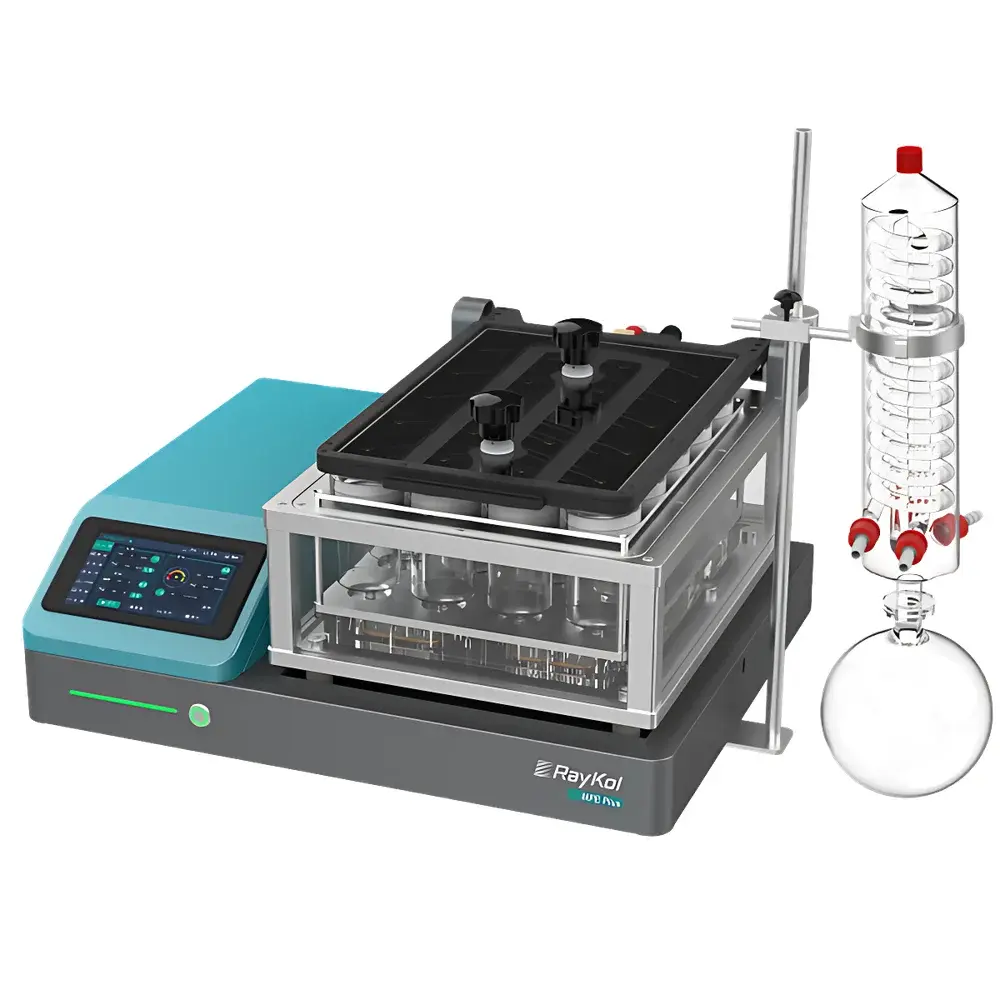
Raykol MPE Plus High-Throughput Vacuum Parallel Concentrator
| Brand | Raykol |
|---|---|
| Origin | Fujian, China |
| Manufacturer Type | Direct Manufacturer |
| Region of Origin | Domestic (China) |
| Model | MPE Plus |
| Instrument Type | Vacuum Parallel Concentrator |
| Maximum Sample Volume per Position | 260 mL |
Overview
The Raykol MPE Plus High-Throughput Vacuum Parallel Concentrator is an engineered solution for automated, reproducible solvent removal from multiple samples under controlled vacuum and temperature conditions. Designed for laboratories performing routine sample preparation in environmental, food safety, pharmaceutical, and forensic analysis, the MPE Plus operates on the principle of vacuum-assisted evaporation—reducing ambient pressure to lower the boiling point of solvents while maintaining thermal stability of analytes. Its core innovation lies in dynamic, multi-stage vacuum gradient control, which mitigates bumping and foaming during concentration—particularly critical for thermolabile compounds, viscous extracts, or mixed-solvent systems. Unlike single-sample rotary evaporators, the MPE Plus enables parallel processing of up to 24 samples (configurable via interchangeable racks), significantly improving throughput without compromising precision or method robustness.
Key Features
- Flip-Lid Vacuum Sealing Mechanism: Patented hinged vacuum cover engages with downward compression and upward rotation—enabling one-handed operation and consistent seal integrity across variable-height glass tubes (e.g., 15–250 mL culture tubes, test tubes, and custom borosilicate vials). Optional height-adjustable screw seals accommodate non-uniform tube batches.
- High-Throughput Sample Compatibility: Interchangeable sample racks support standard tube diameters (13 mm, 16 mm, 18 mm, 25 mm) and volumes up to 260 mL per position. Fixed flange-edge design ensures uniform compression force distribution and leak-free vacuum maintenance across all channels.
- Intelligent Volume Monitoring: Integrated infrared liquid-level sensor at the instrument base detects residual volume below 1 mL; triggers automatic endpoint recognition and system pause—critical for preserving trace analytes in final concentration stages.
- Tail-Tube Active Cooling: Dedicated coolant circulation module connects directly to sample rack tail-tubes, delivering chilled water (4–10 °C) to suppress post-evaporation degradation and extend analyte stability during extended hold times.
- Multi-Mode Vacuum Control: Three operational modes—manual, programmable (20-step pressure ramping), and frequency-inverter-driven pump control—allow precise adaptation to solvent volatility profiles (e.g., ethyl acetate vs. DMSO) and matrix complexity (e.g., soil extracts vs. plasma supernatants).
- Modular Condensate Management: Standard 3 L solvent collection bottle paired with >5 L total condensate capacity. Optional auto-drain condenser system enables staged separation of low-boiling fractions (e.g., hexane, dichloromethide) prior to high-boiling residue concentration—minimizing cross-contamination and carryover.
Sample Compatibility & Compliance
The MPE Plus accommodates a broad range of sample matrices—including aqueous extracts, organic solvent eluates, acid-digested environmental solids, and biological fluid supernatants—without requiring derivatization or pre-filtration. It supports workflows compliant with ISO/IEC 17025:2017 (general requirements for competence of testing and calibration laboratories), ASTM D7066-20 (standard practice for solvent removal in pesticide residue analysis), and USP (analytical instrument qualification). When operated with validated methods and audit-trail-enabled software (see Software & Data Management), it meets GLP and GMP documentation requirements for regulated environments including EPA Method 525.3, EU Directive 2002/63/EC, and China’s GB/T standards referenced in pharmacopoeial monographs.
Software & Data Management
The MPE Plus integrates with Raykol’s proprietary PC-based control software, supporting full method storage, real-time vacuum/temperature logging, and electronic signature capability. All parameter changes, run start/stop events, and alarm triggers are timestamped and stored with user ID attribution—ensuring compliance with FDA 21 CFR Part 11 for electronic records and signatures. Audit trails are exportable in CSV or PDF format for internal review or regulatory submission. Remote monitoring via Ethernet connection allows integration into centralized lab information management systems (LIMS) for automated data handoff to downstream GC-MS or LC-MS platforms.
Applications
The MPE Plus is routinely deployed in accredited laboratories conducting analyses aligned with pharmacopoeial and environmental regulatory frameworks, including but not limited to:
• Pesticide residue quantification per Chinese Pharmacopoeia (ChP) 2020 Vol. IV General Chapter 2341 (Method V)
• Semi-volatile organic compound (SVOC) determination in soil/sediment per HJ 834–2017
• Organochlorine pesticide analysis per HJ 835–2017
• Dioxin/furan congener profiling in air emissions and solid waste per HJ 77.2–2008 and HJ 77.3–2008
• Azo dye screening in textiles per GB/T 17592–2011 and EN 14362–2017
• Peroxide value and acid value determination in edible oils per GB 5009.227–2016 and GB 5009.229–2016
• Multi-residue pesticide screening in fruits/vegetables per GB 23200.8–2016
FAQ
What vacuum accuracy can be achieved during gradient-controlled runs?
The MPE Plus maintains pressure stability within ±0.5 mbar over programmed segments when used with the optional frequency-inverter vacuum pump.
Is the system compatible with corrosive solvents such as hydrochloric acid or trifluoroacetic acid?
Standard configuration uses PTFE-coated valves and stainless-steel condenser pathways; for extended exposure to strong acids or halogenated solvents, optional Hastelloy C-276 wetted parts are available upon request.
Can the MPE Plus be integrated into an automated sample preparation line?
Yes—RS-232 and Ethernet interfaces support bidirectional communication with robotic liquid handlers and autosamplers via Modbus TCP or custom API protocols.
Does the infrared volume sensor require calibration?
No; the sensor is factory-calibrated and drift-compensated through dual-wavelength detection—no user recalibration is needed under normal operating conditions.
What maintenance intervals are recommended for the vacuum pump and condenser system?
With daily use, oil change every 500 hours (for oil-lubricated pumps); cold trap cleaning every 200 runs; condenser coil inspection quarterly. Maintenance logs are automatically generated and archived in the software audit trail.



