
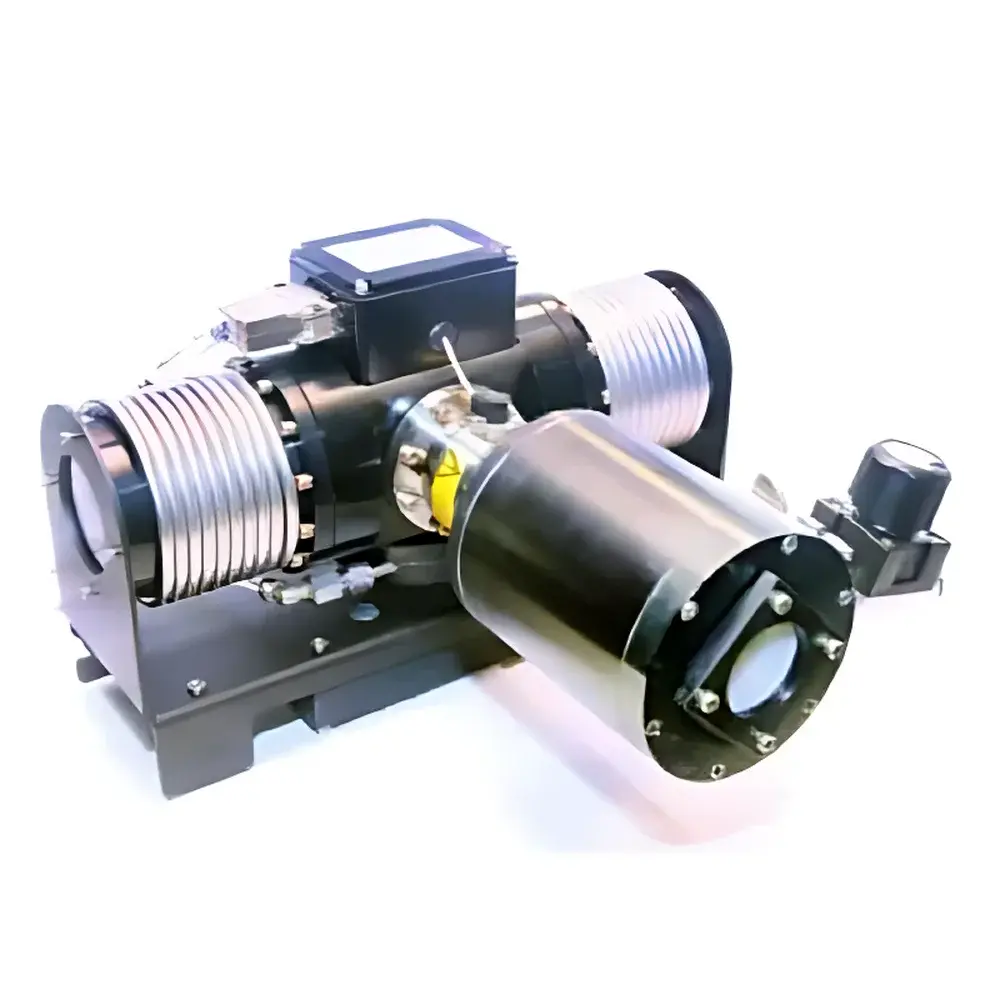
Rayscience QCL Series THz Quantum Cascade Laser System
| Brand | Rayscience |
|---|---|
| Origin | Canada |
| Manufacturer Type | Authorized Distributor |
| Origin Category | Imported |
| Model | QCL |
| Price Range | USD 70,000–140,000 (FOB) |
| Core Component | Semiconductor-based THz laser source with integrated Stirling cooler and driver |
Overview
The Rayscience QCL Series THz Quantum Cascade Laser System is a turnkey, continuous-wave (CW) and pulsed terahertz radiation source engineered for precision spectroscopy, gas sensing, detector characterization, and focal-plane array illumination. Operating in the 1.8–5.0 THz range—spanning the critical gap between mid-infrared and microwave regimes—the system leverages quantum cascade laser physics, where intersubband transitions in engineered semiconductor heterostructures generate coherent THz photons. Unlike photoconductive or optical rectification sources, QCLs deliver intrinsic narrow-linewidth emission with milliwatt-level average output power, high spectral stability, and direct electrical pumping. The system integrates a cryogen-free Stirling-cycle cooler, eliminating liquid helium or nitrogen dependencies while maintaining junction temperatures below 60 K—essential for suppressing non-radiative decay pathways and enabling sustained lasing at room-ambient operating conditions.
Key Features
- Cryogen-free operation: Integrated Stirling cooler provides closed-loop cooling to <60 K without consumables or external chiller infrastructure
- Turnkey usability: Pre-aligned optical path; no routine beam collimation, wavelength calibration, or cavity realignment required
- Flexible excitation modes: Selectable CW or pulsed operation with pulse widths adjustable from DC up to <200 ns via USB-controlled bias driver
- Modular QCL core: Interchangeable multi-mode QCL chips—each optimized for specific center frequencies (e.g., 1.8, 2.7, 3.9, 4.7 THz) and output power profiles (0.5–2 mW avg.)
- Compact footprint: Benchtop enclosure (≤450 × 350 × 200 mm) suitable for cleanroom integration, portable lab deployment, or OEM subsystem embedding
- Control interface: Native Windows-compatible software (XP/Vista/7) with USB 2.0 connectivity; supports manual bias adjustment and automated sweep protocols
Sample Compatibility & Compliance
The QCL system is compatible with standard THz time-domain spectroscopy (TDS) accessories, including silicon lens-coupled detectors, Golay cells, bolometric arrays, and gas absorption cells with path lengths from 10 cm to 10 m. Its non-ionizing, low-photon-energy output (4–16 meV) ensures safe interaction with biological tissues and organic thin films. The system complies with IEC 60825-1:2014 Class 3B laser safety requirements and meets CE marking directives for electromagnetic compatibility (EMC) and low-voltage equipment. While not inherently GLP/GMP-certified, its deterministic bias control, thermal stability (<±0.1 K), and reproducible output power enable traceable measurements aligned with ASTM E2912–21 (Standard Practice for THz Spectroscopic Characterization of Gaseous Analytes) and ISO/IEC 17025–2017 documentation workflows when paired with calibrated reference detectors.
Software & Data Management
The included Rayscience QCL Control Suite provides real-time monitoring of junction temperature, drive current, output power (via integrated thermopile sensor), and pulse timing parameters. Data export supports CSV and HDF5 formats for interoperability with MATLAB, Python (NumPy/SciPy), and LabVIEW environments. Audit trails record all user-initiated parameter changes, timestamps, and system health metrics—supporting 21 CFR Part 11–compliant electronic records when deployed within validated QA/QC laboratories. Firmware updates are delivered via secure HTTPS portal; no physical media or third-party drivers required.
Applications
- High-resolution rotational spectroscopy of polar gases (e.g., H2O, NH3, CH3OH) with MHz-level linewidth resolution
- Calibration and noise floor assessment of uncooled microbolometer arrays and pyroelectric THz detectors
- Non-destructive evaluation of polymer crystallinity, pharmaceutical tablet coating uniformity, and semiconductor dopant profiling
- Terahertz near-field microscopy illumination where diffraction-limited spot size demands high brightness and spatial coherence
- Development of frequency-agile THz systems—multi-module configurations support rapid spectral hopping across >3 THz bandwidth
FAQ
What cooling method does the QCL system use, and what is its typical base temperature?
It employs a single-stage Stirling cryocooler achieving stable junction temperatures ≤60 K without liquid cryogens.
Is wavelength tuning available across the full 1.8–5 THz range?
Standard modules are discrete-frequency; tunable variants (with ±10 GHz fine-tuning via temperature/current modulation) are under development and available on pre-order.
Can the system operate in vacuum or controlled-atmosphere enclosures?
Yes—the hermetically sealed laser head and compact driver allow integration into gloveboxes or vacuum chambers with feedthrough-rated USB and power connectors.
What is the beam divergence specification, and how is it managed optically?
FWHM divergence ranges from 5° to 35° depending on chip design and facet coating; collimation optics (aspheric Si lenses, f = 25–50 mm) are recommended and sold separately.
Does the system support synchronization with external measurement hardware (e.g., lock-in amplifiers or oscilloscopes)?
Yes—TTL-compatible trigger outputs and sync inputs are provided for gated detection, pump-probe experiments, and phase-locked loop integration.





