
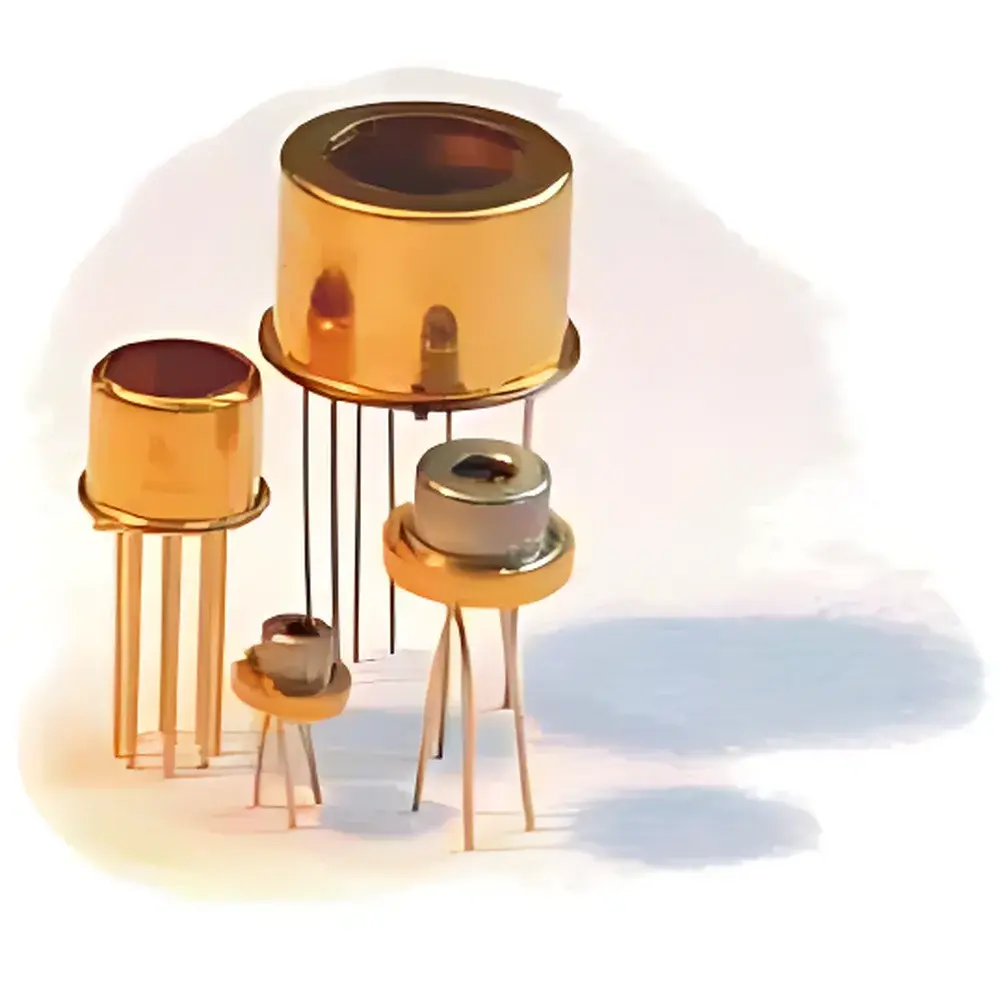
Rayscience QCL12500nm DFB Quantum Cascade Laser
| Brand | Rayscience |
|---|---|
| Origin | Shanghai, China |
| Manufacturer Type | Authorized Distributor |
| Product Origin | Domestic (PRC) |
| Model | QCL12500nm |
| Pricing | Available Upon Request |
| Wavelength | 12.5 μm |
| Operating Mode | Pulsed |
| Max Operating Temperature | 250 K |
| SMSR | >30 dB (typ.) |
| Spectral Linewidth | <0.001 cm⁻¹ (FWHM) |
| Beam Divergence (Parallel) | 35–45° |
| Beam Divergence (Perpendicular) | 55–65° |
| Emitting Area | 8 × 20 µm |
| Threshold Current (Ith) | 4.0–5.0 A |
| Forward Current (If) | 4.5–5.5 A |
| Optical Output Power (Popt) | 1–3 mW |
| Slope Efficiency (η) | 0.7–1.5 mW/A |
| Temperature Tuning Rate (CT) | 0.4–0.6 nm/K |
| Pulse Width (Δt) | 100–150 ns |
| Repetition Rate (f) | Up to 100 kHz |
Overview
The Rayscience QCL12500nm DFB Quantum Cascade Laser is a single-mode, distributed feedback mid-infrared laser source engineered for high-precision molecular spectroscopy and trace gas detection. Operating at a center wavelength of 12.5 µm (799.5 cm⁻¹), it leverages the quantum cascade gain mechanism—based on intersubband transitions in engineered AlInAs/GaInSb heterostructures—to deliver narrow-linewidth, temperature-tunable emission in pulsed operation. Unlike interband diode lasers, QCLs operate under unipolar carrier transport, enabling room-temperature-compatible cryogenic cooling (≤250 K) while maintaining high spectral purity and low-amplitude noise. This device is specifically optimized for applications requiring high side-mode suppression ratio (SMSR >30 dB) and stable wavelength referencing—critical for absorption spectroscopy of fundamental vibrational-rotational bands of gases such as CO₂, CH₄, NO₂, SO₂, and volatile organic compounds (VOCs) in the fingerprint region of the MIR spectrum.
Key Features
- Single-frequency DFB architecture with integrated grating for inherent wavelength stability and mode selectivity
- High SMSR (>30 dB typical) ensures minimal interference from adjacent longitudinal modes during high-resolution spectroscopic scans
- Pulsed operation (100–150 ns pulse width, up to 100 kHz repetition rate) enables time-gated detection and thermal management optimization
- Temperature-tunable output (0.4–0.6 nm/K tuning coefficient) allows precise scanning across absorption line profiles without mechanical tuning elements
- Compact TO-66 or HHL package options compatible with standard thermoelectric coolers (TECs) and optical alignment fixtures
- Robust electrical specifications: threshold current 4.0–5.0 A; forward current rating up to 7 A absolute maximum; slope efficiency 0.7–1.5 mW/A
- Controlled beam ellipticity (divergence: 35–45° parallel, 55–65° perpendicular) facilitates efficient coupling into multipass gas cells or hollow-core fibers
Sample Compatibility & Compliance
This QCL is designed for integration into laboratory-grade and field-deployable gas sensing platforms—including extractive and open-path configurations—and meets mechanical and electrical interface requirements for OEM system integration. While not certified as a standalone medical or industrial safety device, its performance parameters align with key spectroscopic standards including ASTM E1421 (standard practice for calibration of FTIR spectrometers), ISO 14001 environmental monitoring guidelines, and US EPA Method TO-16 for ambient air VOC analysis. The device operates within GLP-compliant instrument control environments when paired with validated driver electronics and calibrated reference cells. Storage and operational temperature ranges (0–370 K storage; ≤250 K operating) comply with IEC 60068-2 environmental testing protocols for semiconductor optoelectronic components.
Software & Data Management
Rayscience provides comprehensive driver firmware and LabVIEW-compatible SDKs for real-time current pulsing, temperature ramping, and synchronization with lock-in amplifiers or digitizers. All drivers support analog modulation inputs (0–5 V) for fast wavelength dithering and digital trigger inputs for external timing control. Audit trails—including timestamped current/voltage logs, TEC setpoint history, and pulse parameter metadata—are exportable in CSV or HDF5 format to support 21 CFR Part 11–compliant data integrity workflows. Optional software modules enable automated spectral line fitting (Voigt profile deconvolution), concentration inversion via Beer–Lambert modeling, and cross-sensitivity compensation using multi-wavelength QCL arrays.
Applications
- High-sensitivity trace gas detection in environmental monitoring stations (e.g., urban air quality, landfill emissions)
- In situ combustion diagnostics in aerospace and energy research (CO, NOₓ, H₂O vapor quantification)
- Pharmaceutical headspace analysis for residual solvent detection (e.g., acetone, ethanol, dichloromethane)
- Industrial process control for semiconductor fab ambient monitoring (NF₃, SiF₄, HF)
- Fundamental molecular physics studies requiring sub-Doppler resolution in supersonic jet expansions
- Calibration source for Fourier-transform infrared (FTIR) spectrometers and cavity-enhanced absorption systems
FAQ
What cooling method is required to operate this QCL?
Active thermoelectric cooling (TEC) is mandatory; the device must be maintained at ≤250 K for stable single-mode operation. Liquid nitrogen dewars or closed-cycle cryocoolers are not required but may extend lifetime under continuous high-duty-cycle conditions.
Is wavelength calibration traceable to NIST standards?
Yes—each unit is factory-characterized against a stabilized CO₂ reference cell (NIST-traceable line at 12.503 µm) and shipped with a calibration certificate listing measured center wavelength, SMSR, and tuning slope at multiple temperatures.
Can this laser be operated in continuous-wave (CW) mode?
No—this specific QCL12500nm variant is designed exclusively for pulsed operation. CW versions require different waveguide design and heat-sinking architecture and are available under separate model numbers.
What optical interfaces are supported for beam delivery?
The emitter is compatible with standard aspheric collimators (f = 4 mm, NA = 0.55) and anamorphic prism pairs for circularization. Fiber coupling is achievable using chalcogenide (e.g., AMTIR-1) or fluoride (e.g., InF₃) mid-IR fibers with appropriate AR coatings.
Does Rayscience offer system-level integration support?
Yes—application engineering services include optical layout review, driver selection guidance, spectral simulation (using HITRAN-based models), and validation testing against target analytes in certified gas mixtures.




