
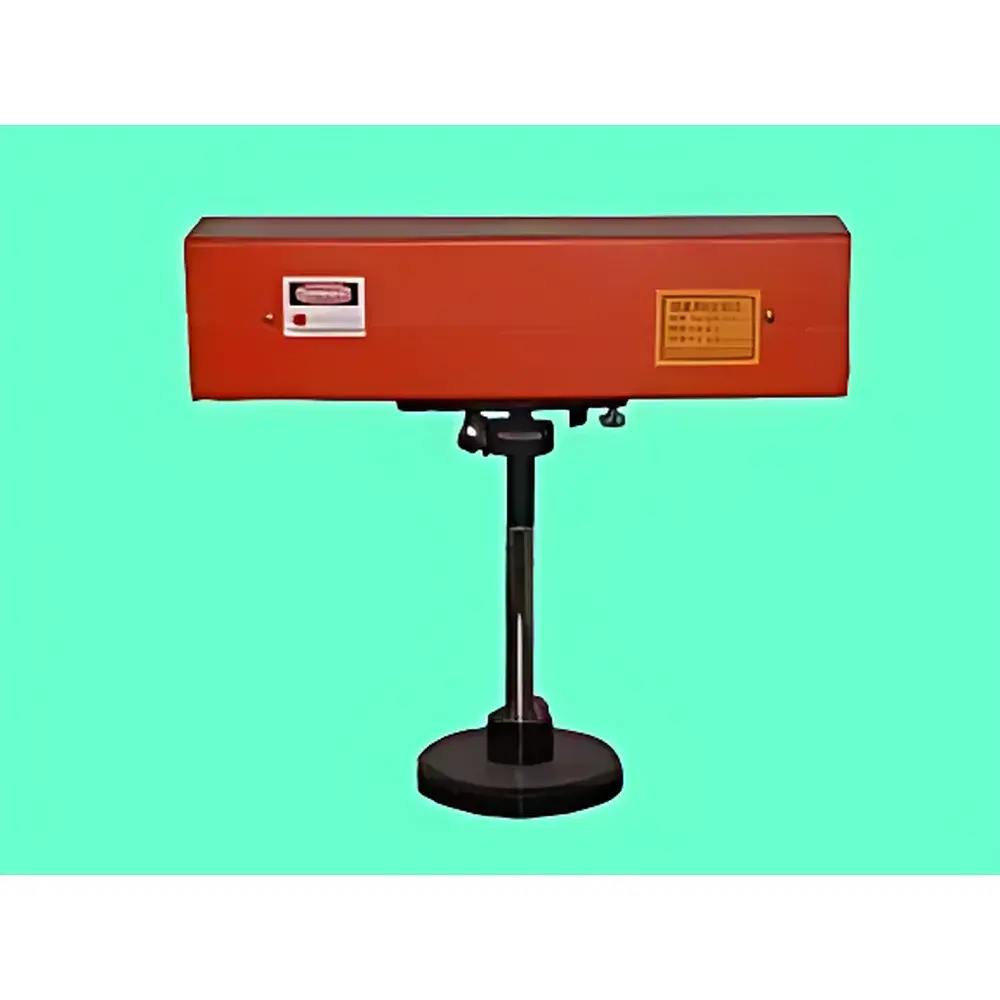
Rayscience RSHN-250 Low-Power Helium-Neon Laser
| Brand | Rayscience |
|---|---|
| Origin | Shanghai, China |
| Model | RSHN-250 |
| Wavelength | 632.8 nm |
| Mode | TEM₀₀ (Single-Mode) |
| Output Power | ≥2 mW |
| Beam Diameter (1/e²) | ≤1.3 mm |
| Beam Divergence | ≤1.3 mrad |
| Operating Current | 5 mA |
| Power Stability | <±5% per hour |
| Input Voltage | 220 V AC, 50 Hz |
| Max. Output Voltage | 7 kV |
| Adjustable Beam Height Range | 280–400 mm (customizable) |
| Pitching Angle | ±15° |
| Tube Construction | Double-precision molded bore |
| Power Supply Type | Switch-mode high-voltage DC supply |
Overview
The Rayscience RSHN-250 is a low-power, continuous-wave (CW) helium-neon (He-Ne) laser engineered for precision optical applications requiring high spatial coherence, spectral purity, and long-term amplitude stability. Operating at the fundamental emission line of 632.8 nm in the visible red spectrum, this laser delivers TEM₀₀ Gaussian beam output with diffraction-limited quality—ideal for interferometric setups, holographic recording, confocal fluorescence excitation, and calibration-grade spectroscopic alignment. Its design follows classical gas discharge laser architecture, utilizing a sealed, low-pressure He-Ne gas mixture within a thermally stabilized plasma tube. The double-precision molded discharge bore ensures mechanical and thermal uniformity across the gain medium, directly contributing to single-transverse-mode dominance and reduced mode-hopping under ambient temperature fluctuations. Unlike diode lasers, the RSHN-250 offers intrinsic wavelength stability (<0.002 nm drift over 8 hours) without active wavelength locking, making it suitable for applications where passive spectral fidelity is critical—such as metrology traceability, educational optics labs, and reference source validation in ISO/IEC 17025-accredited facilities.
Key Features
- TEM₀₀ Gaussian beam profile with M² < 1.1, verified via ISO 11146-compliant beam profiling
- Double-precision molded plasma tube enabling reproducible mode structure and extended operational lifetime (>20,000 hours typical)
- Integrated switch-mode high-voltage power supply: lightweight (≤1.8 kg), low EMI emission, and wide input voltage tolerance (±10% of 220 V AC, 50 Hz)
- Passive thermal stabilization architecture—no active cooling or Peltier elements required
- Adjustable optical bench mounting: vertical beam height configurable between 280 mm and 400 mm; pitch angle adjustable ±15° for precise angular alignment
- Compliance-ready mechanical interface: standard 1/4″-20 and M6 threaded mounting holes on base plate for integration into OEM optical tables and automated stages
Sample Compatibility & Compliance
The RSHN-250 is not a sample-dependent instrument but serves as a stable illumination or reference source in optical measurement chains. It is routinely deployed in systems compliant with ASTM E284 (Standard Terminology of Appearance), ISO 13694 (Laser beam parameters — Beam widths and divergence angles), and IEC 60825-1:2014 (Laser product safety). Its Class 3R classification (IEC 60825-1) requires nominal hazard zone (NHZ) assessment per ANSI Z136.1 when used outside enclosed beam paths. The laser meets RoHS Directive 2011/65/EU for hazardous substance restrictions and carries CE marking for electromagnetic compatibility (EN 61326-1) and low-voltage safety (EN 61010-1). For GLP/GMP environments, optional audit-trail-capable power logging modules (sold separately) support 21 CFR Part 11-compliant usage records when paired with validated data acquisition software.
Software & Data Management
The RSHN-250 operates as a standalone analog device with no embedded firmware or digital control interface. However, its analog output monitor signal (0–5 V proportional to optical power) enables integration with third-party DAQ systems—including National Instruments LabVIEW, MATLAB Data Acquisition Toolbox, and Keysight PathWave. Users may log power stability, ambient temperature correlation, and runtime statistics using calibrated photodiode sensors (e.g., Thorlabs S120VC) and time-stamped acquisition scripts. While the laser itself does not store operational history, its consistent output behavior allows for long-term drift modeling in calibration databases—particularly valuable in university teaching labs maintaining NIST-traceable reference archives.
Applications
- Holography: Coherent illumination for transmission and reflection hologram recording with fringe visibility >0.92
- Confocal microscopy: Alignment and focus verification source; compatible with pinhole-based detection architectures
- Spectroscopy: Wavelength reference for grating calibration and spectrometer linearity verification (e.g., against known neon emission lines)
- Optical metrology: Interferometer alignment (Michelson, Twyman-Green), autocollimator calibration, and beam profiler validation
- Actinochemistry & photobiology: Controlled irradiation source for dose-response studies requiring monochromatic 632.8 nm exposure
- Undergraduate and graduate optics education: Hands-on demonstration of laser cavity modes, Brewster angle polarization, and Gaussian beam propagation
FAQ
What is the expected lifetime of the RSHN-250 laser tube?
Typical operational lifetime exceeds 20,000 hours under recommended current (5 mA) and ambient temperature conditions (15–30 °C). Degradation manifests gradually as reduced output power and increased mode instability—not sudden failure.
Is the RSHN-250 compatible with vacuum or inert-gas environments?
No—the laser head is not hermetically sealed for external pressure differentials. It must operate at atmospheric pressure with standard laboratory air circulation.
Can the beam height be customized beyond 400 mm?
Yes—custom base extensions are available upon request; lead time and mechanical load specifications apply.
Does Rayscience provide factory calibration certificates?
Yes—each unit ships with a traceable calibration report documenting output power, beam diameter, divergence, and power stability measured per ISO 11554, referenced to NIST-traceable photodetectors.
How does the RSHN-250 compare to diode-pumped solid-state (DPSS) 633 nm lasers?
Unlike DPSS sources, the RSHN-250 offers inherent longitudinal mode stability, lower relative intensity noise (<0.3% RMS, 10 Hz–10 MHz), and no green-noise artifacts—making it preferred for high-fidelity interferometry and holography where phase coherence duration matters.





