
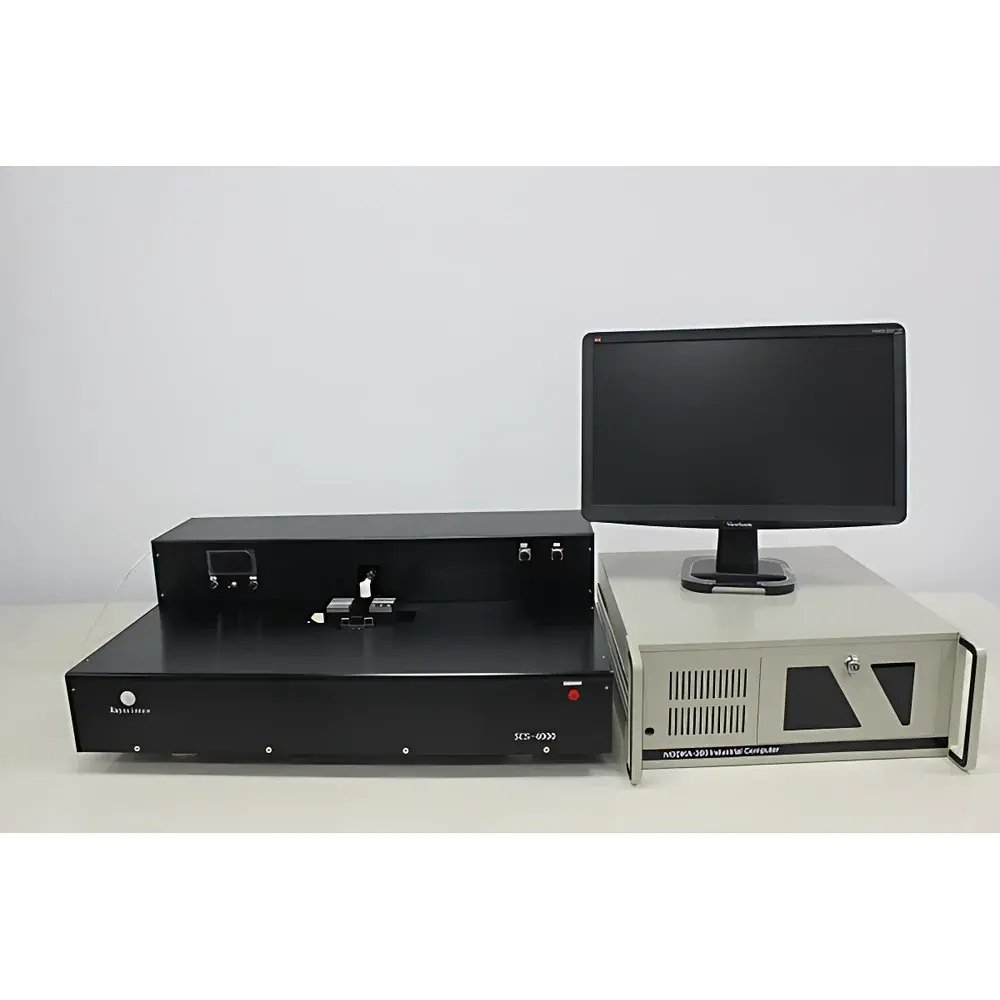
Rayscience SCS4000PM Polarization-Maintaining Fiber Coupler Fusion Tapering System
| Brand | Rayscience |
|---|---|
| Origin | Shanghai, China |
| Model | SCS4000PM |
| Tapering Precision | ±0.2 µm |
| Max. Biaxial Drawing Distance | 80 mm |
| Fiber Clamping Range | φ0.1–0.5 mm |
| Flame Axial Oscillation | 0–20 mm |
| Flame Translation Speed | 0–4 mm/s |
| H₂ Flow Rate | 0–500 SCCM (adjustable) |
| O₂ Flow Rate | 0–200 SCCM (adjustable) |
| Heating Zone Temperature Control | 0–200 °C (encapsulation) |
| Detector Options | InGaAs (800–1700 nm), Si (400–1000 nm), Ge (1000–1800 nm) |
| Light Sources | 1310/1550 nm FP laser (1 mW), 633 nm HeNe (2 mW), 850/1310 nm multimode LD (optional) |
| Power Supply | 220 V AC, 6 A |
Overview
The Rayscience SCS4000PM Polarization-Maintaining Fiber Coupler Fusion Tapering System is an engineered platform for the precision fabrication of polarization-maintaining (PM) fiber couplers and tapered fiber waveguides via the fusion-tapering technique. It operates on the principle of controlled thermal drawing under inert or reactive gas environments—specifically hydrogen-oxygen flame heating—to induce adiabatic tapering of stripped PM fibers. During the process, two or more PM fibers are aligned, rotationally oriented to match their stress axes (e.g., slow/fast axes), fused under localized high-temperature heating, and simultaneously drawn apart at sub-micron resolution. This yields a biconical coupling region where evanescent field overlap enables wavelength-selective power splitting while preserving polarization extinction characteristics. The system is purpose-built for R&D laboratories and photonics manufacturing facilities requiring reproducible, low-loss, high-extinction-ratio PM couplers operating at telecom wavelengths (1310 nm and 1550 nm), with full support for custom taper profiles, asymmetric splitting ratios, and post-fabrication encapsulation.
Key Features
- Sub-micron mechanical control: High-resolution biaxial drawing stage with ±0.2 µm positional accuracy, enabled by imported linear slide rails and precision ground ball screws (2 mm pitch).
- Stable, uniform flame heating: Proprietary coaxial H₂/O₂ burner design—inner hydrogen core surrounded by outer oxygen sheath—eliminates thermal drift associated with dual-oxygen configurations and ensures repeatable axial temperature profiles across the taper zone.
- Configurable gas delivery: Dual mass flow controllers (MFCs) for independent, digitally regulated H₂ (0–500 SCCM) and O₂ (0–200 SCCM) supply, synchronized with draw speed and flame position.
- Modular optical monitoring: Optional integrated CCD imaging system for real-time visualization of fiber alignment, axis matching, and taper evolution—critical for PM fiber rotational registration and burn consistency.
- Multi-wavelength in-situ characterization: Selectable detector modules (InGaAs, Si, Ge) covering 400–1800 nm, paired with optional broadband or single-wavelength sources (1310/1550 nm FP lasers, 633 nm HeNe, multimode LDs) for live transmission and extinction ratio measurement during tapering.
- Flexible packaging integration: On-platform thermal curing stage (0–200 °C) supporting both epoxy-based heat-curing and optional UV-curable encapsulants, ensuring mechanical stability and environmental robustness of final devices.
Sample Compatibility & Compliance
The SCS4000PM accommodates standard and specialty PM fibers with cladding diameters from 125 µm to 500 µm—including PANDA, Bow-Tie, and elliptical-clad designs—via customizable clamping fixtures. All motion control, gas regulation, and thermal subsystems conform to IEC 61000-6-2 (EMC immunity) and IEC 61000-6-4 (EMC emissions) standards. Software architecture supports audit-trail logging per GLP/GMP requirements, with timestamped parameter records (draw length, flame position, gas flows, detected power) exportable in CSV format. While not certified to ISO 17025, the system is routinely deployed in ISO 9001-certified photonics production environments for process development and qualification runs.
Software & Data Management
The proprietary tapering control software provides closed-loop coordination of mechanical, thermal, and optical subsystems. Users define taper trajectory profiles—including linear, exponential, or user-defined draw-speed vs. length functions—and map them to corresponding flame oscillation amplitude, gas flow setpoints, and real-time power feedback thresholds. All operational parameters are logged with millisecond resolution; raw photodetector voltage traces, motor encoder positions, and MFC outputs are time-synchronized and stored in binary + ASCII formats. Exported datasets are compatible with MATLAB, Python (NumPy/Pandas), and LabVIEW for post-process modeling of coupling efficiency, phase-matching conditions, and birefringence evolution. No cloud connectivity or remote access features are implemented—data remains local to ensure lab network security and IP protection.
Applications
- Development of polarization-diverse interferometric sensors (e.g., fiber optic gyroscopes, current sensors)
- Fabrication of high-extinction-ratio PM splitters for coherent detection systems and quantum optics experiments
- Research into adiabatic mode conversion in asymmetric tapers for LP₀₁–LP₁₁ coupling
- Prototyping of wavelength-flattened PM couplers for DWDM component integration
- Process validation of PM fiber splicing and tapering for aerospace-grade avionics harnesses
- Education and training in guided-wave photonics, nonlinear optics, and fiber device physics
FAQ
What types of polarization-maintaining fibers are supported?
Standard PANDA and Bow-Tie fibers with 125 µm cladding are fully supported; custom fixtures enable handling of 250 µm coated or 500 µm jacketed PM fibers.
Can the system produce non-50:50 splitting ratios?
Yes—splitting ratios from 1:99 to 99:1 are achievable through precise control of draw length, flame temperature, and initial fiber separation.
Is real-time extinction ratio monitoring possible during tapering?
Yes—when equipped with InGaAs detector and 1310/1550 nm source, the system calculates ER in real time using orthogonal polarization state interrogation and logs it synchronously with mechanical parameters.
Does the system comply with FDA 21 CFR Part 11 for electronic records?
No—the software does not include electronic signatures, audit trail encryption, or role-based access control required for Part 11 compliance; however, raw data files meet ALCOA+ principles for traceability.
What maintenance is required for the hydrogen-oxygen burner?
Quarterly inspection of nozzle integrity and MFC calibration verification is recommended; no consumable parts require replacement under normal operation within specified flow ranges.





