
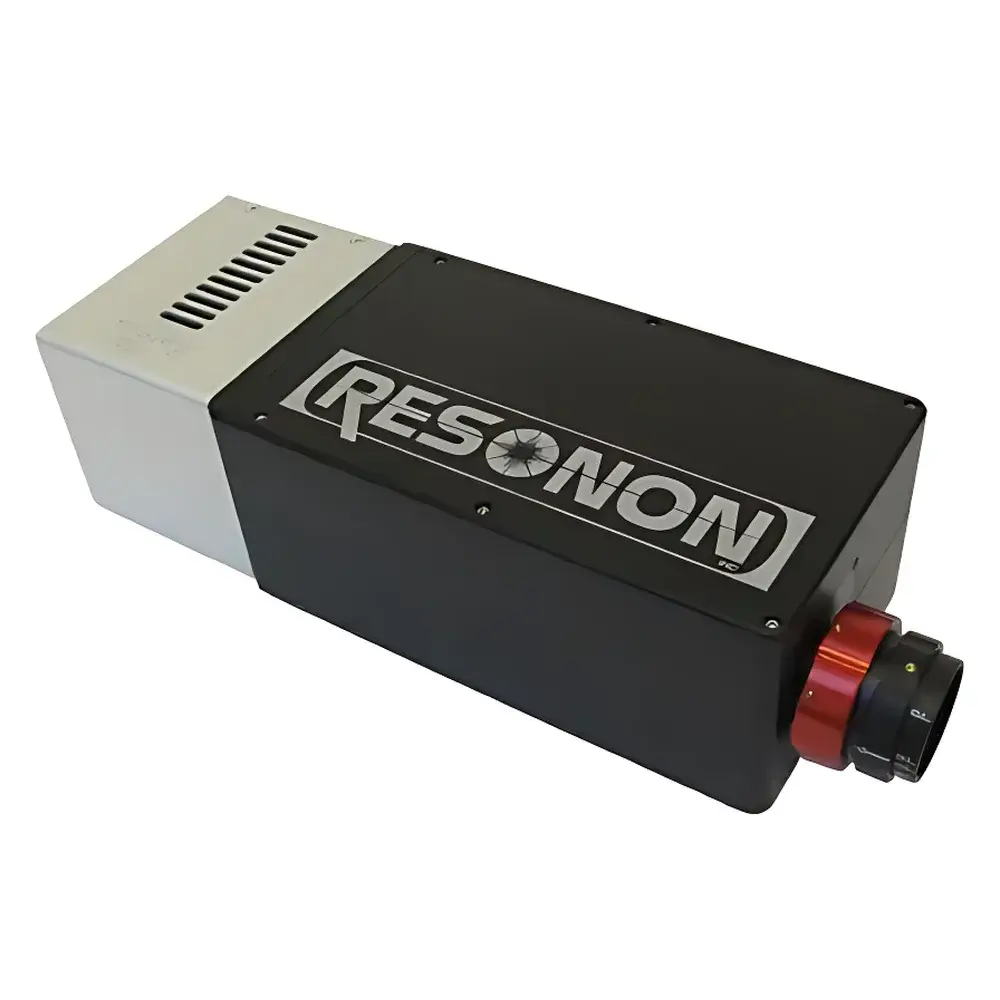
Resonon Pika NIR Hyperspectral Imaging Spectrometer
| Brand | Resonon |
|---|---|
| Origin | USA |
| Model | Pika NIR |
| Operating Principle | Push-broom |
| Imaging Method | Dispersive |
| Platform Compatibility | Ground-based & Airborne |
| Spectral Range | 900–1700 nm |
| Spectral Resolution | 4.9 nm |
| Spatial Channels | 3200 |
| Field of View (TFOV) | 7.3°, 11°, 22°, or 90° (selectable) |
| Instantaneous Field of View (IFOV) | 0.4, 0.6, 1.2, or 6.3 mrad |
| Frame Rate | 520 fps |
| Spectral Bands | 164 |
| Bit Depth | 14-bit |
| Interface | GigE Vision |
| Weight | 2.7 kg |
| Dimensions | 11.0 × 29.6 × 8.9 cm |
| Operating Temperature | 5–40 °C |
| Aperture | f/1.8 |
| RMS Spot Radius (avg.) | 10 µm |
| Smile (peak-to-peak) | 10 µm |
| Keystone (peak-to-peak) | 10 µm |
Overview
The Resonon Pika NIR is a high-performance, push-broom hyperspectral imaging spectrometer engineered for precision spectral-spatial data acquisition in the short-wave infrared (SWIR) region. Based on dispersive prism-grating optics and optimized for minimal optical aberrations, it captures contiguous spectral bands across 900–1700 nm with 4.9 nm spectral resolution and 164 calibrated spectral channels. Its push-broom architecture enables synchronized line-scanning acquisition—ideal for integration with ground-based scanning stages, UAV gimbals, or fixed-mount laboratory setups. Designed for scientific rigor and field-deployable robustness, the Pika NIR delivers radiometrically calibrated data traceable to NIST standards, supporting quantitative reflectance, absorption, and spectral unmixing workflows in environmental monitoring, agricultural phenotyping, mineral identification, and industrial quality control.
Key Features
- Low-Aberration Optical Design: Engineered with diffraction-limited optics; peak-to-peak smile and keystone distortion each limited to ≤10 µm, ensuring spatial-spectral fidelity across the full FOV.
- High Radiometric Stability: Integrated factory-applied radiometric calibration enables absolute reflectance quantification without post-acquisition empirical correction.
- Optimized SWIR Sensitivity: f/1.8 aperture and low-stray-light optical path maximize photon collection efficiency in the 900–1700 nm band, delivering high signal-to-noise ratio (SNR) even under low-illumination conditions.
- Modular Platform Integration: Compact form factor (11.0 × 29.6 × 8.9 cm) and lightweight construction (2.7 kg) support seamless integration into UAV payloads, robotic arms, conveyor-mounted inspection systems, and benchtop spectroscopic stations.
- Real-Time Acquisition Performance: GigE Vision interface supports sustained frame rates up to 520 fps at full spatial resolution (3200 pixels per line), enabling high-throughput scanning of dynamic or large-area targets.
- Standardized Data Output: Outputs 14-bit raw digital numbers (DN) with metadata embedded per frame (wavelength array, exposure time, temperature, GPS timestamp when synchronized), compliant with HDF5 and ENVI-compatible BIL/BIP formats.
Sample Compatibility & Compliance
The Pika NIR accommodates diverse sample geometries and measurement configurations—including reflective surface mapping, transmitted light analysis (with appropriate illumination geometry), and stand-off remote sensing. Its selectable TFOV (7.3° to 90°) and IFOV (0.4–6.3 mrad) allow optimization for macro-scale crop canopy surveys or micro-scale material defect detection. The instrument complies with CE marking requirements for electromagnetic compatibility (EMC Directive 2014/30/EU) and RoHS 2011/65/EU. While not certified as medical or safety-critical equipment, its radiometric output supports method validation per ASTM E131–22 (Standard Terminology Relating to Molecular Spectroscopy) and ISO 18387:2015 (Hyperspectral imaging — Vocabulary and performance parameters).
Software & Data Management
The system ships with SpectrononPro v4.x—a modular, scriptable software suite supporting real-time preview, acquisition control, geometric correction, spectral library matching, and pixel-level classification (e.g., SVM, SAM, MAF). Raw data ingestion, batch processing, and export to MATLAB, Python (via resononpy API), or ENVI are fully supported. All calibration files (radiometric, spectral, geometric) are stored internally and applied automatically during acquisition. Audit-trail logging—including user actions, parameter changes, and timestamped calibration events—is enabled by default, satisfying GLP-aligned documentation requirements for regulated laboratories. Data integrity is reinforced via checksum-verified file writes and optional encrypted storage modes.
Applications
- Agricultural Remote Sensing: Detection of water stress, nitrogen status, and disease onset via SWIR-based vegetation indices (e.g., NDWI, SRWI, CAI).
- Geological & Mining Surveying: Identification of clay minerals (kaolinite, smectite), carbonates, sulfates, and hydroxides using diagnostic absorption features near 1400, 1900, and 2200 nm.
- Pharmaceutical Solid-State Analysis: Quantitative mapping of polymorphic distribution and excipient homogeneity in tablet coatings and granules.
- Recycling & Waste Sorting: Discrimination of polymer types (PET, HDPE, PVC) and composite materials based on C–H and O–H overtone signatures.
- Food Quality Assurance: Non-destructive assessment of sugar content, moisture distribution, and bruising in fruits and vegetables.
FAQ
Is the Pika NIR compatible with third-party flight controllers or autopilots?
Yes—it supports hardware-triggered acquisition via TTL pulse input and can synchronize with PX4, ArduPilot, or DJI SDKs using custom middleware. GPS/IMU data fusion is achievable through NMEA 0183 or MAVLink packet injection.
Does the system require external calibration sources during routine operation?
No. Factory radiometric calibration is stable over the specified operating temperature range (5–40 °C); however, periodic verification using a NIST-traceable reflectance standard (e.g., Spectralon®) is recommended for critical QA/QC applications.
Can spectral data be exported for machine learning model training?
Yes. SpectrononPro exports spectra in CSV and HDF5 formats with wavelength metadata. Python bindings enable direct integration with scikit-learn, TensorFlow, and PyTorch pipelines for supervised classification or regression modeling.
What is the typical radiometric uncertainty across the spectral range?
At 23 °C and 100 ms integration time, relative radiometric uncertainty is ≤3.5% (k=2) between 950–1650 nm, validated against calibrated tungsten-halogen and blackbody sources per ISO/IEC 17025 procedures.





