
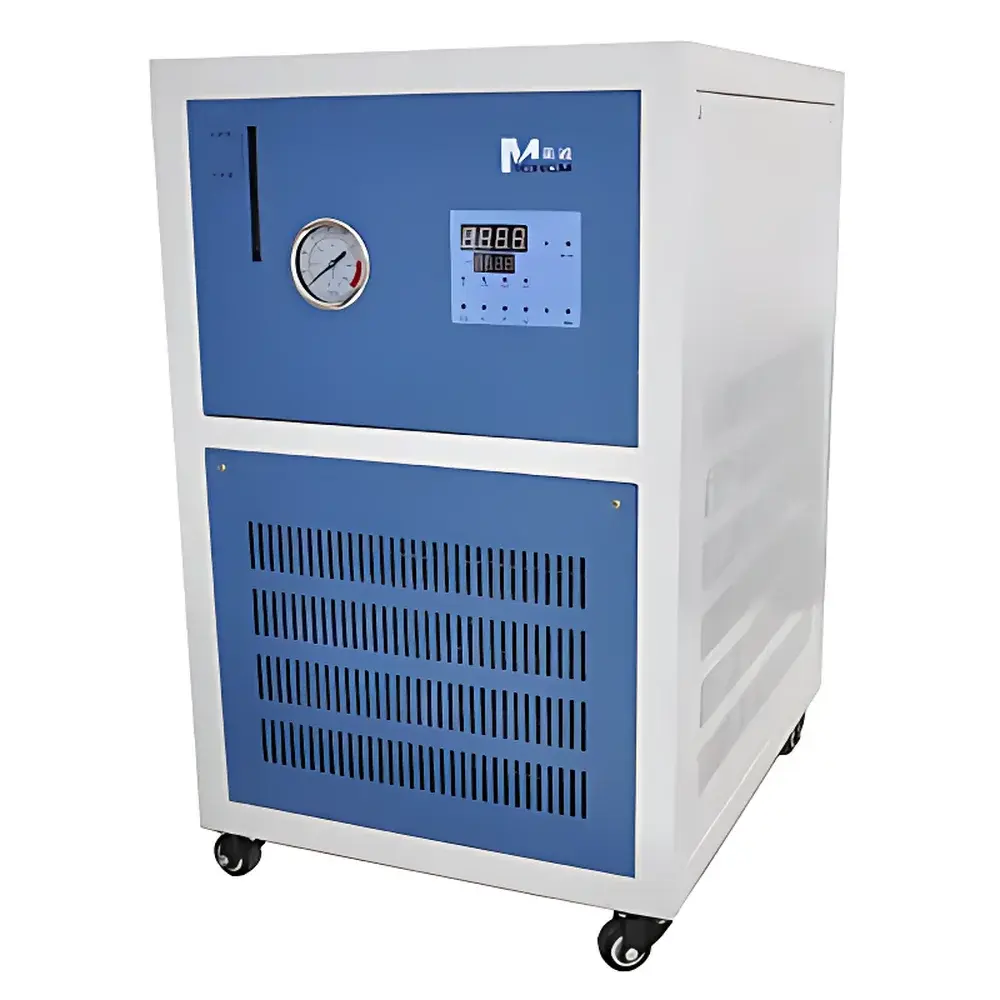
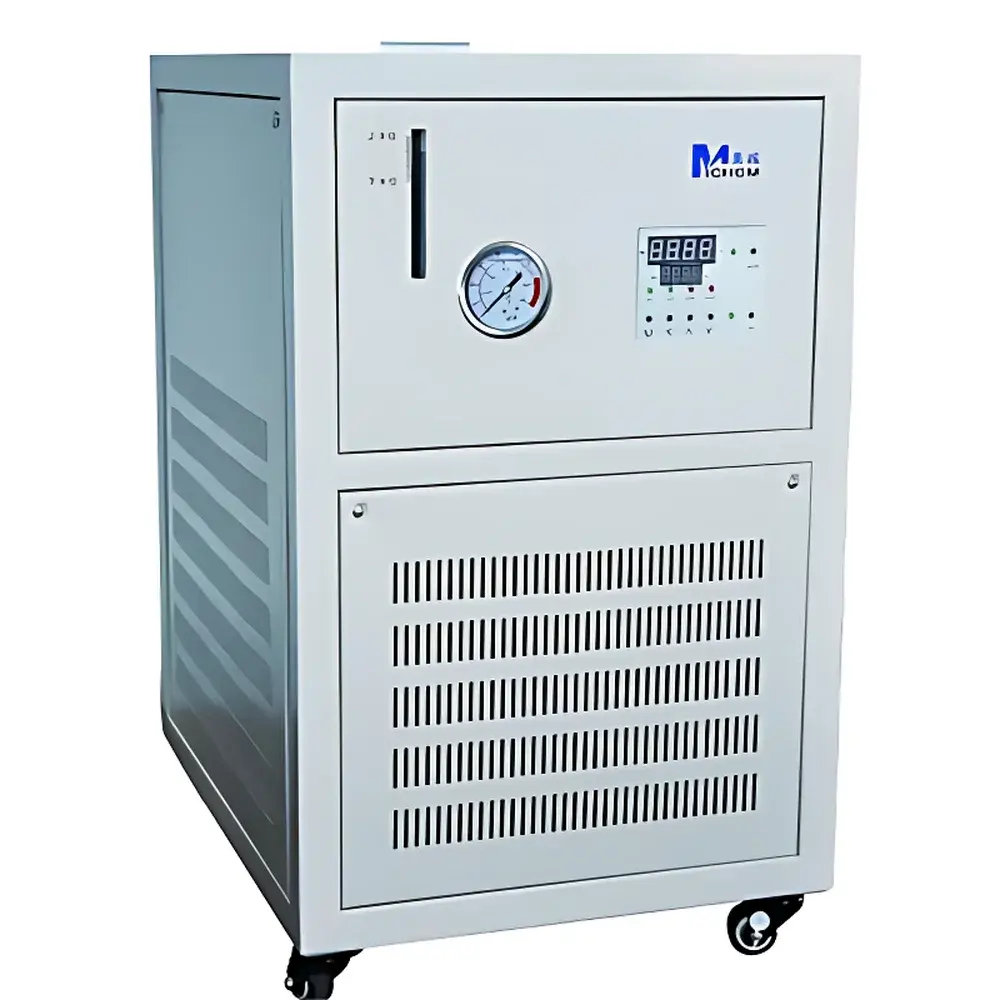
MICHEM MC-1000C Circulating Chiller
| Brand | MICHEM |
|---|---|
| Origin | Beijing, China |
| Model | MC-1000C |
| Instrument Type | Integrated Circulating Chiller |
| Cooling Method | Water-Cooled |
| Temperature Control Range | 5–35 °C |
| Cooling Capacity | 1000 W |
| Temperature Stability | ±0.1 °C |
| Circulation Pump Pressure | 7 bar |
| Circulation Flow Rate | 5 L/min |
| Reservoir Volume | 7 L |
| Operating Mode | Continuous |
| Compressor Type | Inverter-Driven |
| Control Algorithm | PID |
| Input Power | 500 W |
| Power Supply | 220 V, 10 A |
| Dimensions (W×D×H) | 520×420×680 mm |
Overview
The MICHEM MC-1000C Circulating Chiller is an integrated, inverter-controlled refrigeration system engineered for precision thermal management of laboratory and industrial instrumentation requiring stable, continuous coolant supply. It operates on vapor-compression refrigeration principles—utilizing a hermetically sealed inverter-driven compressor, high-efficiency condenser, expansion valve, and evaporator—to deliver tightly regulated cooling water within a 5–35 °C range. Unlike conventional tap-water cooling methods—which consume up to 1440 tons of water annually per instrument and introduce scaling risks in hard-water regions—the MC-1000C recirculates deionized or treated water, eliminating waste, preventing mineral deposition, and ensuring long-term compatibility with sensitive analytical hardware. Its design addresses critical operational constraints in modern labs: energy efficiency, acoustic performance, pressure stability, and seamless integration with temperature-sensitive equipment such as ICP-MS systems, electron microscopes, and high-power lasers.
Key Features
- Inverter-driven compressor enables dynamic modulation of refrigeration output, achieving ±0.1 °C temperature stability while reducing energy consumption by over 30% compared to on/off cycling chillers of equivalent capacity.
- High-pressure circulation pump delivers up to 7 bar at 5 L/min flow rate, supporting multi-instrument daisy-chaining and overcoming hydraulic resistance in extended tubing loops or high-backpressure applications (e.g., vacuum pumps, NMR cryoprobes).
- 7-liter stainless-steel reservoir with level sensor and corrosion-resistant internal coating ensures consistent fluid volume and minimizes evaporation-induced concentration drift during extended operation.
- Microprocessor-based PID controller with real-time feedback loop maintains setpoint accuracy across ambient fluctuations; soft-start compressor ramp-up (20-second gradual power increase) suppresses inrush current and extends component service life.
- Integrated safety architecture includes overtemperature, low-flow, dry-run, and high-pressure cutouts—all logged with timestamped event records for GLP/GMP traceability.
Sample Compatibility & Compliance
The MC-1000C is compatible with aqueous coolants—including deionized water, 20–30% ethylene glycol/water mixtures, and proprietary corrosion-inhibited formulations—ensuring material compatibility with copper, stainless steel, and fluoropolymer wetted parts. It meets electromagnetic compatibility requirements per IEC 61326-1 and electrical safety standards per IEC 61010-1. While not certified to ISO/IEC 17025 or FDA 21 CFR Part 11 out-of-the-box, its deterministic control logic, audit-trail-capable event logging (via optional RS485/Modbus interface), and configurable alarm thresholds support validation under ISO 9001, ISO 13485, and GxP-compliant laboratory quality systems.
Software & Data Management
The unit features a local LCD interface with dual-line display (setpoint/actual temperature, flow status, fault codes) and tactile membrane keypad. For remote monitoring and integration, the optional RS485 port supports Modbus RTU protocol, enabling bidirectional communication with SCADA platforms, LIMS, or custom Python-based data acquisition scripts. Logged parameters—including compressor frequency, outlet temperature, flow rate, and fault history—are exportable via serial dump for trend analysis. Firmware updates are performed via USB host port using signed binary packages, preserving integrity during field maintenance.
Applications
- Analytical Instrumentation: Continuous cooling for graphite furnace AAS, ICP-OES/ICP-MS plasma sources, SEM/TEM column heat sinks, MALDI-TOF ion sources, XRD goniometers, FTIR interferometers, and rheometry Peltier stages.
- Vacuum & Medical Systems: Thermal stabilization of diffusion pumps, turbo-molecular pumps, MRI quench-cooling circuits, linear accelerator klystrons, and patient temperature management units.
- Industrial & Manufacturing: Laser diode array thermal control, thin-film sputtering chamber baseplates, CNC spindle cooling, injection molding tooling, and bioreactor jacket temperature regulation.
FAQ
What coolant types are compatible with the MC-1000C?
Deionized water is recommended for most lab applications; 20–30% ethylene glycol/water mixtures may be used where sub-zero ambient exposure is anticipated. Propylene glycol is acceptable for food/pharma-grade environments. Coolant pH must be maintained between 6.5 and 8.5.
Can the MC-1000C support multiple instruments simultaneously?
Yes—its 7 bar maximum pressure and 5 L/min flow enable parallel connection of up to three medium-load instruments (e.g., two ICP torches + one spectrometer detector) when properly balanced with flow restrictors and pressure-regulating valves.
Is external temperature feedback supported for cascade control?
Not natively; the unit uses internal Pt100 sensor feedback only. However, the RS485/Modbus interface allows external PLCs to read outlet temperature and modulate setpoint dynamically via register write commands.
What maintenance intervals are recommended?
Compressor oil inspection every 24 months; condenser coil cleaning every 6 months in dusty environments; coolant replacement every 12 months or per conductivity threshold (>5 µS/cm).
Does the chiller comply with noise regulations for ISO Class 5 cleanrooms?
At full load, sound pressure level is ≤58 dB(A) at 1 m distance—within typical cleanroom HVAC noise budgets, though vibration isolation mounts are advised for seismic-sensitive instruments like AFMs.



