
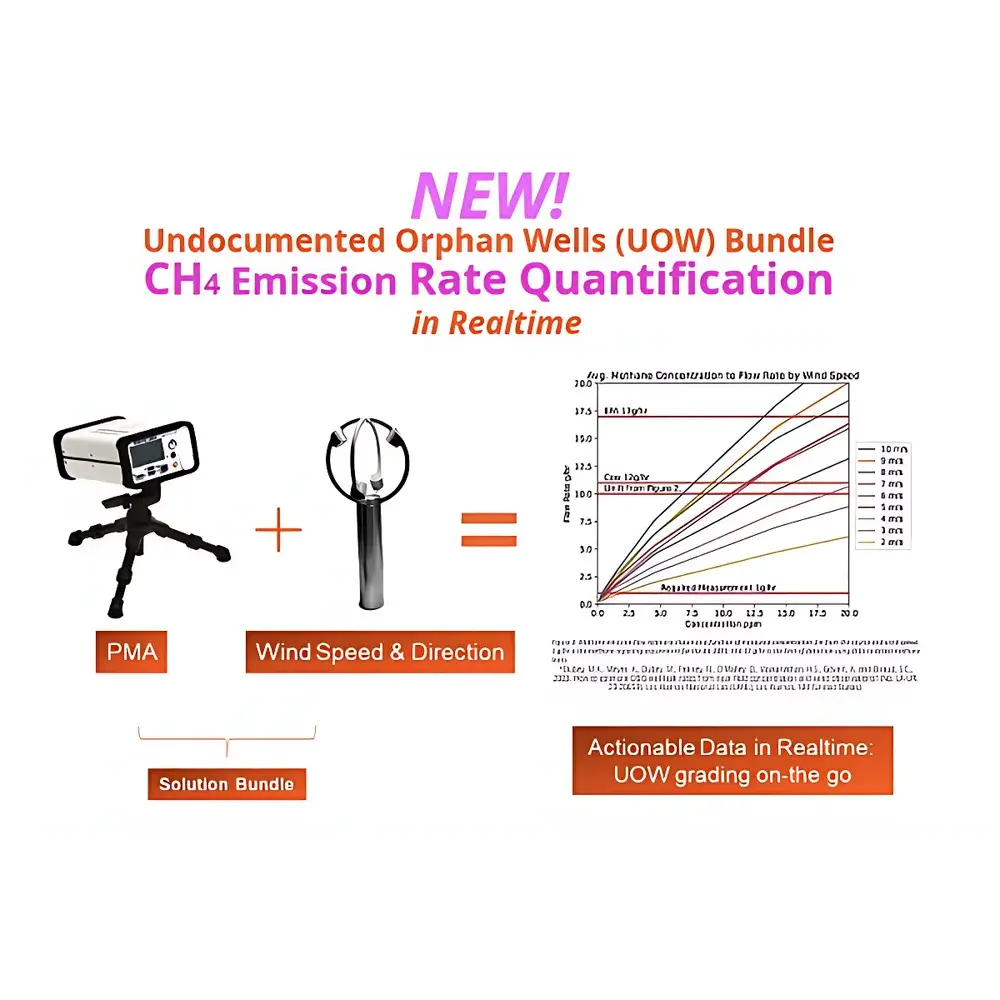
LI-COR LI-G2003 Portable Cavity-Enhanced Absorption Spectroscopy (CEAS) CH₄/H₂O Analyzer
| Brand | LI-COR |
|---|---|
| Origin | USA |
| Manufacturer Type | Authorized Distributor |
| Country of Origin | Imported |
| Model | LI-G2003 Portable CH₄/H₂O Analyzer (PMA) |
| Price | Available Upon Request |
| Detection Principle | Cavity-Enhanced Absorption Spectroscopy (CEAS) |
| CH₄ Sensitivity | < 10 ppb (1σ, 1 s) |
| CH₄ Measurement Range | 0–1 % (10,000 ppm) |
| H₂O Measurement Capability | Yes |
| Form Factor | Handheld / Vehicle-Mountable / UAV-Compatible |
| Weight | 2.3 kg (5.0 lbs) |
| Power Supply | Internal Rechargeable Battery |
| Connectivity | Integrated GPS + Wi-Fi |
| Software | Open-Source, Customizable Firmware & Data Acquisition Suite |
| Calibration Stability | Extended Drift-Free Operation Without Frequent Recalibration |
| Compliance | Designed for Field Deployment in EPA Method 21–adjacent surveys, ASTM D6522-compliant ambient air monitoring, and GHG inventory verification per IPCC Tier 2/3 protocols |
Overview
The LI-COR LI-G2003 Portable CH₄/H₂O Analyzer (PMA) is an ultra-compact, field-deployable gas analyzer engineered for high-sensitivity, real-time quantification of methane (CH₄) and water vapor (H₂O) concentrations in ambient air. Built upon cavity-enhanced absorption spectroscopy (CEAS), the instrument leverages high-finesse optical cavities and narrow-linewidth near-infrared lasers to achieve sub-10 ppb (1σ, 1 s) detection limits for CH₄—enabling precise identification of fugitive emissions from landfills, natural gas infrastructure, agricultural operations, and wastewater treatment facilities. Unlike traditional NDIR or electrochemical sensors, CEAS provides inherent immunity to pressure and temperature-induced spectral broadening when coupled with active cavity length stabilization and wavelength modulation techniques. The LI-G2003 operates across a full 0–1 % CH₄ dynamic range (0–10,000 ppm), supporting both low-background atmospheric monitoring and high-concentration plume characterization without range switching or signal saturation.
Key Features
- Sub-10 ppb CH₄ detection sensitivity at 1-second integration time (1σ), validated under field-representative conditions including variable humidity and ambient temperature fluctuations
- Simultaneous, co-located CH₄ and H₂O measurement using dual-wavelength CEAS architecture—enabling real-time water vapor correction and improved accuracy in humid environments
- Ultra-lightweight design (2.3 kg) with ergonomic handheld housing, integrated rechargeable battery (≥8 h continuous operation), and MIL-STD-810G-rated mechanical robustness
- Onboard high-precision GPS (sub-meter horizontal accuracy) synchronized with spectral data acquisition for georeferenced emission mapping
- Wi-Fi 802.11n connectivity for remote configuration, live telemetry streaming, and over-the-air firmware updates
- Open-source software development kit (SDK) and Python-based data acquisition libraries—supporting custom algorithm integration, third-party platform interoperability (e.g., QGIS, ArcGIS, MATLAB), and automated QA/QC workflows
Sample Compatibility & Compliance
The LI-G2003 is optimized for direct sampling of ambient air, stack effluents (with optional dilution module), and soil gas headspace via standard 1/4″ Swagelok® fittings. It meets functional requirements for U.S. EPA Method 21–informed leak detection surveys and supports data collection aligned with ASTM D6522 (Standard Test Method for Determination of Methane Emissions from Landfill Surfaces). Its measurement traceability is maintained through NIST-traceable calibration gas protocols, and its long-term stability satisfies GLP-aligned field validation intervals (≤30-day zero/span checks recommended). The analyzer complies with FCC Part 15 Class B and CE RED Directive 2014/53/EU for electromagnetic compatibility in mobile environmental monitoring applications.
Software & Data Management
Data acquisition, visualization, and post-processing are managed via LI-COR’s open-source PMA Control Suite—a cross-platform application built on Qt and Python. All raw spectra, timestamped concentration values, GPS metadata, and system diagnostics are stored in HDF5 format with embedded CF-1.6 metadata conventions. The software supports automated drift correction using internal reference cells, configurable averaging windows (1–60 s), and real-time alarm thresholds. Audit trails—including user actions, parameter changes, and calibration events—are logged in immutable JSON files compliant with FDA 21 CFR Part 11 principles for electronic records. Export options include CSV, NetCDF, and GeoJSON for GIS-integrated reporting and regulatory submission.
Applications
- Landfill surface emission mapping and flux estimation using mobile survey platforms (ATV, vehicle, backpack, or UAV-mounted configurations)
- Leak detection and repair (LDAR) programs across natural gas transmission and distribution networks
- Quantitative assessment of biogas production and fugitive losses at anaerobic digesters and wastewater treatment plants
- Soil-atmosphere CH₄ exchange studies in wetland and rice paddy ecosystems
- Validation of satellite-based CH₄ observations (e.g., TROPOMI, GHGSat) through ground-truth point measurements
- Urban atmospheric chemistry campaigns requiring high-temporal-resolution CH₄/H₂O covariance analysis
FAQ
Is the LI-G2003 suitable for use in high-humidity environments?
Yes—the dual-wavelength CEAS architecture enables real-time H₂O cross-sensitivity compensation, and the optical path is actively temperature-stabilized to minimize condensation-related artifacts.
Does the analyzer require daily calibration?
No—its optical design ensures exceptional long-term stability; typical field deployments maintain accuracy for up to 30 days between zero/span verifications using certified gas standards.
Can the LI-G2003 be integrated with third-party data loggers or SCADA systems?
Yes—via ASCII-over-TCP/IP or Modbus TCP protocols, and through the open SDK for custom API-driven integration.
What is the minimum detectable flux when used with an eddy-covariance system?
When paired with a 10 Hz anemometer and appropriate inlet configuration, the LI-G2003 supports CH₄ flux detection thresholds below 0.1 µg m⁻² s⁻¹ under typical boundary layer conditions.
Is firmware update capability available in the field?
Yes—updates are delivered over Wi-Fi and installed without requiring physical access to internal components or factory service intervention.







