
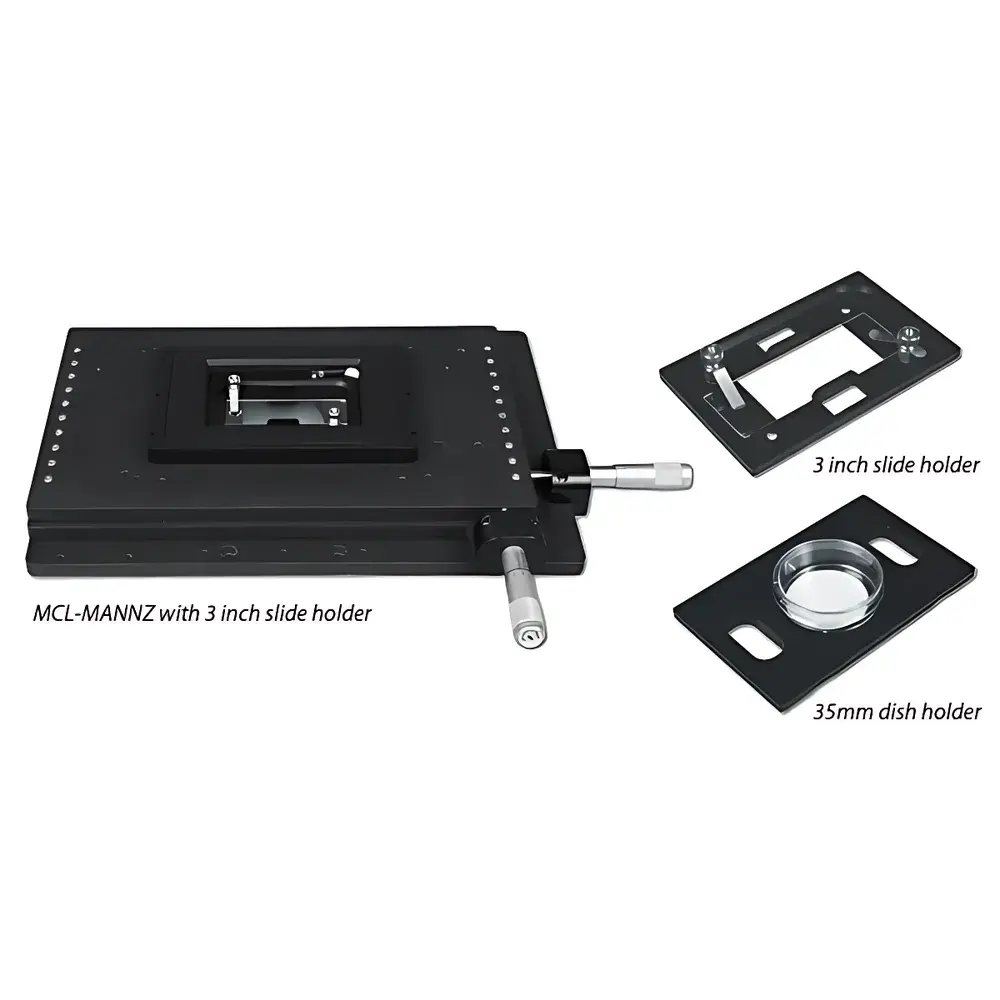
MCL Think Nano MCL-MANNZ Integrated Micro- and Nanopositioning Stage
| Brand | MCL Think Nano |
|---|---|
| Origin | USA |
| Manufacturer Type | Authorized Distributor |
| Product Category | Imported |
| Model | MCL-MANNZ |
| Product Type | Motorized & Manual Hybrid Translation Stage |
| XY Travel Range | 25 mm |
| Z Travel Range | 200 µm |
| XY Resolution (Manual) | 1 µm (vernier), 10 µm (main scale) |
| Z Resolution | 0.4 nm |
| Z Resonant Frequency | 250 Hz ±20% |
| Max Horizontal Load (Z-axis) | 0.5 kg |
| Closed-Loop Control | Yes (PicoQ® absolute position sensing) |
| Controller | Nano-Drive® C |
| Interface | USB 2.0, 0–10 V analog input |
| Compatible Microscopes | Olympus IX, Nikon TE/Ti, Leica DMI, Zeiss Axiovert/Axio Observer |
| Mounting Compatibility | 3″ (75 mm) slides, 35 mm Petri dishes, inverted microscopes, optical tables |
Overview
The MCL Think Nano MCL-MANNZ is an integrated hybrid positioning system engineered for high-precision optical microscopy applications requiring both coarse manual adjustment and nanoscale Z-axis control. It combines a robust, aluminum-bodied manual XY translation stage—featuring 25 mm travel per axis and vernier-assisted 1 µm readability—with a closed-loop piezoelectric nanopositioner delivering 200 µm of vertical displacement and sub-nanometer resolution (0.4 nm). Unlike purely motorized or fully manual stages, the MCL-MANNZ bridges operational flexibility and metrological rigor: its coarse XY stage provides mechanical stability with a blocking force of 10 N per axis, while the Z-axis nanopositioner employs proprietary PicoQ® capacitive sensing technology to deliver absolute, drift-free, repeatable position measurement without homing or referencing. This architecture ensures consistent sample height alignment within the working distance of high-NA objective lenses—critical for maintaining focus during long-duration time-lapse or multi-channel fluorescence acquisitions on inverted platforms.
Key Features
- Hybrid design: Manual micrometer-driven XY stage (25 mm range) + closed-loop piezo Z-stage (200 µm range)
- PicoQ® absolute position sensing: Eliminates hysteresis and thermal drift; enables true repeatability and traceable positioning
- High mechanical stability: 10 N blocking force per XY axis ensures minimal deflection under load and resistance to vibration-induced drift
- Optimized optical integration: Designed to mount directly onto standard inverted microscope frames (Olympus IX, Nikon TE/Ti, Leica DMI, Zeiss Axiovert/Observer) without adapter modification
- Universal sample compatibility: Accommodates 75 mm × 25 mm glass slides and 35 mm Petri dishes with precise centering and tilt minimization
- Compact Nano-Drive® C controller: Supports USB 2.0 communication and 0–10 V analog input for external synchronization with TTL-triggered acquisition systems
- LabVIEW-ready API: Fully documented driver suite enables custom automation, batch scripting, and integration into existing experimental control frameworks
Sample Compatibility & Compliance
The MCL-MANNZ meets mechanical and dimensional requirements for ISO 80000-compliant optical staging environments. Its mounting interface conforms to standard inverted microscope footprints defined in ASTM E2719-19 (Standard Guide for Microscope Stage Design), ensuring mechanical interoperability without compromising stage flatness or orthogonality. The aluminum construction (6061-T6) satisfies RoHS Directive 2011/65/EU and supports cleanroom-compatible handling protocols. While not certified as medical device hardware, the system’s deterministic motion behavior, absence of backlash, and absolute position feedback align with GLP-aligned instrumentation practices for quantitative imaging workflows. All position data generated via the Nano-Drive® C controller includes timestamped metadata, supporting audit-trail requirements under FDA 21 CFR Part 11 when used in regulated research settings.
Software & Data Management
The Nano-Drive® C controller provides native support for Windows-based host software including MCL’s Nano-Control GUI (v4.2+), which enables real-time position monitoring, waveform-driven Z-scanning, and multi-point coordinate sequencing. The LabVIEW driver package (NI-VISA compliant) exposes low-level commands for dynamic setpoint updates, sensor readback polling at up to 1 kHz, and synchronous triggering with camera exposure signals. Position logs are exportable in CSV format with millisecond-resolution timestamps, enabling correlation with spectral, temporal, or intensity datasets. No cloud dependency or proprietary runtime is required—firmware updates are performed locally via signed HEX files. Firmware versioning follows semantic versioning (e.g., v2.1.4), with release notes publicly archived for traceability.
Applications
- Confocal and super-resolution microscopy: Precise Z-stack acquisition for STORM and PALM, where axial localization accuracy depends on sub-10 nm step fidelity and thermal stability
- Single-molecule fluorescence tracking: Maintaining focus over >30-minute acquisitions under variable buffer conditions and temperature gradients
- Nanomanipulation workflows: Coordinating XY coarse repositioning with nanometer-scale Z adjustments during probe-sample approach in optical tweezer or AFM-coupled experiments
- Multi-modal correlative imaging: Synchronizing stage position with spectral detector readout, laser excitation gating, and piezo-driven objective scanning
- Automated slide screening: Integrating manual XY navigation with programmable Z-focusing routines for rapid region-of-interest (ROI) selection across heterogeneous tissue sections
FAQ
Is the MCL-MANNZ compatible with non-inverted microscope configurations?
Yes—custom mounting plates and base adapters are available for direct attachment to optical tables, breadboards (M6 or 1/4″-20 threaded holes), or upright microscope stages upon engineering consultation.
Can the Z-axis nanopositioner operate under vacuum or inert atmosphere?
The standard MCL-MANNZ is rated for ambient laboratory conditions only; vacuum-compatible variants (with modified cabling and outgassing-tested materials) require special order and lead-time validation.
What is the maximum recommended payload for simultaneous XY + Z operation?
For optimal dynamic performance and resonant frequency retention, the combined horizontal load should not exceed 0.5 kg; heavier loads necessitate static calibration and may reduce effective bandwidth below 200 Hz.
Does the Nano-Drive® C controller support third-party DAQ synchronization?
Yes—the controller accepts TTL-level trigger inputs and provides synchronized digital output pulses aligned to position update cycles, enabling hardware-level coordination with National Instruments, Thorlabs, or Becker & Hickl acquisition systems.
How is positional accuracy verified and maintained over time?
Each unit undergoes factory calibration using NIST-traceable interferometric verification; users may perform in-situ linearity checks using calibrated grating targets or stage-integrated reference marks—no recalibration service is required under normal operating conditions.




