
Retsch PT100 Sample Divider
| Brand | Retsch |
|---|---|
| Origin | Germany |
| Model | PT100 |
| Sample Division Principle | Rotating Cone Divider (Rotary Splitter) |
| Dividing Ports | 6, 8 or 10 |
| Rotation Speed | 110 rpm (electronically regulated, load- and frequency-independent) |
| Maximum Feed Size | ≤10 mm |
| Batch Capacity | Up to 5000 mL |
| Container Options | 100 mL, 250 mL or 500 mL wide-neck or Duran® laboratory bottles |
| Timer Range | 1–60 min or continuous operation |
| Dimensions (W×H×D) | 580 × 910 × 420 mm (including optional DR 100 dosing unit) |
| Net Weight | ~33.5 kg |
| Compliance | CE-marked |
| Maintenance | Maintenance-free drive |
| Noise Level | Low-noise operation |
Overview
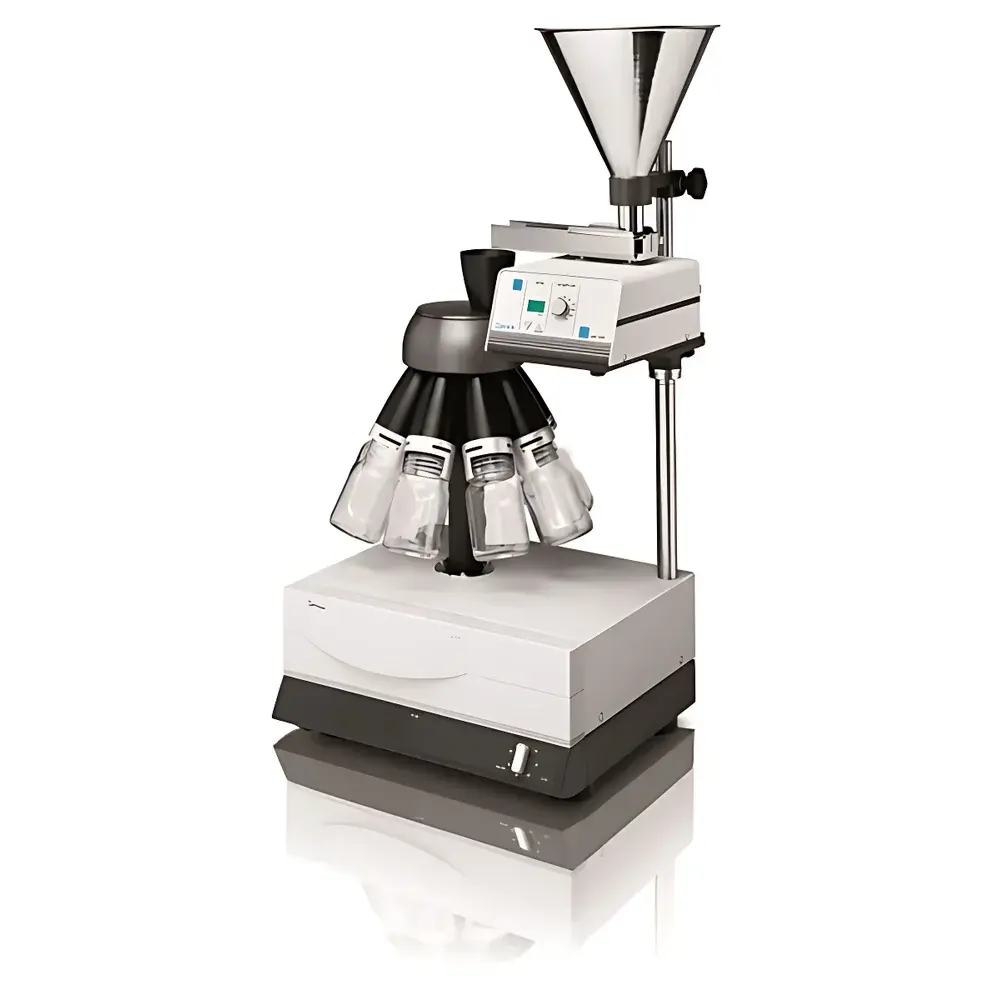
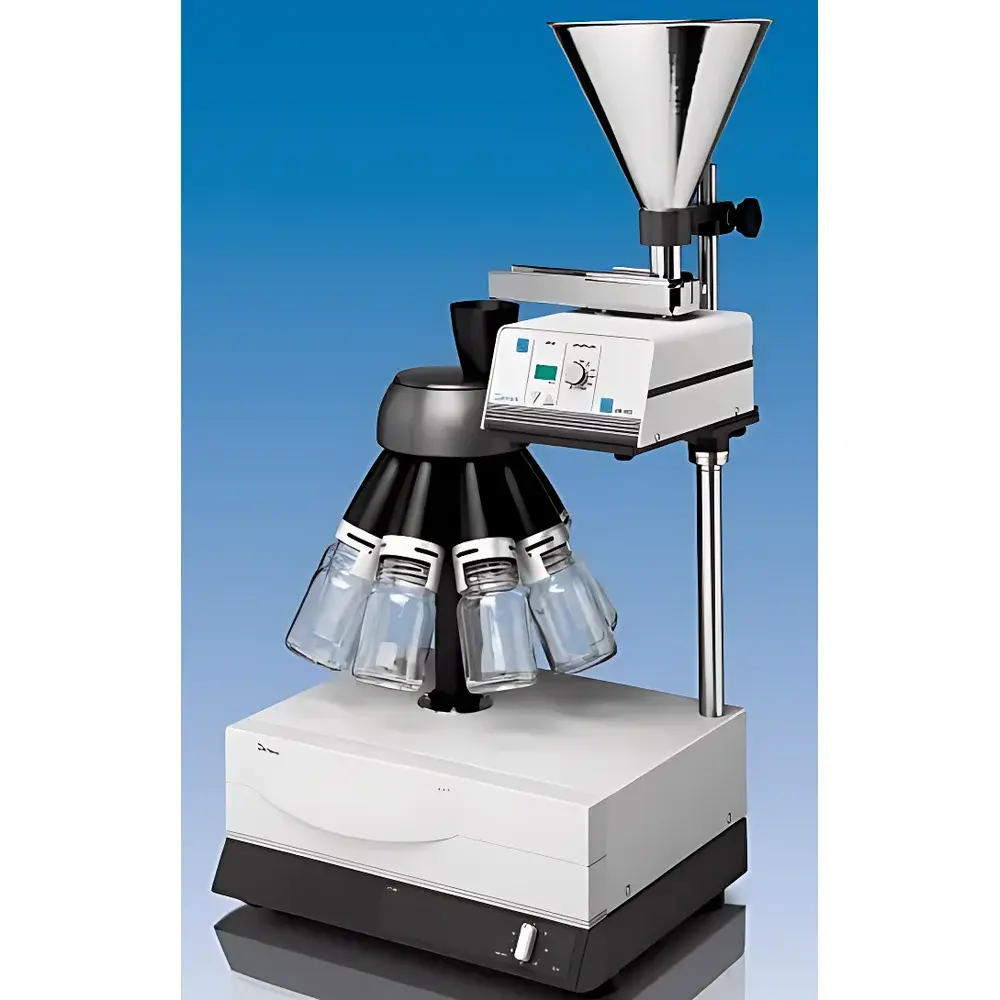
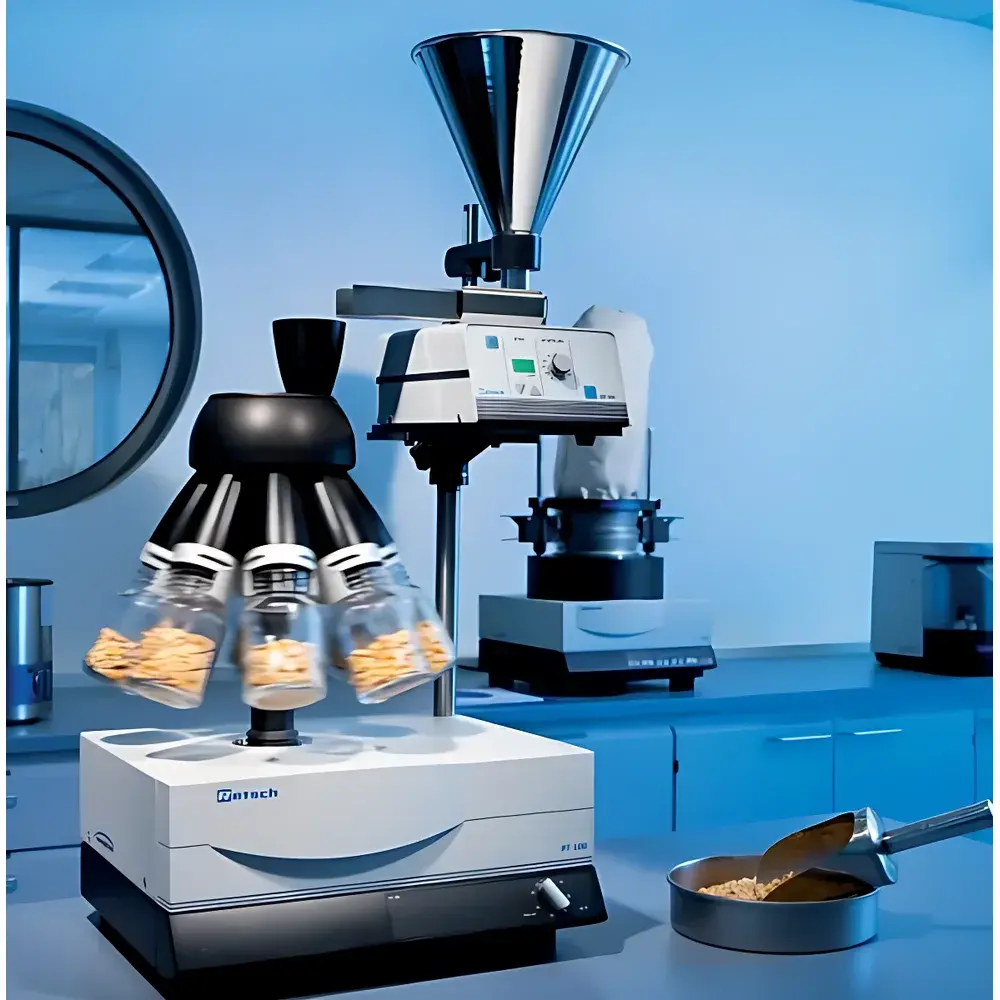
The Retsch PT100 Sample Divider is a precision-engineered rotary cone splitter designed for high-reproducibility sample division of free-flowing bulk granular and powdered materials. Operating on the principle of gravitational feed combined with controlled rotational splitting, the PT100 ensures statistically representative sub-sampling by distributing incoming material uniformly across multiple collection ports via a rotating conical divider head. This method eliminates manual bias and minimizes segregation effects—critical when handling heterogeneous particulate samples prior to particle size analysis, chemical assay, or quality control testing. The device is particularly suited for laboratories requiring compliance with ISO 13320, ASTM D6938, and ISO 14687 standards for representative sampling of dry, non-cohesive solids. Its electronically stabilized 110 rpm rotation speed remains invariant under variable load conditions and mains frequency fluctuations—ensuring consistent volumetric distribution regardless of feed rate or material density.
Key Features
- Electronically regulated rotation at precisely 110 rpm—monitored in real time and independent of mechanical load or supply frequency
- Modular design supporting interchangeable divider heads with 6-, 8-, or 10-port configurations for flexible fractionation strategies
- Integrated analog timer allowing programmable operation from 1 to 60 minutes—or continuous mode for high-throughput workflows
- Rapid-lock container fixation system enabling tool-free, ergonomic loading and unloading of standard wide-neck or Duran® laboratory bottles (100 mL, 250 mL, 500 mL)
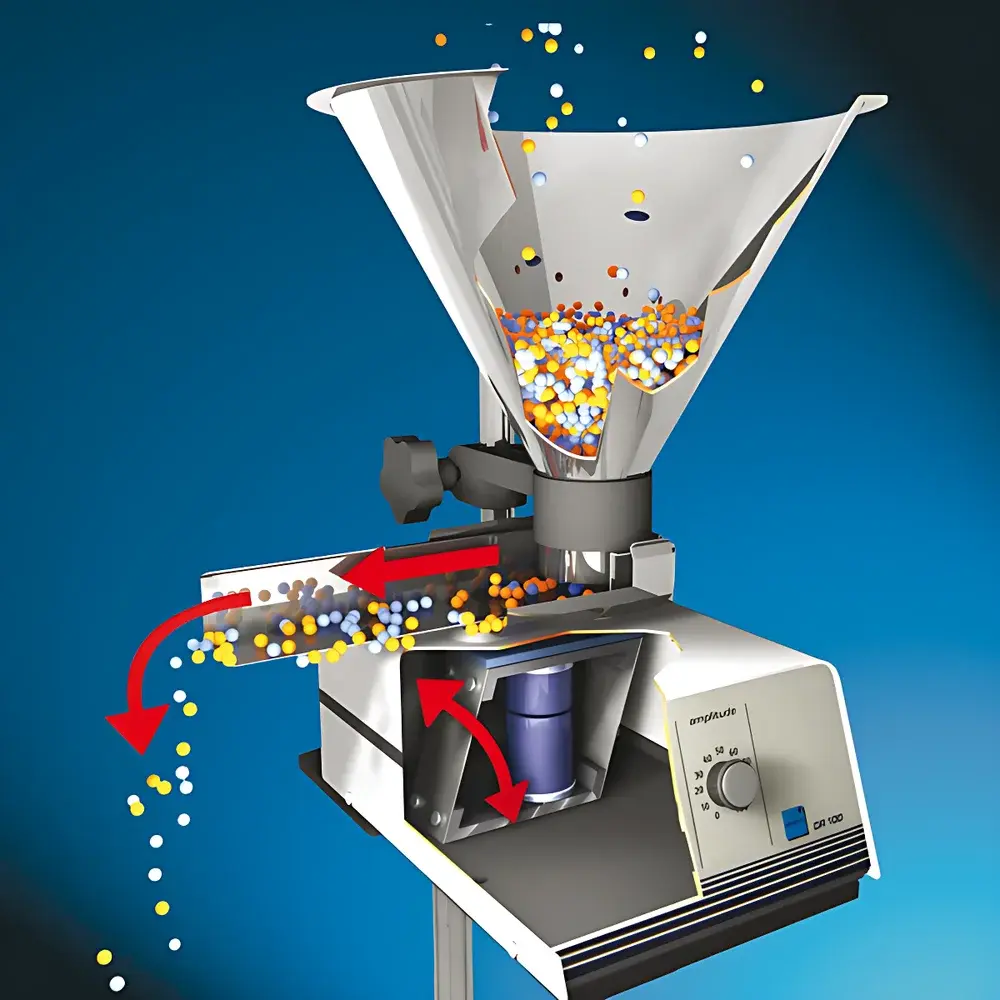
- Optional integration with the Retsch DR 100 vibratory dosing unit for fully automated, metered feed—eliminating operator-induced variability
- Compact footprint (580 × 910 × 420 mm) and maintenance-free low-noise drive mechanism suitable for shared lab environments
- CE-certified construction with robust stainless-steel and anodized aluminum components for long-term stability and corrosion resistance
Sample Compatibility & Compliance
The PT100 accepts free-flowing, non-sticky, dry particulates with maximum particle dimensions up to 10 mm—covering a broad spectrum of industrial and research-grade materials including foundry sands, cement clinker, mineral ores, agricultural grains, metal powders, pharmaceutical excipients, fertilizers, coal, soil aggregates, and polymer granules. It is not intended for cohesive, hygroscopic, fibrous, or electrostatically charged materials without prior conditioning. The instrument supports GLP-aligned workflows through traceable operational parameters (e.g., fixed rotation speed, timed cycles), and its mechanical design conforms to ISO 11713 (sampling of particulate solids) and EN 15051 (laboratory equipment for sampling). When used in conjunction with validated analytical protocols (e.g., USP <429> for particle size distribution), the PT100 contributes to data integrity requirements under FDA 21 CFR Part 11 where electronic records are employed.
Software & Data Management
The PT100 operates as a standalone electromechanical instrument with no embedded firmware or digital interface. All operational parameters—including duration, port configuration, and rotational consistency—are mechanically or analogically controlled, ensuring deterministic repeatability without software dependencies. For laboratories implementing LIMS or ELN systems, process metadata (e.g., batch ID, start/stop time, divider configuration) must be manually logged or integrated via external time-stamped documentation. While the base unit lacks connectivity, its compatibility with the optional DR 100 dosing module allows synchronization with external PLCs or programmable logic controllers in automated production QC lines—facilitating audit-ready sequence logging in GMP-compliant environments.
Applications
- Preparation of representative sub-samples for laser diffraction particle size analysis (e.g., Mastersizer, Horiba LA-960)
- Reduction of large field-collected soil or sediment batches prior to XRF or ICP-MS digestion
- Homogenization and division of catalyst powders or battery electrode materials for BET surface area measurement
- Quality assurance sampling in cement manufacturing per ASTM C114 and EN 196-2
- Feedstock preparation for proximate analysis of biomass, coal, or animal feed per AOAC 971.15 and ISO 1171
- Regulatory sampling of food-grade powders (e.g., flour, milk powder) under EU Regulation (EC) No 882/2004
FAQ
What types of materials are compatible with the PT100?
Free-flowing, dry, non-cohesive granular or powdered solids with particle sizes ≤10 mm—such as sand, minerals, grains, metal powders, and fertilizers. Cohesive, wet, or fibrous materials require pre-conditioning or alternative sampling methods.
Can the PT100 be integrated into automated laboratory workflows?
Yes—when paired with the optional DR 100 vibratory dosing unit, the PT100 supports synchronized, metered feeding and can interface with PLC-controlled systems for unattended batch processing.
Is calibration required for routine operation?
No routine calibration is specified; however, users should verify rotational speed annually using a certified tachometer and confirm mechanical alignment of the divider head per Retsch’s maintenance guidelines.
Does the PT100 meet international standards for representative sampling?
It complies with the mechanical principles outlined in ISO 11713 and EN 15051, and supports implementation of sampling plans aligned with ISO 3534-2 and ASTM E141 for statistical representativeness.
What safety certifications does the instrument carry?
The PT100 bears the CE marking, indicating conformity with EU Machinery Directive 2006/42/EC and Electromagnetic Compatibility Directive 2014/30/EU.
Related Products



