
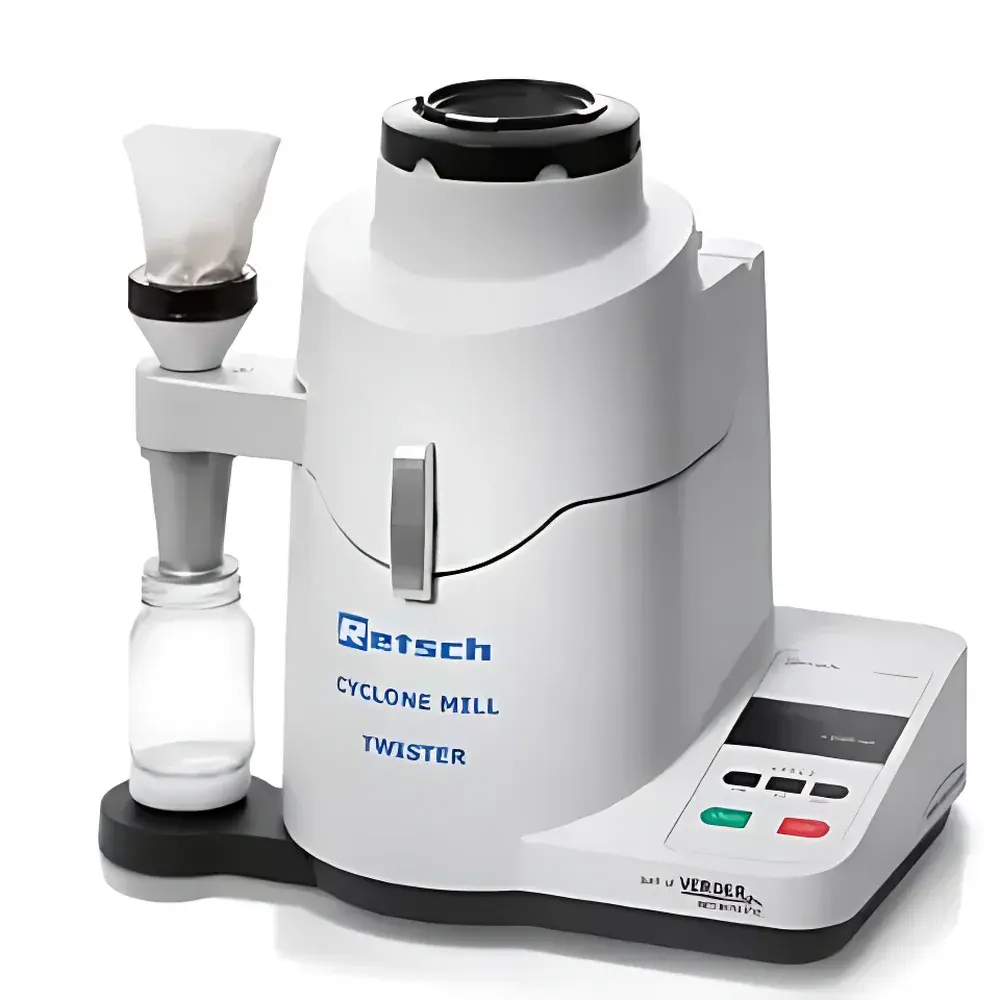
Retsch Twister Cyclone Mill
| Brand | Retsch |
|---|---|
| Origin | Germany |
| Model | Twister |
| Instrument Type | Cyclone Mill |
| Maximum Feed Size | < 10 mm |
| Final Particle Size | < 250 µm |
| Batch Volume | < 250 mL |
| Rotational Speeds | 10,000 / 12,000 / 14,000 rpm |
| Rotor Tip Speed | 52 / 62 / 72 m/s |
| Rotor Diameter | 98.5 mm |
| Sieve Aperture Options | 1 mm, 2 mm |
| Motor Power | 900 W |
| Dimensions (W×H×D) | 449 × 427 × 283 mm |
| Net Weight | 14 kg |
| Compliance | CE |
Overview
The Retsch Twister Cyclone Mill is a high-efficiency, air-cooled laboratory mill engineered specifically for the preparation of homogenous, low-temperature ground samples intended for near-infrared (NIR) spectroscopy analysis. Unlike conventional jaw crushers or rotor mills that rely primarily on compression or shear forces, the Twister employs a dynamic cyclonic grinding principle: a high-speed rotating knife generates controlled turbulent airflow within the grinding chamber, simultaneously fragmenting the sample via impact and friction while transporting fine particles through an integrated cyclone separator into a collection vessel. This pneumatic conveying mechanism eliminates mechanical contact between ground material and internal surfaces post-grinding, minimizes heat accumulation (< 2 °C temperature rise typical for cereal grains), and preserves moisture content and chemical integrity—critical parameters for quantitative NIR calibration stability and predictive accuracy.
Key Features
- Three-step variable speed control (10,000 / 12,000 / 14,000 rpm) enables precise adaptation to diverse sample matrices—from soft, fibrous feedstuffs (e.g., alfalfa hay) to moderately tough seeds (e.g., soybeans, corn kernels).
- Cyclonic separation architecture ensures rapid, residue-free transfer of ground material into standardized 250 mL collection bottles, reducing carryover and enabling sequential batch processing without manual scraping.
- Interchangeable ring sieves (1 mm and 2 mm aperture) provide consistent particle size distribution control; sub-250 µm output meets ASTM E1655 and ISO 12099 requirements for NIR reference sample homogeneity.
- Robust 900 W series-wound industrial motor delivers sustained torque across all speed settings, supporting long-term operation under routine QC laboratory conditions.
- Ergonomic front-panel interface with tactile speed selector and visual status indicators simplifies operator training and reduces procedural variability in GLP-compliant environments.
- CE-certified design incorporates integrated thermal protection, emergency stop circuitry, and interlocked access covers meeting IEC 61000-6-2/6-4 electromagnetic compatibility standards.
Sample Compatibility & Compliance
The Twister is validated for use with organic, non-metallic, low-fat biological materials including cereals (rice, wheat, barley), oilseeds (soybean, rapeseed), forage crops (alfalfa, timothy grass), tobacco leaves, milled pharmaceutical excipients, and pet food formulations. It is not suitable for abrasive, high-mineral, or thermolabile compounds requiring cryogenic milling. All grinding components—including rotor, housing liner, and cyclone body—are manufactured from corrosion-resistant stainless steel (AISI 304) compliant with FDA 21 CFR §177.2400 for indirect food contact. The instrument supports audit-ready documentation workflows aligned with ISO/IEC 17025 accreditation requirements for testing laboratories.
Software & Data Management
While the Twister operates as a standalone benchtop instrument without embedded software, its deterministic mechanical behavior—repeatable speed steps, fixed sieve geometry, and consistent airflow dynamics—enables full traceability within LIMS-integrated sample preparation protocols. Operators may log speed selection, sieve configuration, batch ID, and collection vessel number directly into electronic lab notebooks (ELNs) or chromatography data systems (CDS). For regulated environments (e.g., GMP pharmaceutical QC), the Twister’s mechanical simplicity facilitates straightforward validation per USP Analytical Instrument Qualification, particularly Operational Qualification (OQ) testing of speed accuracy, particle size reproducibility (RSD ≤ 3.5% for n = 6 replicate maize batches), and cleaning verification.
Applications
- Routine NIR calibration sample preparation in agricultural commodity trading labs (e.g., protein/oil/moisture quantification in soybean meal).
- Homogenization of herbal raw materials prior to HPLC or GC-MS fingerprinting in botanical quality control.
- Standardized grinding of animal feed pellets for nutritional composition modeling using PLS regression.
- Preparation of certified reference materials (CRMs) for feed safety testing (e.g., mycotoxin extraction efficiency studies).
- High-throughput sample conditioning in seed certification programs where morphological integrity must be preserved alongside particle size control.
FAQ
What types of samples are compatible with the Twister Cyclone Mill?
The Twister is optimized for dry, fibrous, or granular organic materials with moisture content below 15% and hardness below Mohs 3.5—such as whole grains, legumes, dried herbs, and pelleted feeds. It is not recommended for wet, sticky, oily, or highly abrasive samples.
Does the Twister require calibration for NIR method transfer?
No. Its mechanical consistency—combined with fixed-sieve geometry and cyclonic particle classification—ensures stable, narrow PSD output. This eliminates the need for frequent NIR model recalibration when changing instruments or operators.
How is cross-contamination prevented between batches?
The cyclonic transport system deposits >98% of ground material directly into the collection bottle without wall adhesion. Residual traces are removed by a 15-second “air purge” at maximum speed after each run, verified by visual inspection and optional ATP swab testing.
Can the Twister be integrated into automated sample prep workflows?
Yes. Its compact footprint, standard 230 V / 50 Hz power input, and repeatable start/stop timing make it compatible with robotic arm handling and conveyor-linked sample introduction systems in high-volume analytical facilities.
Is maintenance documentation available for regulatory audits?
Retsch provides a comprehensive Preventive Maintenance Manual (P/N 20.800.000), including torque specifications for rotor assembly, sieve wear tolerance thresholds, and motor service intervals—all traceable to ISO 9001:2015 manufacturing records.



