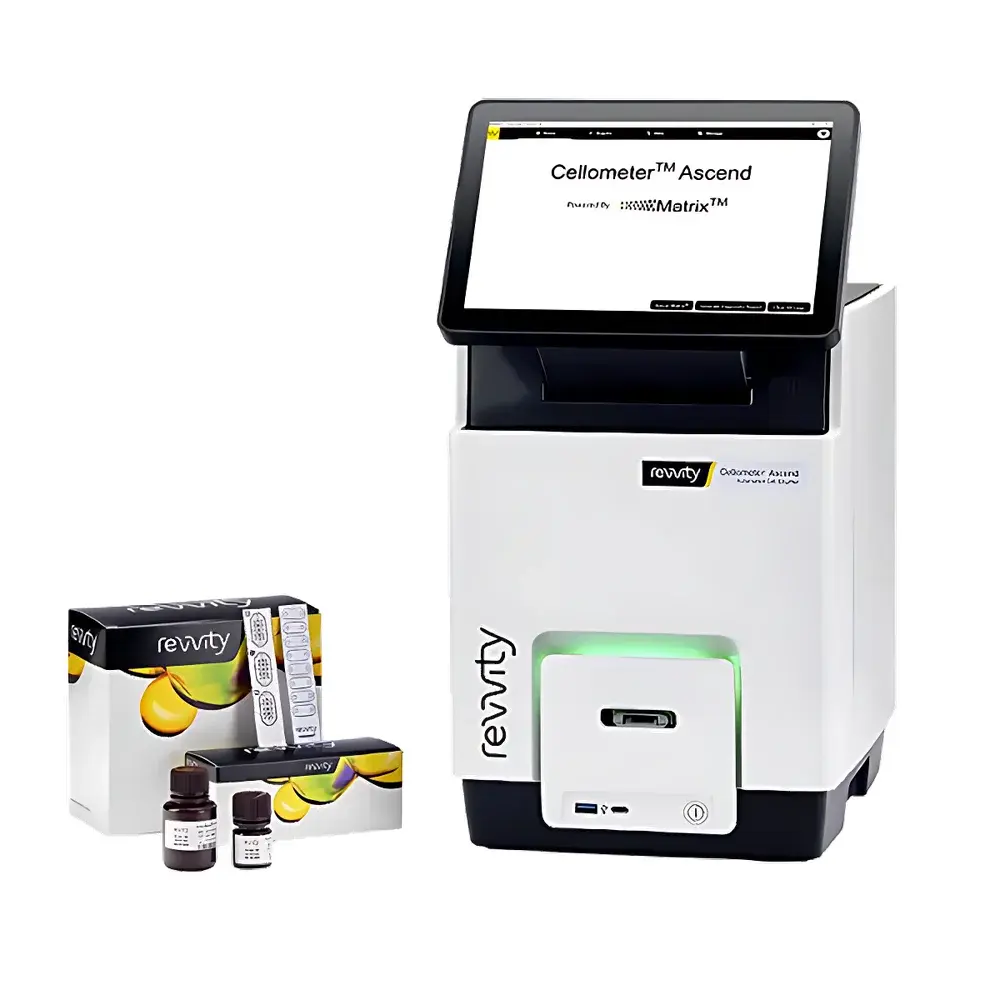
Revvity Cellometer Ascend Automated Cell Counter
| Brand | Revvity |
|---|---|
| Origin | USA |
| Manufacturer Type | Original Equipment Manufacturer (OEM) |
| Product Category | Imported Instrument |
| Model | Cellometer Ascend |
| Detection Concentration Range | 2×10⁴ – 4×10⁷ cells/mL |
| Detectable Cell Size Range | 5–80 µm |
Overview
The Revvity Cellometer Ascend is an advanced, fully automated cell counter engineered for high-precision, high-throughput viability and concentration analysis in demanding life science and biopharmaceutical workflows. Utilizing digital image-based cytometry with simultaneous brightfield and dual-fluorescence (acridine orange/propidium iodide, AO/PI) detection, the Ascend captures high-resolution micrographs across expanded imaging fields—up to 17× the area of a standard hemocytometer grid. Its optical architecture integrates motorized autofocus, precision stage control, and calibrated LED illumination to ensure consistent focus and quantitative reproducibility across heterogeneous samples. Designed specifically for compliance-critical environments, the system operates under a secure software framework aligned with FDA 21 CFR Part 11 requirements—including role-based user authentication, electronic signatures, and immutable audit trails—making it suitable for GLP, GMP, and clinical manufacturing settings.
Key Features
- Parallel multi-sample processing: Analyzes 1–8 samples per run using interchangeable 3-well or 8-well disposable counting slides.
- Dual-modality imaging: Simultaneous acquisition in brightfield and two fluorescence channels (460/525 nm and 535/617 nm), enabling discrimination of viable, apoptotic, and necrotic cells via AO/PI staining—or membrane integrity assessment using trypan blue exclusion.
- Extended dynamic range: Accurately quantifies cell concentrations from 2×10⁴ to 4×10⁷ cells/mL with minimal sample volume (as low as 10 µL per well).
- Large-area imaging: Captures 2–8 stitched images per sample, covering 4–17× the surface area of a conventional Neubauer chamber—reducing sampling bias and improving statistical confidence in low-abundance or clumped populations.
- Pre-validated cell-type library: Includes over 400 pre-optimized parameter sets for common cell types including PBMCs, primary tumor isolates, hematopoietic stem cells, alveolar lavage fluid, splenocytes, and whole blood lysates.
- Automated workflow integration: Supports predefined assay templates for viability, apoptosis, transfection efficiency, and confluence analysis—with customizable “Favorites” for rapid recall of frequently used configurations.
Sample Compatibility & Compliance
The Cellometer Ascend demonstrates robust performance across diverse biological matrices without centrifugation or washing steps: adherent and suspension cell lines (e.g., HEK293, CHO-K1, Jurkat), primary human and murine cells (including cryopreserved PBMCs and fresh tumor digests), whole blood, bone marrow aspirates, and bronchoalveolar lavage (BAL) fluid. Its optical design accommodates variable debris loads and background fluorescence, while adaptive thresholding algorithms minimize operator dependency. The instrument and its embedded software are validated for regulatory compliance with 21 CFR Part 11, supporting full traceability of user actions, data modifications, and instrument calibration events. Optional IQ/OQ documentation packages are available to facilitate laboratory qualification under ISO 13485, ICH Q5D, and USP guidelines.
Software & Data Management
The Ascend Control Software provides a secure, Windows-based interface with encrypted local database storage and export options compliant with LIMS and ELN systems (CSV, PDF, TIFF, FCS). All analyses include metadata tagging (user ID, timestamp, instrument serial number, slide lot number) and support version-controlled protocol management. Audit logs record every login, parameter change, result modification, and report generation event with tamper-proof timestamps. Electronic signature functionality enables multi-level approval workflows for QC release and batch documentation. Data integrity is further reinforced through automatic backup scheduling and optional networked deployment with centralized administration console.
Applications
The Cellometer Ascend serves as a core analytical platform in cell therapy manufacturing (CAR-T, NK cell expansion), bioprocess monitoring (upstream bioreactor sampling), vaccine development (primary dendritic cell activation assays), immuno-oncology research (tumor-infiltrating lymphocyte enumeration), and academic cell biology (CRISPR editing efficiency validation, organoid dissociation yield assessment). Its ability to resolve subtle morphological shifts—such as early-stage blebbing in apoptosis or nuclear condensation post-transfection—makes it particularly valuable for mechanistic studies requiring multiparametric phenotypic correlation.
FAQ
Does the Cellometer Ascend require daily calibration?
No—optical calibration is factory-performed and verified during installation; routine verification uses standardized reference slides included with each consumable kit.
Can I integrate Ascend data into our existing LIMS or ELN?
Yes—export formats include CSV, PDF, TIFF, and FCS; API access and HL7/FHIR compatibility are available via enterprise licensing.
Is AO/PI staining compatible with downstream functional assays?
AO/PI is non-fixative and non-permeabilizing; cells remain viable post-staining for short-term functional readouts such as cytokine secretion or metabolic activity assays.
What consumables are required for operation?
Only Revvity-certified disposable counting slides (3-well or 8-well formats); no additional reagents, lenses, or alignment tools are needed.
How does the Ascend handle clumped or aggregated cells?
Advanced segmentation algorithms apply size-, intensity-, and shape-based clustering filters to distinguish single cells from doublets or small aggregates—configurable thresholds allow user-defined adjustment based on cell type and application.