
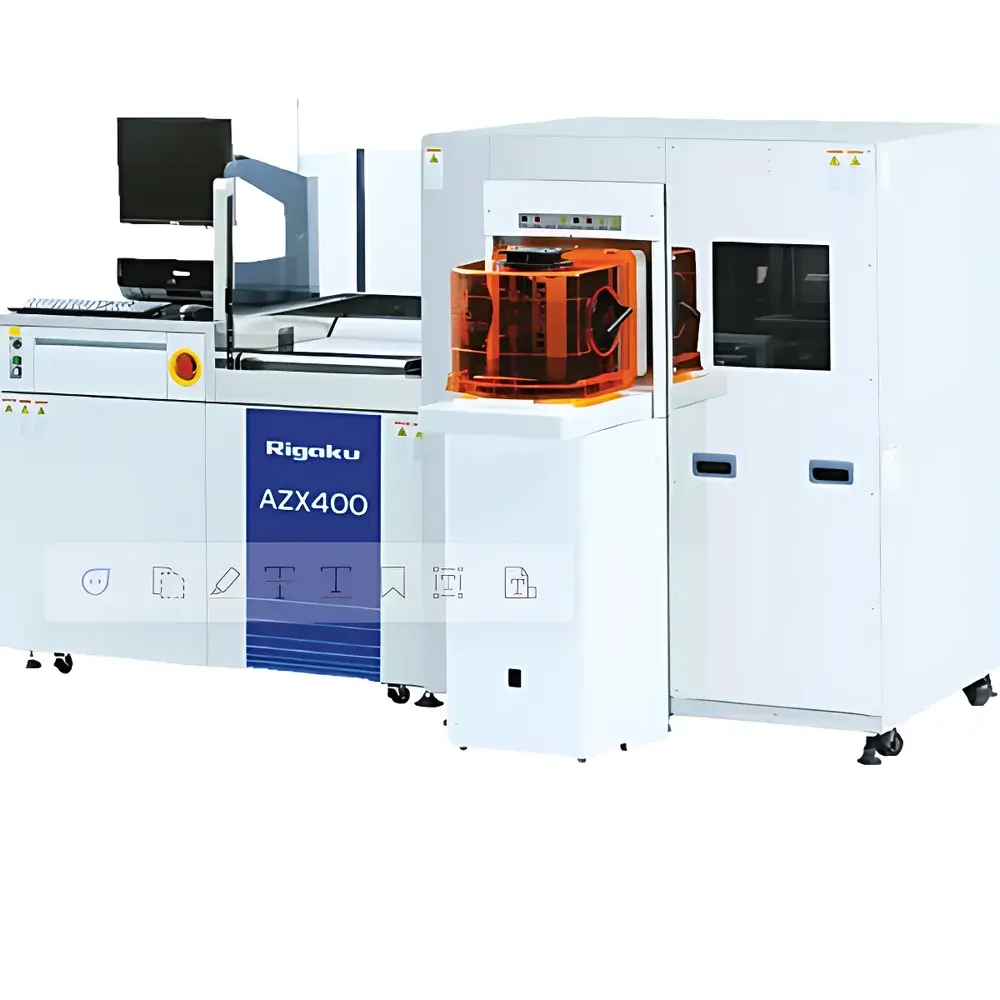
Rigaku AZX 400 Sequential Wavelength Dispersive X-Ray Fluorescence Spectrometer
| Brand | Rigaku |
|---|---|
| Origin | Japan |
| Model | AZX 400 |
| Sample Capacity | Ø400 mm × 50 mm thickness × 30 kg max |
| Elemental Range | Ta, Cu, Ru, Pt, Mn |
| Repeatability | 0.12% RSD |
| Configuration | Floor-standing WD-XRF system |
| Application Focus | Semiconductor metrology, sputtering target QC, magnetic disk analysis, multilayer thin-film characterization |
| Compliance | Designed for ISO/IEC 17025-compliant labs |
Overview
The Rigaku AZX 400 is a high-precision sequential wavelength dispersive X-ray fluorescence (WD-XRF) spectrometer engineered for rigorous elemental quantification in demanding industrial and semiconductor manufacturing environments. Unlike energy dispersive (ED-XRF) systems, the AZX 400 employs Bragg diffraction from precisely aligned analyzing crystals to isolate characteristic X-ray lines with superior peak-to-background ratios and spectral resolution—enabling accurate detection and quantification of trace and major elements across complex matrices. Its robust floor-standing architecture accommodates large-format samples up to 400 mm in diameter, 50 mm in thickness, and 30 kg in mass—making it uniquely suited for direct analysis of sputtering targets, hard disk platters, ceramic substrates, and multi-layered thin-film wafers without sectioning or destructive preparation. The system operates on fundamental parameter (FP) and empirical calibration methodologies, delivering quantitative results traceable to NIST SRMs and compliant with ASTM E1621, ISO 21043, and IEC 62321-5 for RoHS-constrained substance screening.
Key Features
- Sequential WD-XRF optics with selectable analyzing crystals (e.g., LiF, PET, Ge) and high-resolution proportional counters for optimized sensitivity across light (Na) to heavy (U) elements
- Motorized goniometer with <0.001° angular positioning accuracy ensures precise Bragg angle alignment for each element line
- High-power 4 kW end-window X-ray tube (Rh anode) with variable kV/mA control (up to 60 kV / 120 mA) for matrix-adapted excitation
- Dual-stage vacuum and helium purge pathways enable optimal detection of elements from Na (Z=11) to U (Z=92)
- Integrated sample stage with programmable XYZ translation and tilt adjustment for spatially resolved mapping and multi-point analysis
- Optional automated wafer loader (AZX 400-WL) supporting 100–300 mm semiconductor wafers with SEMI E47.1-compliant handling and recipe-driven measurement sequences
Sample Compatibility & Compliance
The AZX 400 accepts irregular, heavy, and geometrically challenging samples—including full-diameter sputtering targets (e.g., ITO, CoCrTa, TiAl), magnetic recording media, PCB laminates, and metallized ceramics—without requiring mounting fixtures or size reduction. Its open-sample chamber design eliminates height restrictions common in benchtop ED-XRF instruments. All analytical protocols are structured to support regulatory compliance: data acquisition logs include operator ID, timestamp, instrument configuration, and calibration status—fully auditable under FDA 21 CFR Part 11 when paired with Rigaku’s certified LabSolution™ software. System validation documentation aligns with ISO/IEC 17025 requirements for testing laboratories, and routine performance verification follows ASTM E1361 for precision and bias assessment.
Software & Data Management
Rigaku LabSolution™ software provides a unified platform for method development, spectral acquisition, quantitative analysis, and reporting. It features embedded FP algorithms with matrix correction (e.g., alpha coefficients, absorption enhancement modeling), customizable calibration curves (linear, quadratic, or polynomial), and statistical process control (SPC) charting for real-time QC monitoring. Raw spectral data, background-subtracted intensities, and uncertainty estimates are stored in vendor-neutral formats (CSV, XML) compatible with LIMS integration. Audit trail functionality records all user actions—including method edits, result overrides, and calibration updates—with immutable timestamps and digital signatures, satisfying GLP and GMP documentation requirements.
Applications
- Quantitative composition analysis of sputtering targets used in PVD processes—ensuring stoichiometric consistency of AlTiN, SiO₂, or NiFe alloys prior to deposition
- Thickness and interfacial composition profiling of multilayer films (e.g., Co/Pt, Ta/Nb, Ru/Cu stacks) via sequential line scanning and depth-resolved FP modeling
- Elemental homogeneity mapping of magnetic disk substrates to detect localized segregation of Cr, Co, or B dopants
- RoHS and ELV screening of electronic assemblies per IEC 62321-5, including Pb, Cd, Hg, Cr⁶⁺, and Br-based flame retardants
- Raw material certification for high-purity metals and ceramics in aerospace and medical device supply chains
FAQ
What distinguishes WD-XRF from ED-XRF for thin-film analysis?
WD-XRF offers significantly higher spectral resolution (~5–10 eV vs. ~130–150 eV for ED-XRF), enabling baseline separation of overlapping lines (e.g., Co Kβ and Ni Kα), critical for accurate quantification in multilayer structures.
Can the AZX 400 perform depth profiling without sputtering?
Yes—through variable take-off angle measurements and FP-based attenuation modeling, it non-destructively estimates layer thicknesses and compositions for films up to ~5 µm thick.
Is the system compatible with existing lab informatics infrastructure?
It supports ASTM E1382-compliant data export, OPC UA connectivity, and RESTful API access for integration with enterprise LIMS, MES, and SPC platforms.
What maintenance is required for long-term stability?
Annual crystal alignment verification, X-ray tube lifetime monitoring (typically >20,000 h), and periodic vacuum pump oil replacement—documented in Rigaku’s Preventive Maintenance Guide (PMG-400).
Does Rigaku provide application support for method development?
Yes—Rigaku’s Global Applications Laboratory offers remote and on-site method optimization, CRM-based validation, and ASTM/ISO-compliant uncertainty budgeting services.





