
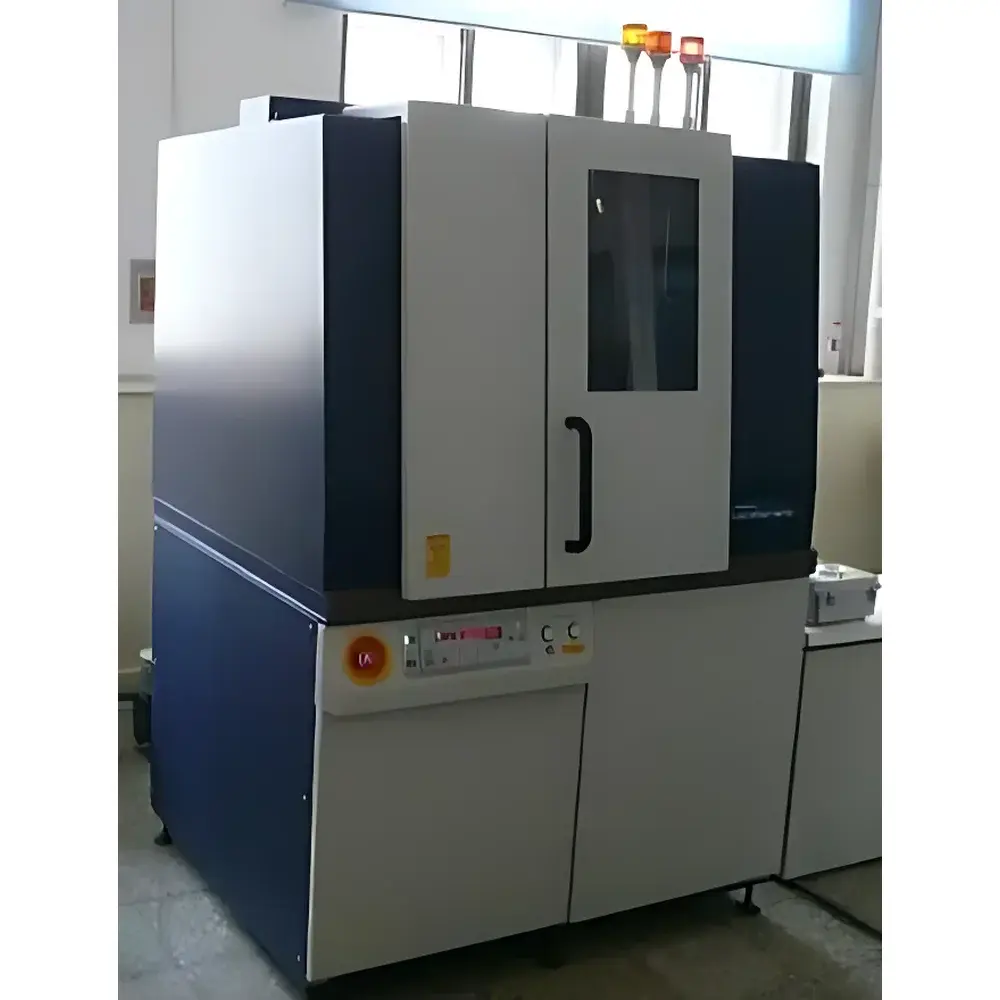
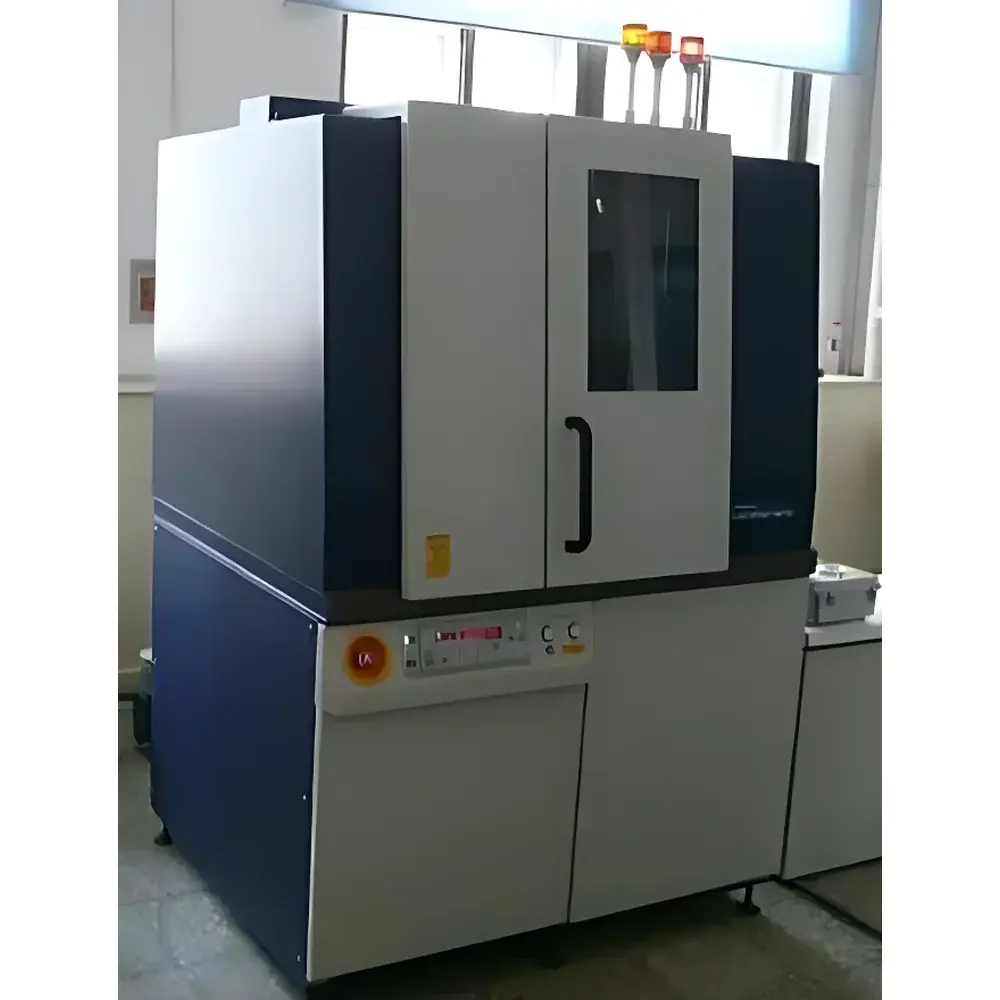
Rigaku D/max-2600/PC High-Power Rotating-Anode X-ray Diffractometer
| Brand | Rigaku |
|---|---|
| Origin | Japan |
| Model | D/max-2600/PC |
| X-ray Generator Power | 9 kW |
| Goniometer Type | Vertical or Horizontal Wide-Angle |
| Minimum Step Angle | 0.0001° |
| Variable Aperture Slit | Programmed |
| Optical Configurations | Focusing and Parallel Beam (Switchable) |
| Monochromator | High-Efficiency Graphite |
| Detector | D/teX-Ultra (Energy Resolution <20%) |
| Automation | Fully Automated Alignment & Calibration |
| Software Suite | Comprehensive XRD Analysis Package |
| Sample Types | Powder, Bulk, Thin Film, Micro-region, Trace |
| Environmental Capabilities | In-situ HT/VT/LT, Humidity, Electrochemical, Magnetic Field |
Overview
The Rigaku D/max-2600/PC is a high-power, rotating-anode X-ray diffractometer engineered for precision crystallographic analysis across academic, industrial, and regulatory laboratories. Based on the long-established D/max platform—widely recognized as an industry benchmark for reliability and methodological consistency—the system employs Cu Kα radiation generated by a 9 kW sealed-tube rotating anode source, delivering exceptional photon flux and thermal stability. Its core measurement principle relies on Bragg diffraction of monochromatic X-rays from crystalline lattices, enabling quantitative phase identification, lattice parameter refinement, microstructural characterization, and structural modeling via Rietveld full-pattern fitting. Designed for reproducible data acquisition under stringent analytical conditions, the D/max-2600/PC supports both conventional θ–2θ scanning and specialized geometries including grazing-incidence (GIXRD), transmission, and small-angle X-ray scattering (SAXS) modes when configured with optional optical modules.
Key Features
- 9 kW high-power rotating anode X-ray generator ensures high-intensity, stable output essential for time-resolved and low-concentration measurements
- Wide-angle goniometer with ±160° 2θ range and 0.0001° minimum step resolution enables high angular fidelity for peak deconvolution and strain evaluation
- Programmable variable divergence and receiving slits allow dynamic optimization of intensity vs. resolution trade-offs per scan segment
- Interchangeable focusing and parallel-beam optics facilitate rapid adaptation between powder, thin-film, and bulk sample configurations without hardware re-alignment
- Graphite monochromator provides >85% Kα transmission efficiency and effective suppression of Kβ contamination
- D/teX-Ultra high-speed silicon strip detector offers sub-millisecond pixel response, real-time energy discrimination (<20% at Mn Kα), and zero dead-time operation during continuous scanning
- Fully automated alignment routines—executed via dedicated calibration tools and embedded firmware—ensure repeatable instrument geometry and standardized data quality across operators and shifts
- Modular design supports seamless integration of environmental stages: furnace (RT–1700°C), cryostat (10–600 K), humidity chamber (10–95% RH), electrochemical cell, and superconducting magnet (up to 9 T)
Sample Compatibility & Compliance
The D/max-2600/PC accommodates diverse physical forms: free-flowing powders (≥1 mg), solid blocks (≤50 mm diameter), polycrystalline thin films (1 nm–5 µm thickness), micro-focused regions (down to 100 µm spot size), and trace-volume samples (e.g., capillary-loaded nanomaterials). All sample holders comply with ISO 17025-accredited laboratory practices and are compatible with ASTM E975 (residual stress), ASTM E1423 (crystallinity), and ISO 21392 (thin-film phase analysis) protocols. The system architecture supports GLP/GMP workflows through audit-trail-enabled software logging, electronic signatures per FDA 21 CFR Part 11, and configurable user access levels aligned with ICH Q7 and ISO 9001 requirements.
Software & Data Management
Control and analysis are unified within Rigaku’s SmartLab Studio II suite—a modular, scriptable platform supporting batch processing, automated report generation (PDF/CSV/XML), and direct export to Crystallography Open Database (COD) and ICDD PDF-4+ formats. Key modules include PDXL for phase identification and quantitative analysis (RIR, internal standard, whole-pattern fitting), TOPAS Academic for advanced Rietveld and parametric modeling, and SAXSQuant for nanoparticle size distribution derivation from Guinier–Porod analysis. Raw data are stored in vendor-neutral .raw/.chi formats; metadata embedding follows NeXus/HDF5 conventions for FAIR (Findable, Accessible, Interoperable, Reusable) compliance.
Applications
- Qualitative and quantitative phase analysis of multi-component mixtures (e.g., catalysts, battery cathodes, pharmaceutical polymorphs)
- Crystallinity index calculation and Scherrer–Williamson crystallite size/strain decomposition in nanomaterials and polymers
- Lattice parameter mapping and symmetry determination (triclinic to cubic) via single-crystal-like indexing of polycrystalline datasets
- Rietveld structure refinement for unknown or partially ordered phases, including magnetic and modulated structures
- Grazing-incidence XRD for depth-resolved phase evolution in multilayer coatings and epitaxial heterostructures
- Pole figure acquisition and orientation distribution function (ODF) reconstruction for metallurgical texture quantification
- Residual stress profiling using sin²ψ methodology with multiple hkl reflections for anisotropic materials
- In-situ synchrotron-comparable studies: operando battery cycling, solid-state reaction kinetics, thermal expansion anisotropy, and field-induced structural transitions
FAQ
What X-ray tube options are available for the D/max-2600/PC?
Standard configuration uses a Cu anode; optional Mo, Co, Fe, Cr, and Ag tubes are available for element-specific excitation and absorption-edge applications.
Is the system compatible with third-party automation or robotic sample changers?
Yes—RS-232, Ethernet, and LabVIEW-compatible APIs enable integration with XYZ autosamplers, glovebox-integrated loaders, and centralized LIMS platforms.
How is calibration traceability maintained across instrument lifetime?
NIST-traceable silicon SRM 640e and LaB₆ standards are supported; automatic calibration checks against certified reference materials are scheduled via SmartLab Studio II’s QC module.
Can the D/teX-Ultra detector be used for energy-dispersive XRD (EDXRD)?
No—the D/teX-Ultra is a position-sensitive detector optimized for wavelength-dispersive geometry; EDXRD requires a separate Si(Li) or SDD configuration.
What maintenance intervals are recommended for the rotating anode generator?
Annual vacuum integrity verification, biannual bearing inspection, and quarterly filament performance validation per Rigaku Technical Bulletin TB-2600-RM.




