
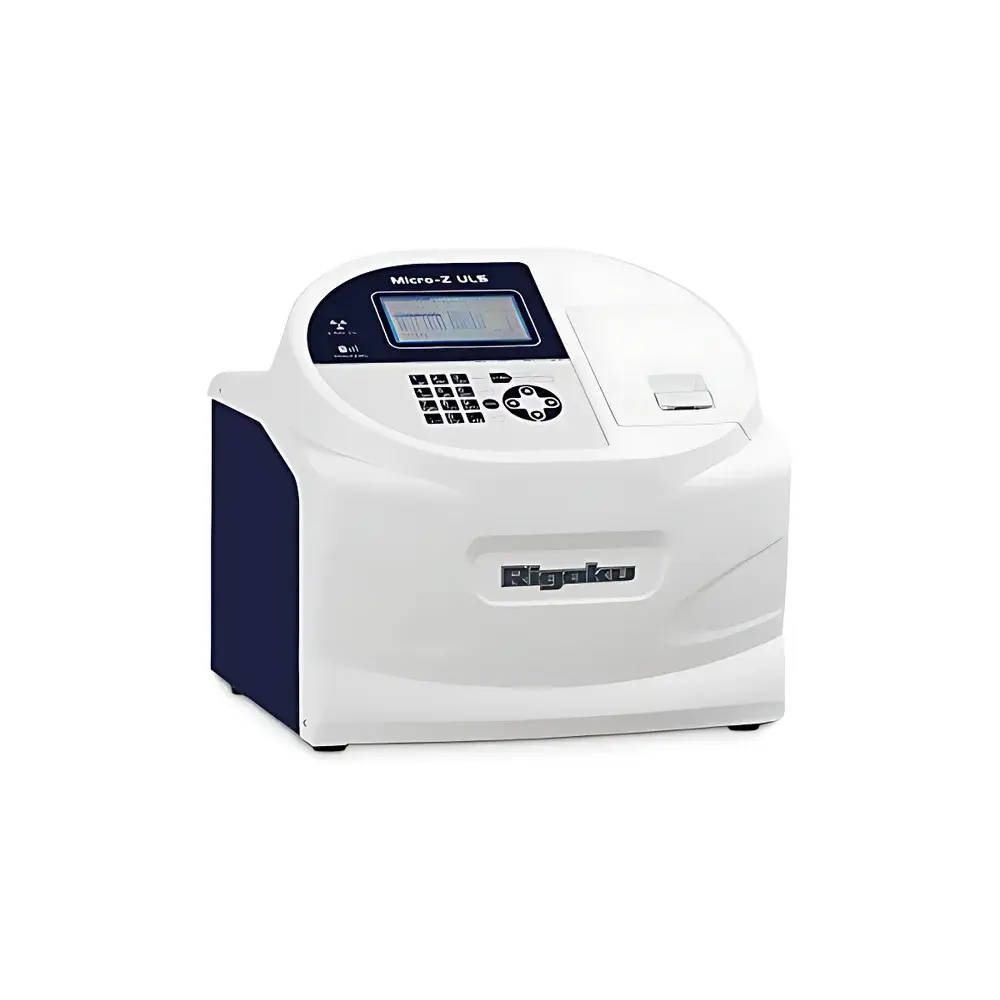
Rigaku Micro-Z ULS Wavelength Dispersive X-ray Fluorescence (WDXRF) Total Sulfur Analyzer
| Brand | Rigaku |
|---|---|
| Origin | Japan |
| Model | Micro-Z ULS |
| Detection Principle | Wavelength Dispersive X-ray Fluorescence (WDXRF) |
| Detection Limit | 0.2 ppm |
| Measurement Range | 0–5 wt% |
| Analysis Time | < 300 s |
| Excitation Source Power | 80 W |
| Vacuum Requirement | Yes (gas-free operation) |
| Power Supply | AC 200–240 V, 200 W |
| Operating Environment | 10–40 °C, RH < 80 % |
| Dimensions (W×D×H) | 45 × 41 × 43 cm |
| Weight | 40 kg |
| Compliance Standards | ASTM D2622, GB/T 11140, SH/T 0842 |
Overview
The Rigaku Micro-Z ULS is a benchtop wavelength dispersive X-ray fluorescence (WDXRF) spectrometer engineered exclusively for precise, rapid, and trace-level total sulfur quantification in liquid petroleum products. Unlike energy-dispersive (EDXRF) systems, the Micro-Z ULS employs high-resolution Bragg diffraction optics to isolate the characteristic sulfur Kα emission line (2.307 keV) with exceptional spectral selectivity—minimizing matrix interference from hydrocarbons, metals, and heteroatoms. This physical separation mechanism ensures metrological robustness across diverse fuel matrices without chemical digestion or calibration transfer between sample types. Designed for routine QC/QA laboratories in refineries, independent testing labs, and regulatory compliance facilities, the instrument delivers certified-level performance aligned with internationally recognized test methods including ASTM D2622 (Standard Test Method for Sulfur in Petroleum Products by Wavelength Dispersive X-ray Fluorescence Spectrometry), GB/T 11140 (Chinese national standard for sulfur analysis in petroleum fractions), and SH/T 0842 (Chinese industry standard for ultra-low-sulfur diesel and gasoline).
Key Features
- Sub-ppm detection capability: Achieves a validated limit of detection (LOD) of 0.2 ppm sulfur in light distillates—enabling compliance verification against Tier 3 gasoline (≤10 ppm), Euro 6 diesel (≤10 ppm), and IMO 2020 marine fuel (≤0.5 wt%) specifications.
- Stable, low-maintenance optical architecture: Utilizes a fixed-channel WDXRF configuration with a single high-efficiency analyzing crystal optimized for sulfur Kα, eliminating mechanical movement of goniometers and ensuring long-term calibration stability (annual recalibration recommended).
- Gas-free vacuum operation: Integrated turbomolecular pumping system replaces helium or argon purge environments—reducing consumable costs, eliminating gas handling hazards, and improving analytical reproducibility under variable ambient conditions.
- Compact footprint and plug-and-play deployment: 40 kg unit fits on standard lab benches; requires only AC power and minimal ventilation—no external chiller, compressed air, or exhaust ducting.
- Non-destructive, membrane-sealed sample presentation: Uses disposable polypropylene or Mylar film-bottomed cups—no solvent exposure, no cup cutting, no residue carryover—ensuring high linearity (R² > 0.9999 over 0–5 wt%) and negligible maintenance downtime.
- High-power microfocus X-ray source: 80 W end-window tube delivers enhanced photon flux at optimal excitation energy—improving signal-to-noise ratio and enabling shorter measurement times without sacrificing precision.
Sample Compatibility & Compliance
The Micro-Z ULS is validated for direct analysis of unmodified liquid hydrocarbon samples including gasoline, diesel fuel, naphtha, kerosene (Jet A-1), crude oil (after homogenization and filtration), and lubricant base stocks. Sample volume requirement is 2–3 mL per analysis. No acid digestion, combustion, or catalyst-assisted oxidation is required—preserving sample integrity and eliminating procedural bias. All measurement protocols adhere strictly to the precision requirements defined in ASTM D2622 (repeatability ≤ 0.15 ppm + 0.003 × sulfur concentration; reproducibility ≤ 0.30 ppm + 0.006 × sulfur concentration). The system supports full audit trail generation, electronic signature enforcement, and user access control—facilitating alignment with GLP and ISO/IEC 17025 laboratory accreditation frameworks.
Software & Data Management
Rigaku’s proprietary ULTRA software provides intuitive method setup, real-time spectrum visualization, automated peak integration, and multi-point calibration curve management. All raw spectra, processed results, instrument parameters, and operator metadata are stored in a relational database compliant with FDA 21 CFR Part 11 requirements—including time-stamped electronic signatures, immutable audit logs, and role-based permission tiers. Data export supports CSV, XML, and LIMS-compatible formats (ASTM E1384, ASTM E1489). Remote diagnostics and firmware updates are supported via secure HTTPS connection—enabling proactive service intervention without onsite visits.
Applications
- Refinery process stream monitoring: Real-time sulfur tracking in hydrotreater feed and product streams to optimize catalyst life and H₂ consumption.
- Fuel certification: Final product release testing for road transport fuels, aviation turbine fuels, and marine distillates per EN 590, ASTM D975, ASTM D1655, and IMO MARPOL Annex VI.
- Crude assay and blending optimization: Quantitative sulfur profiling across crude slates to inform desalting and fractionation strategies.
- Research & development: Catalyst evaluation studies, additive interaction analysis, and alternative fuel formulation (e.g., bio-blends, synthetic fuels).
- Third-party verification: Accredited testing per ISO/IEC 17025 scope for contract laboratories serving OEMs and regulatory agencies.
FAQ
Does the Micro-Z ULS require carrier gas or purge gas during operation?
No—vacuum mode eliminates the need for helium, argon, or nitrogen purge, reducing operational cost and simplifying lab infrastructure.
What is the typical calibration frequency under routine use?
Annual calibration verification is sufficient when operated within specified environmental conditions and using certified reference materials traceable to NIST or equivalent national standards.
Can the system analyze viscous or high-boiling samples such as heavy fuel oil?
Yes—with optional pre-heating sample stage (accessory) and appropriate filtration (<0.45 µm), the instrument accommodates samples up to 400 °C initial boiling point; viscosity limits apply per ASTM D2622 Annex A2.
Is remote software support and troubleshooting available?
Yes—ULTRA software includes secure remote access capability for Rigaku Field Application Scientists to perform diagnostics, parameter optimization, and training sessions without interrupting lab operations.
Are critical components serviceable locally in China?
Yes—Rigaku maintains authorized service centers in Beijing, Shanghai, and Guangzhou equipped to replace X-ray tubes, high-voltage power supplies, and vacuum pumps on-site, minimizing instrument downtime.



