
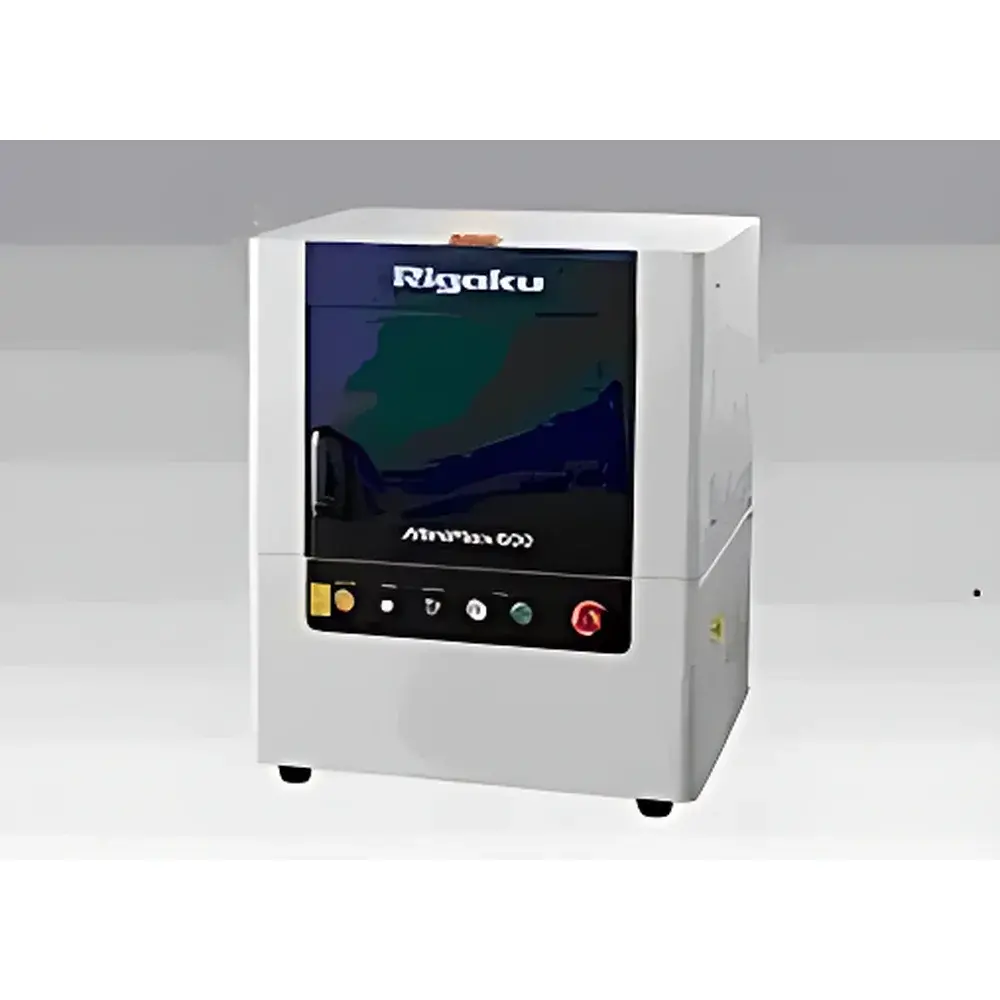
Rigaku MiniFlex 600 Benchtop X-ray Diffractometer
| Brand | Rigaku |
|---|---|
| Origin | Japan |
| Model | MiniFlex 600 |
| Instrument Type | Benchtop Powder X-ray Diffractometer |
| Configuration | Floor-standing |
| Power Output | 600 W |
| Dimensions (W×H×D) | 560 × 700 × 395 mm |
| Weight | ~80 kg |
| Safety | Interlocked X-ray shutter with automatic beam cutoff during sample loading |
| Detector | Compatible with D/teX Ultra2 high-speed 1D array detector |
| Optional Accessories | Monochromator (Kβ suppression), Rotating Sample Stage, Air/Moisture-Sensitive Sample Stage, 6-Position Auto-Sampler |
| Software Suite | PDXL (Qualitative & Quantitative Analysis), ICDD PDF-4+ Database Integration, Dust Quantification Module (for occupational hygiene applications), Multi-Scan Acquisition, Rietveld Refinement (optional module) |
Overview
The Rigaku MiniFlex 600 is a compact, floor-standing benchtop powder X-ray diffractometer engineered for precision phase identification, quantitative analysis, and crystallinity assessment across academic, industrial, and field-deployable environments. Unlike conventional single-crystal diffractometers, the MiniFlex 600 operates on Bragg’s law-based powder diffraction geometry using Cu Kα radiation (λ = 1.5418 Å) generated by a sealed-tube X-ray source. Its optimized goniometric design—featuring a θ–θ configuration with high-precision angular encoding—ensures reproducible 2θ scanning from 5° to 80° (extendable to 120° with optional hardware), delivering data quality comparable to full-size laboratory systems. Designed specifically for powder and polycrystalline samples, it supports both routine QC workflows and exploratory materials research without requiring dedicated radiation shielding rooms. The system meets international safety standards including IEC 61010-1 (electrical safety) and IEC 62495 (X-ray equipment safety), with fully interlocked beam shutters and real-time radiation monitoring.
Key Features
- 600 W high-stability sealed-tube X-ray source—33% higher power than the MiniFlex II—enabling improved signal-to-background ratio and reduced acquisition time without compromising thermal stability.
- High-accuracy automated goniometer with programmable divergence and scattering slits, enabling dynamic optimization of peak-to-background (P/B) ratio across low-angle (60° 2θ) regions.
- Integrated safety architecture: X-ray emission automatically terminates when the sample chamber door is opened or during manual sample insertion; compliance with national radiation protection regulations (e.g., NRC 10 CFR 35, EU Directive 2013/59/Euratom).
- Modular detector compatibility—including the D/teX Ultra2 silicon strip detector—providing >10× faster data collection versus traditional scintillation counters, with intrinsic energy discrimination to suppress fluorescence background.
- Tool-free optical alignment and self-calibrating encoder system minimize setup time and reduce operator dependency—critical for teaching labs and multi-user facilities.
- Robust mechanical enclosure with IP54-rated dust/moisture resistance and shock-absorbing transport mounts, supporting deployment in non-laboratory settings such as mining sites, manufacturing floors, or environmental monitoring stations.
Sample Compatibility & Compliance
The MiniFlex 600 accommodates standard 25 mm and 32 mm diameter powder holders, thin-film substrates, and irregular solids via adjustable sample stage fixtures. Optional accessories include an inert-atmosphere sample stage (N₂/Ar purged) for air-sensitive compounds, a rotating stage for preferred-orientation mitigation, and a six-position auto-sampler for unattended sequential analysis. All configurations comply with ASTM E975 (Standard Practice for X-ray Diffraction Crystallographic Analysis), ISO 17881 (XRD for cementitious materials), and USP (X-ray Powder Diffraction for pharmaceuticals). Data integrity adheres to FDA 21 CFR Part 11 requirements when used with validated PDXL software configurations, including electronic signatures, audit trails, and user-access controls.
Software & Data Management
Rigaku’s PDXL software platform provides a unified interface for instrument control, real-time data visualization, and advanced analysis. Core modules include: (1) Multi-scan acquisition with automatic background subtraction and intensity normalization; (2) Qualitative phase identification using the ICDD PDF-4+ database (over 1.1 million entries); (3) Semi-quantitative analysis via Reference Intensity Ratio (RIR) and full-pattern Rietveld refinement (with licensed add-on); (4) Dedicated dust quantification workflow aligned with OSHA and EU REACH exposure limit methodologies; (5) Batch processing and report generation compliant with GLP/GMP documentation standards. Raw data is stored in industry-standard .raw and .xy formats, ensuring interoperability with third-party tools such as GSAS-II, TOPAS, and HighScore Plus.
Applications
The MiniFlex 600 serves diverse analytical needs: in academia, it supports undergraduate XRD laboratories and graduate-level structural characterization projects; in manufacturing, it enables rapid raw material verification, catalyst crystallinity screening, and corrosion product identification on production lines; in occupational health, its dust analysis module quantifies respirable crystalline silica (RCS), quartz, and other regulated mineral phases per ISO 7702 and NIOSH Method 7500; in environmental science, it characterizes soil mineralogy, asbestos analogues, and heavy-metal-bearing precipitates. Field-deployable operation—enabled by its 80 kg mass and integrated vibration-damping feet—facilitates on-site analysis at heritage conservation sites, archaeological excavations, and disaster response zones.
FAQ
Is the MiniFlex 600 classified as a portable or benchtop instrument?
It is a benchtop instrument with enhanced portability—designed for permanent installation but capable of relocation using standard lab dollies; not battery-powered or handheld.
Does it require external cooling or dedicated HVAC?
No. The 600 W tube uses passive air convection and internal heat sinks; ambient temperature stability within 18–28 °C is recommended.
Can it perform quantitative analysis on amorphous content?
Yes—via internal standard addition or whole-pattern fitting methods when combined with Rietveld refinement software.
What radiation safety certifications does it hold?
CE marking per EU Directive 2013/59/Euratom; conforms to Japanese Ordinance No. 201 (Radiation Hazard Prevention); includes built-in dosimeter interface for facility-level monitoring.
Is remote operation supported?
Yes—PDXL supports LAN-based instrument control and data transfer; integration with LIMS via ASTM E1384-compliant XML export is available.






