
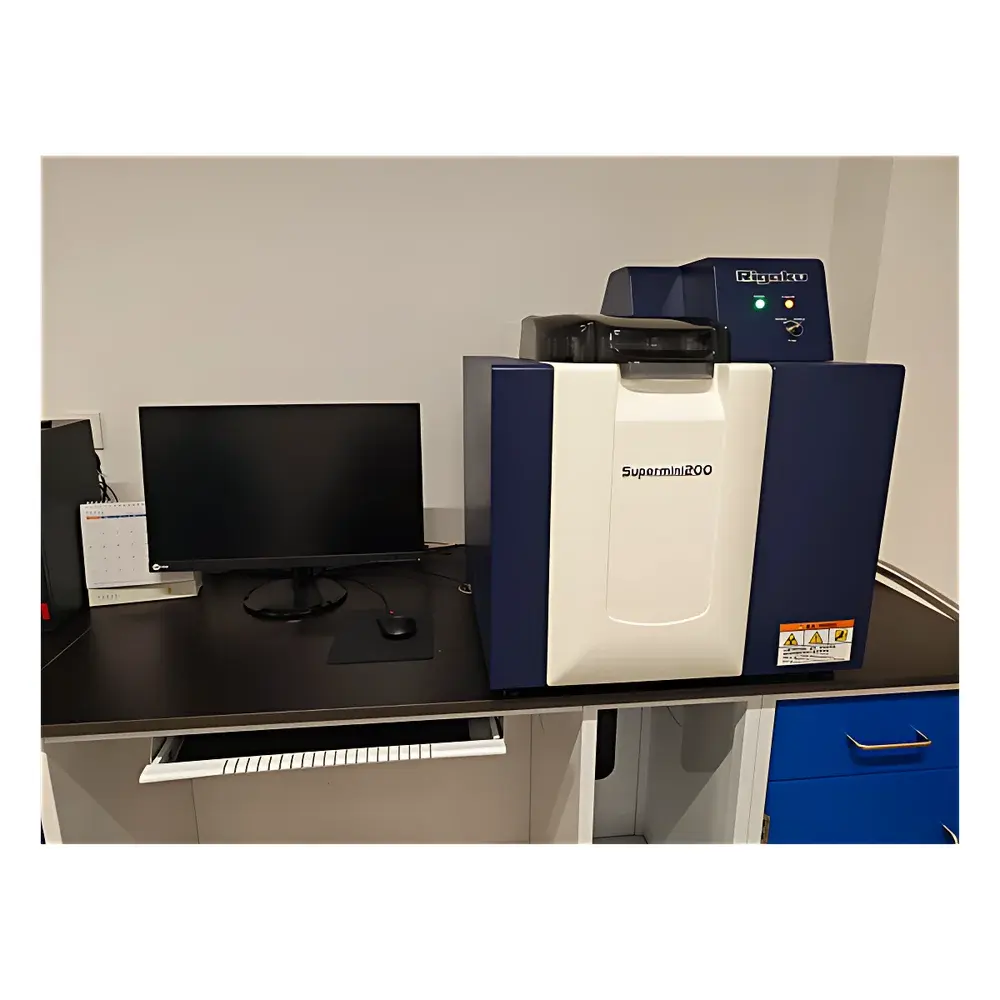
Rigaku Supermini200-P Wavelength Dispersive X-Ray Fluorescence Spectrometer for Petroleum Coke and Catalyst Elemental Analysis
| Brand | Rigaku |
|---|---|
| Origin | Japan |
| Instrument Type | Benchtop |
| X-ray Tube Power | 200 W |
| Elemental Range | Na (11) to U (92) |
| Detector | Flow Proportional Counter (F-PC) and Scintillation Counter |
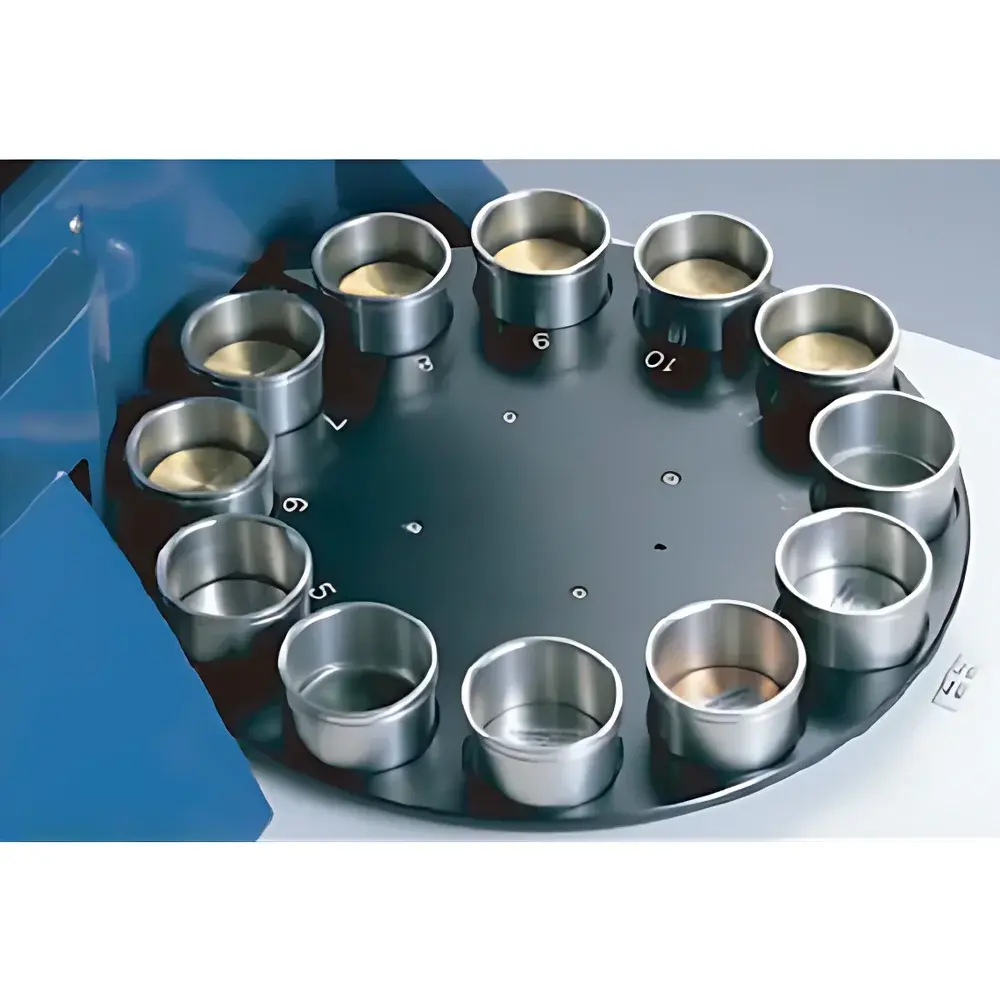
| Sample Handling | 12-position Automatic Sampler |
| Operating Atmosphere | Air, He, or Vacuum |
| Dimensions | 580(W) × 670(H) × 680(D) mm |
| Power Supply | 200–240 V, 10 A |
| Grounding Resistance | <30 Ω |
| Ambient Temperature | 10–40 °C |
| Relative Humidity | <80% RH |
Overview
The Rigaku Supermini200-P is a benchtop wavelength dispersive X-ray fluorescence (WDXRF) spectrometer engineered for high-precision, routine elemental analysis of heterogeneous industrial materials—particularly petroleum coke, refinery catalysts, crude oil, distillates (e.g., gasoline, diesel, naphtha), aqueous samples (including wastewater), and solid polymers. Based on Bragg diffraction principles, the instrument utilizes crystal monochromators to resolve characteristic X-ray lines with superior peak-to-background ratios, enabling trace-level quantification without chemical digestion or matrix dissolution. Its 200 W sealed-tube X-ray source delivers enhanced photon flux for improved detection limits—especially critical for light elements (Na–F) and transition metals (Fe, Ni, V, Ca) in carbon-rich matrices. Designed to comply with YS/T 63.16 (for petroleum coke), SH/T 0934 (for catalysts), and GB/T 11140 (for sulfur in petroleum products), the system supports regulatory-grade reporting in refining, petrochemical QA/QC, and environmental compliance laboratories.
Key Features
- Benchtop architecture with compact footprint (580 × 670 × 680 mm), requiring no dedicated shielding room or high-power infrastructure
- Multi-detector configuration: flow-proportional counter (F-PC) optimized for light elements (Na–F) and scintillation counter for mid-to-heavy elements (Al–U)
- 12-position automatic sample changer enabling unattended batch analysis of powders, solids, and liquids in standardized cups or cells
- Atmosphere control module supporting ambient air, helium purge (for enhanced light-element sensitivity), or vacuum operation (for ultra-low-Z analysis)
- Real-time spectral calibration via helium gas path correction and thin-film standard alignment routines
- Pre-installed quantitative methods compliant with YS/T 63.16, SH/T 0934, and GB/T 11140—validated for Si, Fe, Ni, V, Ca in petroleum coke and S, Sb, Fe, Ni, V, Ca in FCC catalysts at ≤15 ppm practical detection limits
- Native Windows-based software with full LIMS integration capability, audit trail logging, and electronic signature support aligned with FDA 21 CFR Part 11 requirements
Sample Compatibility & Compliance
The Supermini200-P accepts diverse physical forms without mandatory pre-treatment: pressed pellets and fused beads (for powders), direct liquid measurement in quartz or polyethylene cells, and flat-surface solids (e.g., catalyst wafers). It meets ISO/IEC 17025 method validation criteria when operated under documented SOPs and calibrated using certified reference materials (CRMs) traceable to NIST or CRM suppliers such as NRC Canada or BAM Germany. The instrument holds an official exemption certificate from the Japanese Ministry of the Environment, eliminating administrative burdens associated with radiation device registration under national nuclear safety regulations. All analytical protocols are structured to satisfy GLP and refinery-specific quality management systems (e.g., API RP 571, ASTM D7042).
Software & Data Management
The integrated Windows application provides three analysis modes: qualitative scanning (element identification), fundamental parameter (FP)-based quantitative analysis, and empirical calibration with optional standardless approximation. Method development tools include database-matching algorithms for unknown sample classification, matrix correction libraries for petroleum matrices, and automated inter-element interference compensation. Data storage is managed via relational database architecture with configurable retention policies; raw spectra, calibration curves, and result reports are exportable in CSV, PDF, and XML formats. Audit trails record user actions, method modifications, and calibration events—fully compliant with GxP data integrity expectations.
Applications
- Petroleum coke QC: Quantification of Si, Fe, Ni, V, Ca per YS/T 63.16 for anode-grade specification compliance
- Catalyst monitoring: S, Cl, Si, Pb, and heavy metals (Pt, Rh, Pd, Ni, V) in fluid catalytic cracking (FCC) and hydroprocessing catalysts per SH/T 0934
- Refinery feedstock screening: S and Cl in naphtha, diesel, and crude oils per ASTM D7042 and GB/T 11140
- Environmental testing: Heavy metals (Cr, Mn, Fe, Ni, Cu, Zn, As, Cd, Hg, Pb) in coal ash, rubber additives, and wastewater sludge
- Materials certification: Ti–U range analysis for alloy verification, rare earth content in catalyst supports, and residual catalyst metals in polymer products
FAQ
Does the Supermini200-P require sample digestion prior to analysis?
No—solid and liquid samples are analyzed directly, eliminating acid digestion, fusion, or dilution steps.
Is helium purge necessary for sulfur analysis in petroleum products?
Helium atmosphere significantly improves S Kα peak intensity and reduces background noise, especially for low-sulfur fuels (<10 ppm); it is recommended but not mandatory for routine compliance testing.
Can the system be upgraded to extend elemental coverage beyond Na–U?
The optical path and detector configuration are fixed for Na (11)–U (92); however, method optimization and CRM selection can enhance sensitivity for specific elements within this range.
What documentation is provided for regulatory audits?
Factory-issued IQ/OQ protocols, calibration certificates, CRM traceability statements, and software validation summaries are supplied; users may generate additional PQ records per internal SOPs.
Is remote diagnostics supported?
Yes—the system includes secure remote access capability for firmware updates, spectral troubleshooting, and method transfer under IT-controlled network policies.





