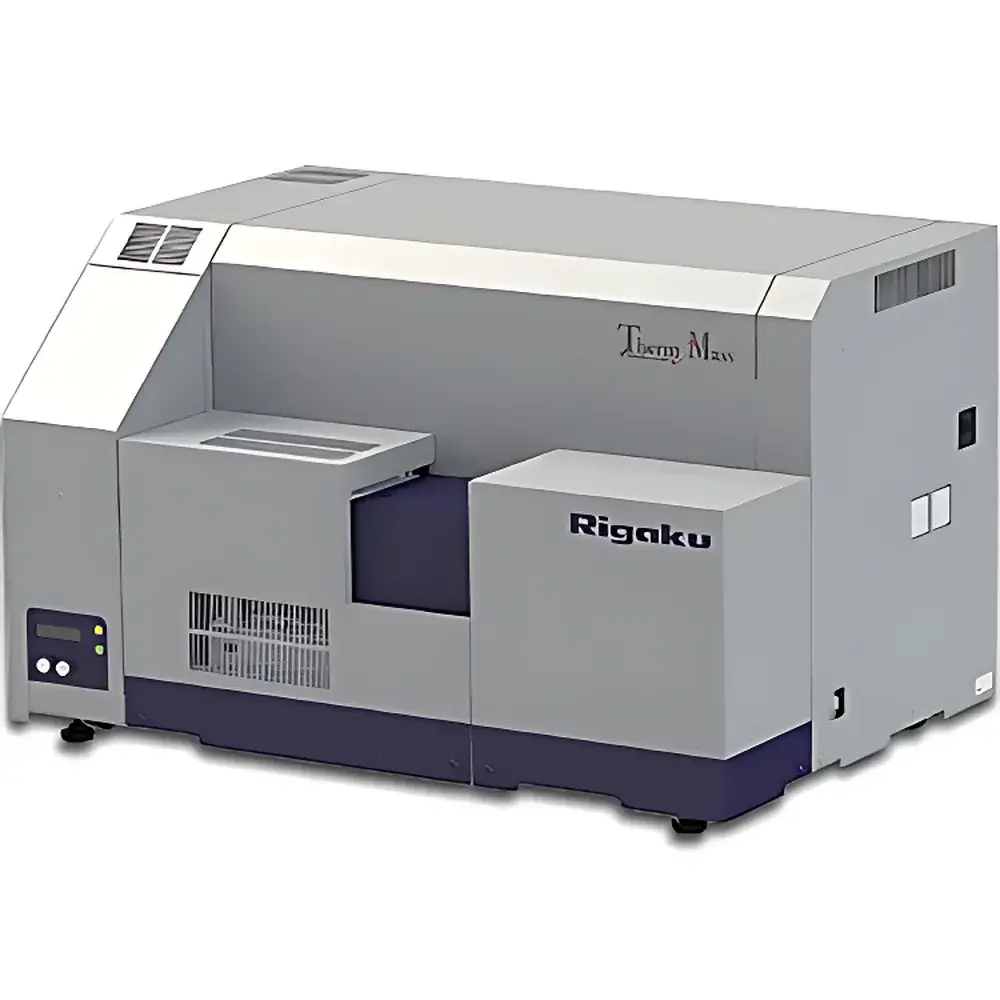
Rigaku Thermo Mass Photo TG-DTA-Photoionization Mass Spectrometry Coupled System

| Brand | Rigaku |
|---|---|
| Origin | Japan |
| Manufacturer Type | Authorized Distributor |
| Origin Category | Imported |
| Model | Thermo Mass Photo |
| Price | Upon Request |
| Interface | Conical quartz inlet mounted inside furnace with jet separator |
| Temperature Range | Ambient to 1100 °C |
| Mass Range | m/z 1–410 |
| Ionization Modes | Vacuum UV Photoionization (Patented Soft Ionization) and Electron Impact (EI) |
| Detection Capability | Fragment-free analysis of evolved gases including H₂ (m/z 1), CO, CH₄, H₂O, NH₃, NOₓ, VOCs, and high-mass organics up to m/z 410 |
Ask about pricing, availability and specifications.
Overview
The Rigaku Thermo Mass Photo is a fully integrated thermal analysis–mass spectrometry coupling system engineered for simultaneous thermogravimetric (TG), differential thermal analysis (DTA), and real-time evolved gas analysis (EGA) using vacuum ultraviolet (VUV) photoionization mass spectrometry. Unlike conventional electron impact (EI) MS-coupled systems that induce extensive molecular fragmentation, this instrument employs Rigaku’s proprietary conical quartz interface and VUV photon-based soft ionization—operating at 10.6 eV—to preserve molecular integrity during ion formation. This enables unambiguous identification of labile species such as hydrogen (m/z 1), hydrides, peroxides, and low-volatility organics without spectral ambiguity. The system features a high-temperature furnace with precise temperature control from ambient to 1100 °C, synchronized with microsecond-resolved mass spectral acquisition. Its architecture conforms to ISO 11358 (thermogravimetry), ASTM E1131 (EGA), and supports GLP-compliant data handling through audit-trail-enabled software.
Key Features
- Proprietary conical quartz inlet with integrated jet-type gas separator, minimizing residence time and wall adsorption losses for reactive and condensable species
- Dual-mode ionization: switchable between VUV photoionization (soft, fragment-free) and standard EI mode for structural confirmation when required
- High-sensitivity detection of evolved gases across full m/z 1–410 range—including quantitative H₂ measurement at sub-ppb levels in dynamic TG/MS mode
- Synchronized data acquisition: simultaneous recording of mass intensity, weight change (μg resolution), and DTA signal (±0.1 μV) at up to 10 Hz sampling rate
- Furnace-integrated design ensures minimal thermal lag and optimal gas transfer kinetics between sample zone and ion source
- Robust vacuum architecture with turbomolecular pumping system maintaining <1×10⁻⁶ Pa in the mass analyzer during continuous operation
Sample Compatibility & Compliance
The Thermo Mass Photo accommodates solid, powder, and thin-film samples up to 100 mg in standard alumina or platinum crucibles. It supports inert (N₂, Ar), oxidative (air, O₂), and reducing (H₂/N₂) atmospheres with mass-flow-controlled gas delivery. All hardware and firmware comply with IEC 61000-6-3 (EMC) and IEC 61010-1 (safety). Data acquisition and reporting meet FDA 21 CFR Part 11 requirements for electronic records and signatures, including user authentication, version-controlled method storage, and immutable audit trails. System validation documentation supports IQ/OQ/PQ protocols aligned with ISO/IEC 17025 and GMP Annex 11 frameworks.
Software & Data Management
Operation is managed via Rigaku’s ThermoMass Control Suite—a Windows-based platform supporting method-driven workflows, real-time spectral deconvolution, and multi-dimensional correlation mapping (e.g., m/z vs. temperature vs. mass loss). The software includes built-in spectral libraries (NIST, Wiley, and proprietary evolved gas database), peak integration with baseline correction algorithms, and automated quantification using internal standard calibration curves. Raw data are stored in vendor-neutral HDF5 format; export options include CSV, ASCII, and mzML for third-party chemometric analysis (e.g., PCA, MCR-ALS). All processing steps are logged with timestamps, operator ID, and parameter history to satisfy traceability requirements in regulated environments.
Applications
- Hydrogen storage materials characterization: kinetic profiling of H₂ desorption/absorption cycles, phase transition mapping, and degradation pathway elucidation in Mg-based alloys and metal–organic frameworks (MOFs)
- Catalyst deactivation studies: identification of coke precursors, sulfur poisoning agents, and surface-bound intermediates during TPR/TPD experiments
- Electronic packaging reliability: detection of trace acetic acid, formaldehyde, and chlorine-containing volatiles from epoxy molding compounds under thermal stress
- Pharmaceutical solid-state stability: monitoring of residual solvents, excipient degradation products (e.g., lactide, glycolide), and polymorphic transformation markers
- Food-contact polymer safety assessment: screening for aldehydes, epoxides, and heterocyclic amines released during simulated cooking or sterilization conditions
- Carbon fiber composite pyrolysis: speciation of nitrogen- and oxygen-containing fragments to optimize curing profiles and minimize VOC emissions
FAQ
What distinguishes photoionization from electron impact ionization in evolved gas analysis?
Photoionization at 10.6 eV provides near-threshold ionization energy, minimizing bond cleavage and preserving molecular ions—critical for distinguishing isomers (e.g., xylene isomers) and detecting fragile species like H₂O₂ or HO• radicals.
Can the system quantify hydrogen evolution quantitatively?
Yes—using calibrated m/z 1 response with isotopic correction (H₂ vs. HD/D₂) and background subtraction, supported by certified reference gas mixtures traceable to NIST SRM 1676a.
Is the quartz interface compatible with corrosive gases such as HF or HCl?
The conical quartz inlet is resistant to short-term exposure; for extended analysis of halogenated species, optional gold-coated ion source components and corrosion-resistant gas lines are available as accessories.
How is synchronization between TG, DTA, and MS signals ensured?
All detectors share a common timing reference derived from the furnace controller’s internal clock, with hardware-triggered data acquisition ensuring temporal alignment within ±10 ms across all channels.
Does the system support automated method development for routine QC testing?
Yes—the software includes template-based method creation, pass/fail threshold logic, and batch report generation compliant with ISO 17025 reporting requirements.