
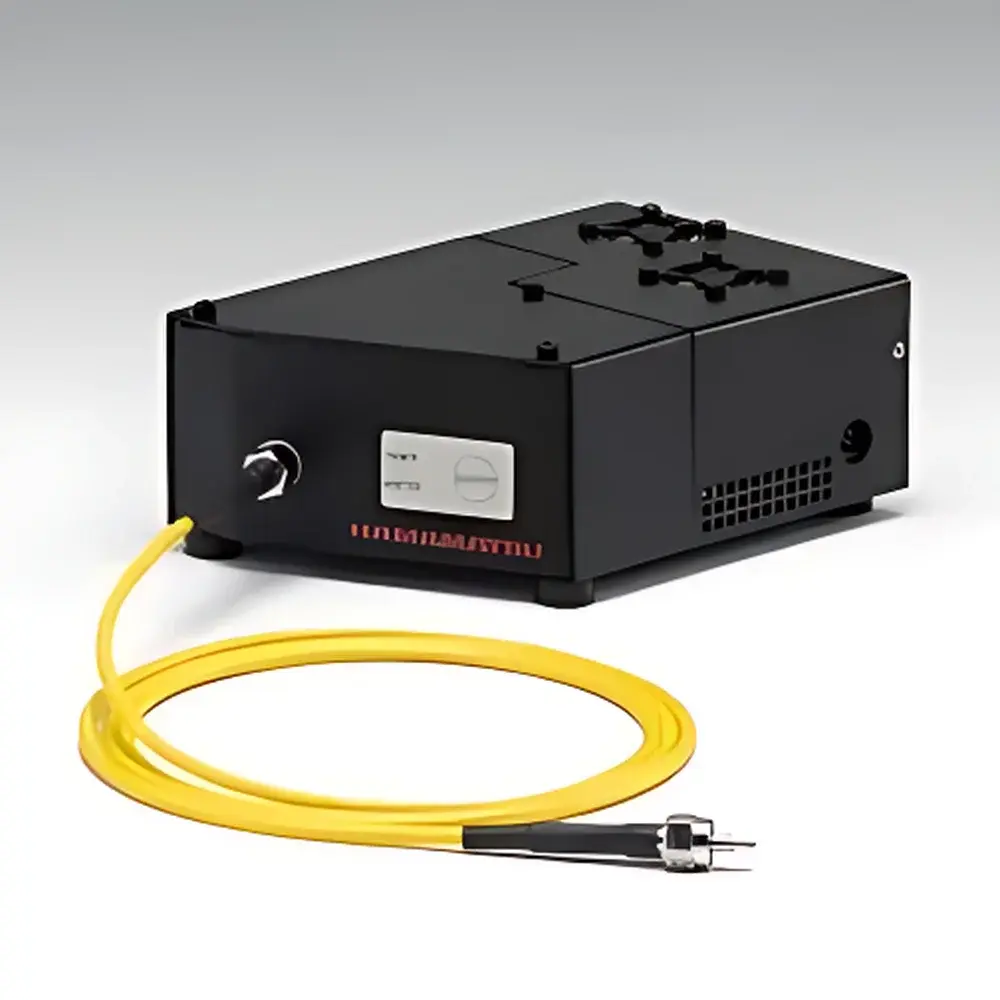
Hamamatsu L12515 UV-Vis Fiber-Coupled Deuterium Light Source
| Brand | Hamamatsu |
|---|---|
| Origin | Japan |
| Manufacturer Type | Original Equipment Manufacturer (OEM) |
| Import Status | Imported |
| Model | L12515 |
| Light Source Type | Deuterium Lamp (S2D2 Compact Design) |
| Illumination Mode | Internal Illumination Configuration |
| Dimensions | 74 mm × 40 mm × 110 mm |
| Output Stability | ≤ 0.004 % p-p (typ., equivalent to 2 × 10⁻⁵ A.U.) |
| Lifetime | ≥ 1500 h (deuterium lamp) |
| Spectral Range | 190–400 nm (UV-Vis, fiber-coupled output) |
| Control Interface | TTL-compatible external shutter control |
Overview
The Hamamatsu L12515 is a compact, fiber-coupled deuterium light source engineered for high-fidelity ultraviolet–visible (UV-Vis) spectroscopic applications requiring stable, broadband continuum emission from 190 nm to 400 nm. Built around Hamamatsu’s proprietary S2D2 (Small Size Deuterium Lamp) technology—the world’s smallest commercially available deuterium lamp as of its 2013 design release—the L12515 delivers enhanced UV radiant flux while maintaining exceptional short- and long-term intensity stability. Its internal illumination architecture enables direct coupling into optical fibers (typically SMA905 or FC/PC connectors), eliminating alignment complexity and minimizing stray light. Unlike conventional arc-based UV sources, the L12515 operates at low DC voltage (< 24 V), reducing electromagnetic interference and enabling seamless integration into space-constrained analytical platforms such as portable spectrometers, microfluidic detection modules, and OEM benchtop analyzers.
Key Features
- Ultra-compact footprint (74 × 40 × 110 mm) optimized for embedded system integration and modular instrument design.
- High spectral radiance in the deep-UV region (190–220 nm), improving signal-to-noise ratio (SNR) in absorbance and reflectance measurements where detector quantum efficiency is inherently low.
- Exceptional output stability: ≤ 0.004 % peak-to-peak intensity fluctuation (typ.), traceable to calibrated photodiode monitoring and regulated thermal management.
- Extended operational lifetime exceeding 1500 hours under continuous DC operation—validated per IEC 61000-4-3 EMI immunity and JEDEC JESD22-A108 thermal cycling standards.
- TTL-compatible external shutter control input (5 V logic level) for synchronized acquisition gating, compatible with most CCD/CMOS spectrometer triggers.
- No warm-up delay required: reaches photometric stability within < 30 seconds after power-on, supporting rapid assay turnaround in QC/QA environments.
Sample Compatibility & Compliance
The L12515 is designed for use with standard silica-core optical fibers (e.g., 200–600 µm core diameter, UV-grade fused silica cladding) and interfaces directly with commercial UV-Vis spectrometers, absorption cells, flow cuvettes, and thin-film measurement stages. It complies with IEC 61326-1 (EMC requirements for laboratory equipment) and meets RoHS 2011/65/EU directive limits for hazardous substances. While not certified as a medical device, its output stability and spectral repeatability support method validation under ISO/IEC 17025-accredited laboratories performing pharmaceutical dissolution testing (USP ), semiconductor wafer inspection (ASTM F39-22), and optical coating characterization (ISO 9211-4). The unit bears CE marking for EMC and safety (EN 61010-1).
Software & Data Management
The L12515 operates as a “dumb” analog light source—no onboard firmware, USB interface, or driver dependency. Intensity control is achieved exclusively via external TTL shutter timing or analog current regulation (0–10 V input optional via custom adapter). For traceable calibration workflows, users integrate the source into existing data acquisition systems compliant with FDA 21 CFR Part 11 (electronic records/signatures) through validated LabVIEW, Python (PyVISA), or MATLAB instrument control frameworks. Audit trails for lamp operating hours and shutter actuation cycles must be maintained externally; no internal non-volatile logging is provided.
Applications
- UV-Vis absorption spectroscopy of nucleic acids, proteins, and small-molecule pharmaceuticals in cuvette- or microfluidic-based assays.
- In-line monitoring of chemical reaction kinetics in flow chemistry reactors using fiber-optic probes.
- Thin-film thickness metrology via spectral reflectometry (e.g., SiO₂ on Si wafers, polymer coatings).
- Calibration reference for UV-sensitive detectors (e.g., back-thinned CCDs, PMTs) in environmental monitoring instruments measuring NO₂, SO₂, or ozone.
- Optical component transmittance/reflectance validation across the deep-UV band (e.g., excimer laser optics, EUV mask inspection subsystems).
- Portable field-deployable water quality analyzers complying with EPA Method 365.3 (phosphate detection) and ISO 7027 (turbidity).
FAQ
What is the recommended fiber coupling configuration for optimal UV throughput?
Use UV-grade multimode fiber with core diameter ≥ 400 µm and numerical aperture ≤ 0.22; ensure connector polish is PC or APC to minimize back-reflection-induced instability.
Can the L12515 be operated continuously for >8 hours without performance drift?
Yes—thermal design supports uninterrupted operation up to 12 h at ambient temperatures ≤ 35 °C; derating is advised above 40 °C per Hamamatsu Technical Note TN-L12515-02.
Is spectral irradiance calibration data provided with each unit?
No—absolute spectral calibration is not included by default; NIST-traceable calibration certificates (e.g., via Optronic Labs OL750) are available as an optional service.
Does the L12515 meet GLP/GMP documentation requirements for regulated labs?
It satisfies hardware-level requirements for instrument qualification (IQ/OQ); however, users must establish their own PQ protocols for intensity linearity, wavelength registration, and stability verification per ASTM E275 and USP .





