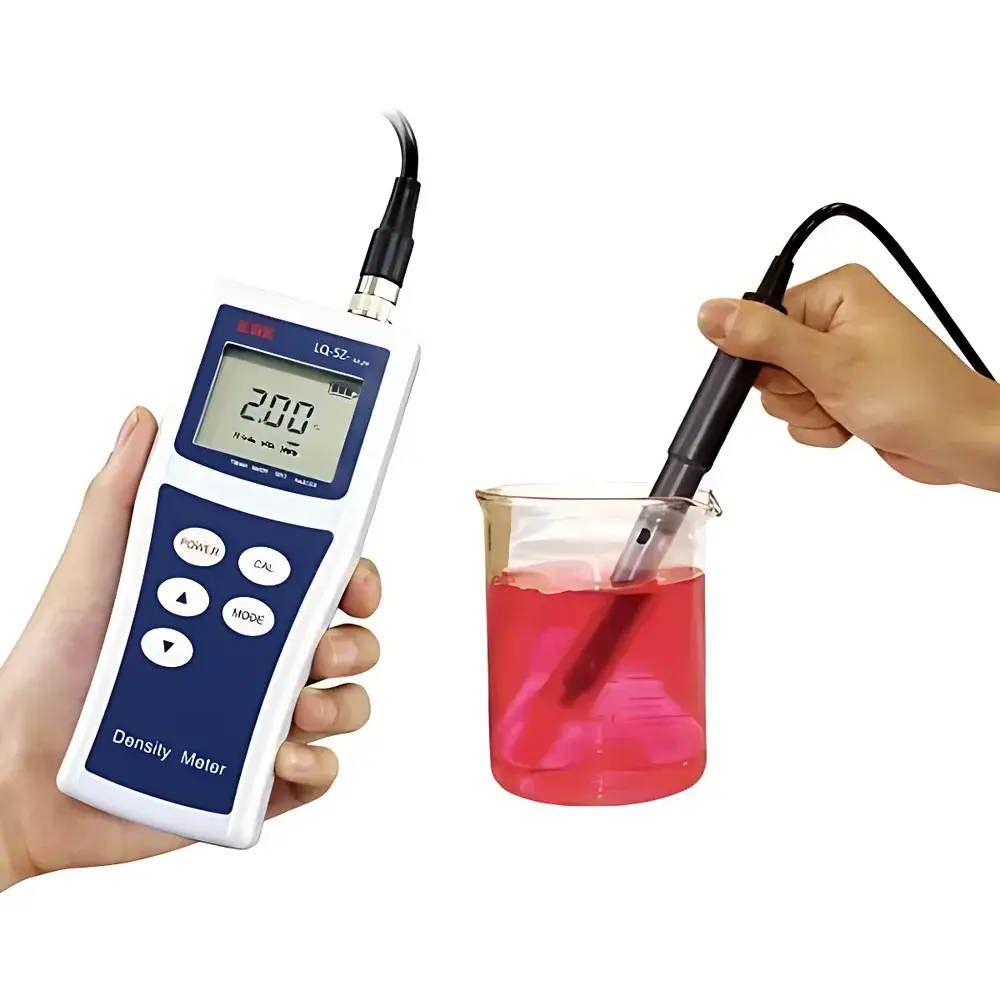
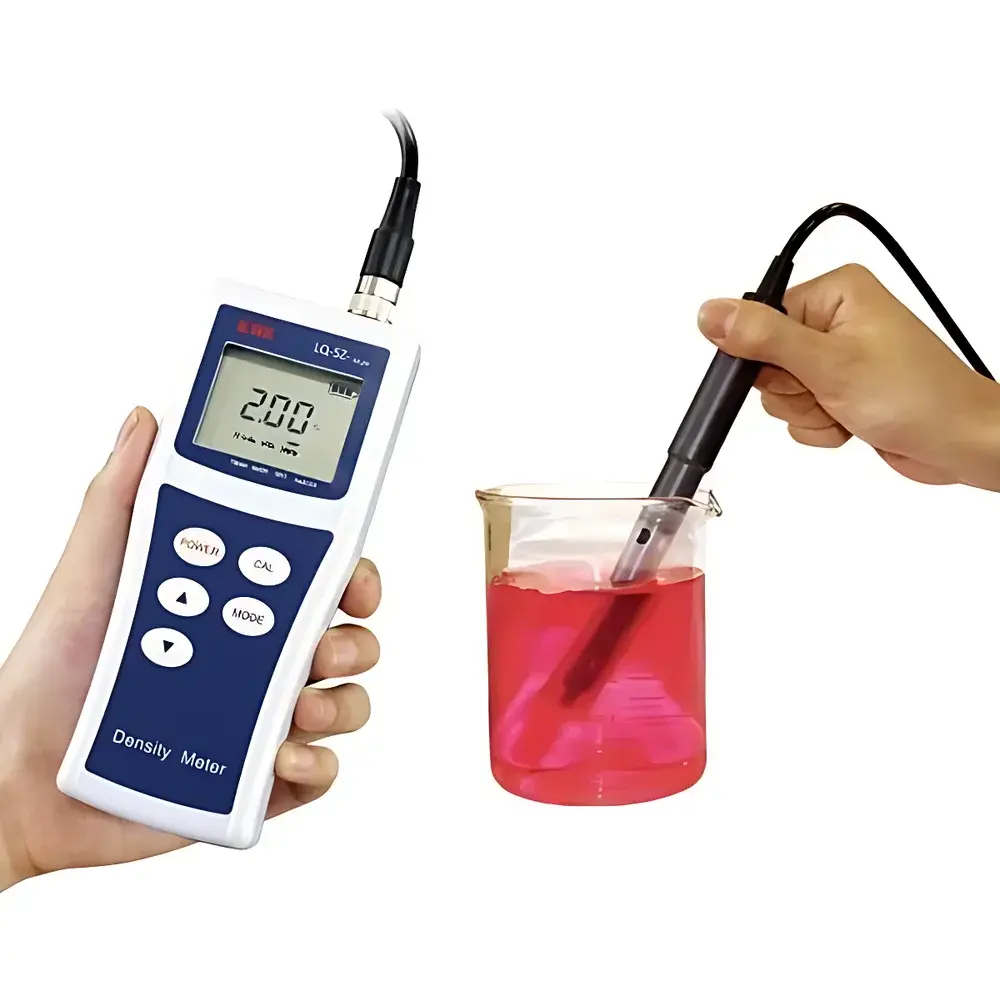
Rikori LQ-5Z-TMAH Multi-Parameter Concentration Meter for Semiconductor TMAH Process Monitoring
| Brand | Rikori |
|---|---|
| Model | LQ-5Z-TMAH |
| Origin | Japan |
| Application | Single-component aqueous alkaline/acidic solution concentration measurement (TMAH, NaOH, Na₂CO₃, NH₃·H₂O, H₂SO₄, HNO₃, HCl) |
| Measurement Principle | Conductivity-based electrochemical sensing with temperature-compensated calibration |
| Range (TMAH) | 0.00–5.00 % w/w or 0.0–50.0 g/L |
| Temperature Range | 0.00–40.00 °C |
| Sensor Type | Chemically resistant 4C-type electrode (1 m cable) |
| Enclosure Rating | IP66 |
| Power | 3× LR03 alkaline batteries (auto-shutdown enabled) |
| Dimensions (main unit) | 38 × 75 × 180 mm (H×W×D) |
| Weight | ~300 g (unit), ~50 g (electrode) |
Overview
The Rikori LQ-5Z-TMAH is a portable, multi-parameter concentration meter engineered specifically for real-time, on-site monitoring of tetramethylammonium hydroxide (TMAH) solutions in semiconductor photolithography and wafer cleaning processes. Unlike generic conductivity meters, this instrument implements a calibrated, single-solution electrochemical measurement principle—relying on temperature-compensated conductivity response to quantify ion concentration in strictly monocomponent aqueous systems. It does not perform spectroscopic or titrimetric analysis; instead, it delivers rapid, repeatable readings by correlating solution conductance to pre-characterized calibration curves for each supported chemical species (TMAH, NaOH, Na₂CO₃, NH₃·H₂O, H₂SO₄, HNO₃, HCl). Designed for use in wet benches, tool-side QC stations, and process engineering labs, the LQ-5Z-TMAH meets the fundamental requirement of semiconductor manufacturing: traceable, operator-independent verification of developer concentration prior to wafer immersion—ensuring consistent resist dissolution kinetics and critical dimension control.
Key Features
- Single-unit capability to measure eight distinct chemical species—each requiring dedicated calibration and exclusive sample composition (no mixed-acid/alkali or organic co-solvent tolerance)
- Dual-unit display: seamless switching between mass percent (% w/w) and mass concentration (g/L) for TMAH and all supported analytes
- Integrated Pt1000 temperature sensor with automatic temperature compensation (ATC) across 0.00–40.00 °C, correcting conductivity readings per NIST-traceable polynomial algorithms
- Chemically inert 4C-type electrode with fluoropolymer body and platinum-group alloy sensing elements—rated for continuous exposure to ≥5 wt% TMAH, 30 wt% NaOH, and concentrated mineral acids
- Full-range zero-point calibration function accessible via front-panel interface, supporting field recalibration without PC or proprietary software
- IP66-rated enclosure—dust-tight and protected against powerful water jets—enabling safe operation in high-humidity cleanroom buffer zones and wet process areas
- Battery-powered architecture (3× LR03) with intelligent auto-shutdown after 10 minutes of inactivity, extending operational life beyond 200 hours per set
Sample Compatibility & Compliance
The LQ-5Z-TMAH is validated exclusively for clear, particle-free, single-solute aqueous solutions. It is incompatible with emulsions, suspensions, organic solvents (e.g., IPA, PGMEA), or mixtures containing multiple ionic species—such as TMAH + IPA blends or buffered HF solutions. Measurement accuracy assumes absence of interfering ions (e.g., Cl⁻ in NaOH samples, SO₄²⁻ in TMAH baths) and adherence to specified temperature limits. While not certified to ISO/IEC 17025 or ASTM D1125, the instrument supports GLP-aligned documentation through manual log entry of calibration date, operator ID, and batch reference. Its design aligns with SEMI F20-0217 guidelines for metrology tools used in photoresist developer management, and its materials comply with SEMI E10 requirements for non-contaminating construction in Class 100–1000 cleanrooms.
Software & Data Management
This is a standalone, embedded-system meter with no Bluetooth, USB, or cloud connectivity. All calibration coefficients, unit preferences, and temperature compensation parameters are stored in non-volatile memory. No external software is required—or provided—for configuration, data export, or firmware updates. Users record measurements manually into controlled lab notebooks or integrated MES/QMS platforms. The absence of digital interfaces eliminates cybersecurity concerns and satisfies internal IT policies restricting network-connected instrumentation in fab environments. Audit trails rely on procedural discipline: operators must annotate calibration certificates, electrode serial numbers, and environmental conditions (ambient temperature/humidity) alongside each measurement event per internal SOPs referencing ISO 9001 clause 7.1.5.2.
Applications
- TMAH developer bath concentration verification prior to lithography stepper exposure (standard for 0.18–0.35 µm node processes)
- NaOH-based stripping solution monitoring in post-etch residue removal lines
- Ammonia-water dilution control in CMP slurry preparation and rinse optimization
- Carbonate-based etch inhibitor concentration checks in SiN/SiO₂ selective etch baths
- Acid bath replenishment validation for sulfuric-peroxide (SPM) and nitric-peroxide (NPM) cleaning chemistries
- Temperature-stabilized QC spot-checks during bath lifetime qualification studies per JEDEC JESD22-A108
FAQ
Can the LQ-5Z-TMAH measure TMAH in IPA-based developer mixtures?
No. The instrument requires pure aqueous TMAH solutions. Organic co-solvents alter conductivity response non-linearly and invalidate factory calibration curves.
Is electrode replacement required after exposure to 5% TMAH?
The 4C electrode is rated for repeated use in ≤5% TMAH at ≤35 °C. Performance degradation is indicated by >±0.15% deviation in zero-point stability or hysteresis >0.05% between up/down concentration sweeps.
Does the device meet FDA 21 CFR Part 11 requirements?
No. As a non-networked, non-auditable, non-electronic-record-keeping instrument, it falls outside the scope of Part 11. It may be used in FDA-regulated facilities only where manual transcription and secondary review are implemented per SOP.
What is the recommended calibration frequency for production use?
Daily zero-point verification before first use; full two-point calibration (zero + mid-range standard) every 8 operating hours or per shift change—whichever occurs first.
Can the same electrode be used for both acid and alkali measurements?
Yes. The 4C electrode is symmetrically designed for bidirectional pH-agnostic conductivity measurement across the full supported concentration range of all seven chemicals.