
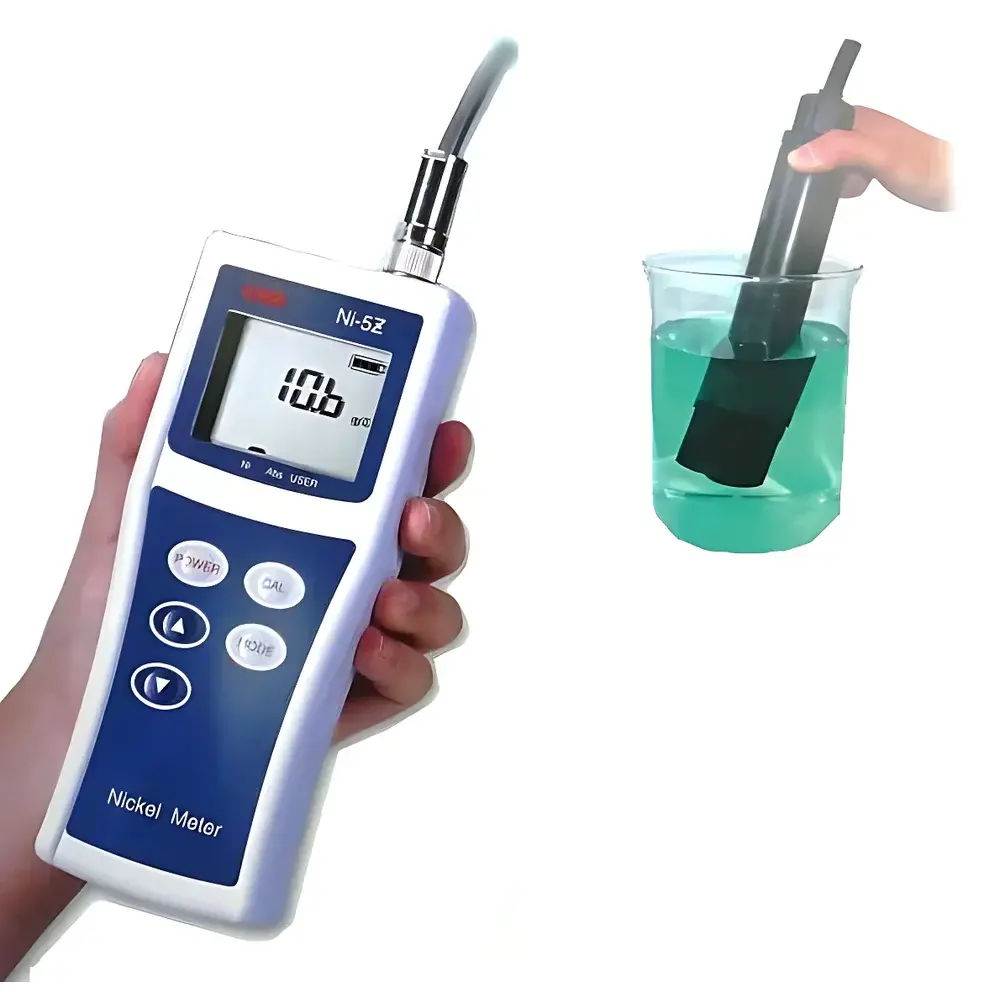
Rikuri CuNi-5Z Portable Copper & Nickel Ion Photometer for Electroplating and PCB Process Baths
| Brand | Rikuri |
|---|---|
| Origin | Japan |
| Model | CuNi-5Z |
| Instrument Type | Portable |
| Detection Principle | Photometric (Absorbance-based) |
| Target Analytes | Cu²⁺, Ni²⁺ |
| Measurement Range | Cu: 0.0–80.0 g/L |
| CuSO₄ | 0.0–300 g/L |
| Ni | 0.0–199.9 g/L |
| Absorbance | 0.000–1.999 AU |
| Temperature | 0.0–50.0 °C |
| Accuracy | ±2% FS |
| Resolution | 0.1 g/L (for metal ions) |
| Response Time | 1 s |
| Operating Environment | −5–45 °C, ≤85% RH |
| Power Supply | 3× AAA alkaline batteries (LR03) |
| Sensor Wetted Materials | PPS, PFA, Fluoroelastomer |
| Cable Length | 2 m |
Overview
The Rikuri CuNi-5Z is a dedicated portable photometer engineered for real-time, in-line monitoring of copper (Cu²⁺) and nickel (Ni²⁺) ion concentrations in electroplating and printed circuit board (PCB) manufacturing process baths. It operates on the principle of quantitative absorbance measurement at specific wavelengths optimized for Cu– and Ni–complex formation in acidic sulfate electrolytes—commonly used in acid copper plating and Watts-type nickel plating solutions. Unlike generic heavy metal analyzers, the CuNi-5Z integrates wavelength-specific optical detection with built-in temperature compensation and dual-concentration reporting (e.g., elemental Cu vs. CuSO₄ equivalent), enabling direct correlation between measured absorbance and bath formulation requirements. Its design prioritizes operational robustness in high-humidity, chemically aggressive environments typical of plating lines—where rapid feedback on metal depletion or contamination is critical to maintaining deposit uniformity, throwing power, and adherence to IPC-4552/4556 specifications.
Key Features
- Simultaneous dual-analyte capability: Measures Cu²⁺ and Ni²⁺ independently using pre-calibrated photometric channels—no reagent swapping or manual wavelength adjustment required.
- Direct concentration readout in multiple engineering units: Switchable display between elemental metal (g/L), compound-equivalent (e.g., CuSO₄·5H₂O, g/L), and dimensionless absorbance (0.000–1.999 AU).
- Integrated Pt1000-grade temperature sensor with automatic temperature compensation (ATC): Compensates for thermal drift in both optical path and complexation kinetics across 0.0–50.0 °C.
- Chemically resistant flow-through sensor (model CUD-61): Wetted parts constructed from PPS (polyphenylene sulfide), PFA (perfluoroalkoxy alkane), and fluoroelastomer—validated for continuous exposure to ≥180 g/L H₂SO₄, chloride-containing nickel strike baths, and organic brightener systems.
- Six preconfigured measurement modes: Includes standard calibration, batch verification, multi-point verification, blank subtraction, user-defined curve, and temperature-only mode—accessible via intuitive rotary encoder interface.
- Field-deployable architecture: Powered by three AAA alkaline cells (LR03); operational life exceeds 200 hours under typical usage; IP65-rated housing resists splashing and condensation.
Sample Compatibility & Compliance
The CuNi-5Z is validated for use with industrial aqueous matrices including sulfuric acid–based copper electrolytes (e.g., 60–250 g/L CuSO₄, 50–100 g/L H₂SO₄), Watts nickel baths (240–300 g/L NiSO₄·6H₂O, 30–50 g/L NiCl₂·6H₂O, 30–50 g/L boric acid), and mixed-metal strike solutions. It complies with ISO 7027 for turbidity-insensitive photometry and meets ASTM D1688 (Copper in Electroplating Solutions) and JIS K 0102 (Heavy Metals in Industrial Wastewater) methodology prerequisites. While not a regulatory compliance instrument per se, its ±2% FS accuracy and traceable calibration protocol support GLP-aligned internal quality control documentation and satisfy audit requirements under IATF 16949 and IPC-A-600 for plating process validation.
Software & Data Management
The device stores up to 500 measurement records locally—including timestamp, analyte, concentration, temperature, and operator ID (via optional alphanumeric input). Data export is supported via USB-C to PC using Rikuri’s certified DataLink v3.2 software, which generates CSV- and PDF-formatted reports compliant with FDA 21 CFR Part 11 (electronic signatures, audit trail, data integrity controls). Calibration history, sensor diagnostics, and firmware revision logs are embedded in each exported file. The software also enables creation of custom calibration curves using NIST-traceable reference standards (e.g., CuSO₄ and NiSO₄ stock solutions certified to ±0.5% uncertainty).
Applications
- Real-time bath monitoring during acid copper plating for semiconductor interconnects and HDI PCBs.
- Control of nickel anode dissolution rate and additive balance in functional nickel plating lines.
- Verification of rinse water carryover contamination prior to passivation or solder mask application.
- Supporting closed-loop chemical dosing systems via analog 4–20 mA output (optional module).
- On-site verification of wastewater pretreatment efficiency before discharge to municipal sewer systems (per local NPDES or JWWA limits).
FAQ
Does the CuNi-5Z require daily recalibration?
No—factory calibration remains stable for ≥30 days under normal operating conditions. A quick 1-point verification using a mid-range standard is recommended before each shift.
Can it measure in chloride-containing nickel baths?
Yes—the CUD-61 sensor’s PFA/fluoroelastomer construction resists pitting and swelling in chloride concentrations up to 50 g/L, and the photometric algorithm corrects for minor spectral interference.
Is temperature compensation applied automatically during measurement?
Yes—temperature is measured simultaneously with absorbance; compensation coefficients are embedded per analyte and validated across the full 0–50 °C range.
What is the minimum detectable concentration for copper?
The practical limit of quantitation (LOQ) is 0.2 g/L Cu in standard sulfate electrolytes, based on signal-to-noise ratio ≥10:1 and repeatability testing per ISO 11843-2.
How is sensor cleaning performed in production environments?
A 5-minute soak in 10% nitric acid followed by DI water rinse restores optical clarity; no ultrasonic cleaning or abrasive tools are required.







