
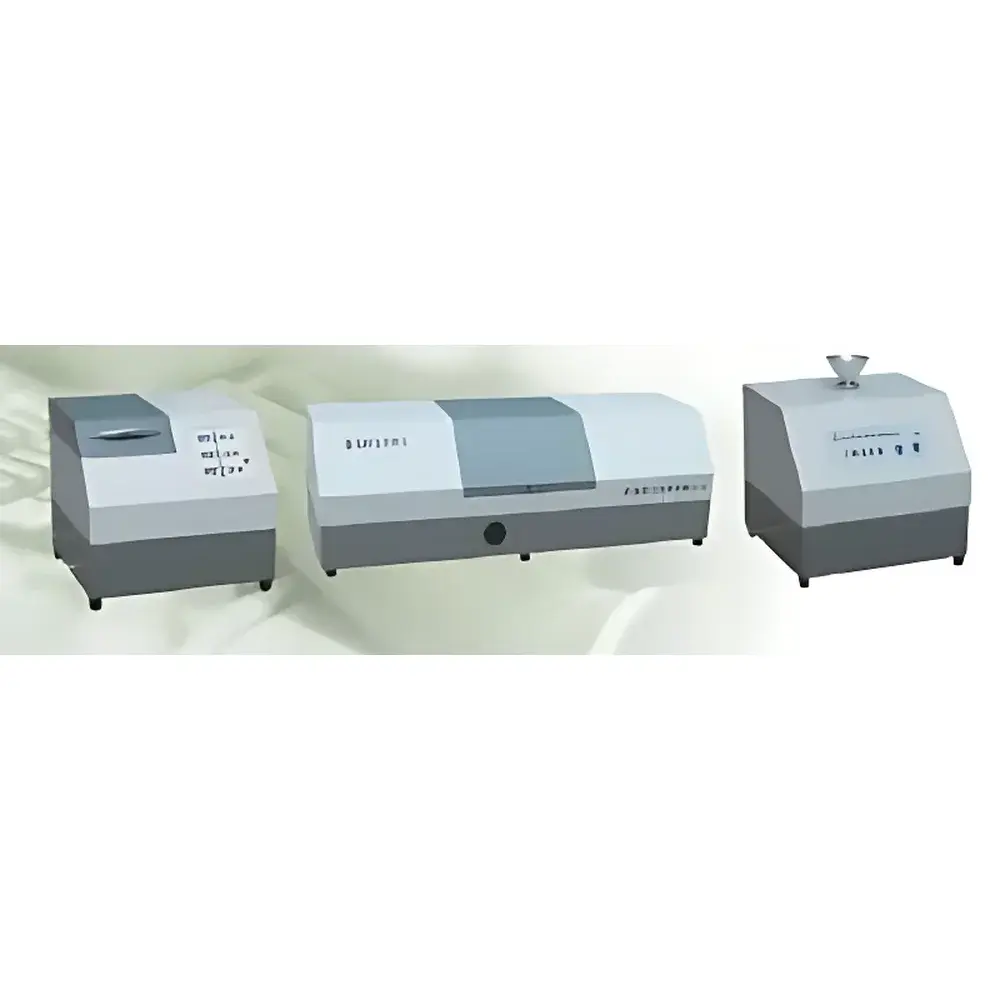
Rise-2022 Dry/Wet Dual-Mode Laser Particle Size Analyzer
| Origin | Beijing, China |
|---|---|
| Manufacturer Type | Authorized Distributor |
| Origin Category | Domestic (PRC) |
| Model | Rise-2022 |
| Pricing | Upon Request |
| Measurement Range | 0.1–600 µm |
| Accuracy Error | < ±1% (D50, NIST-traceable standard reference materials) |
| Repeatability | < ±1% (D50, same sample, repeated measurements) |
| Electrical Supply | AC 220 ±10 V, 50 Hz, 200 W |
| Dimensions (L×W×H) | 950 × 330 × 300 mm |
| Weight | 40 kg |
Overview
The Rise-2022 Dry/Wet Dual-Mode Laser Particle Size Analyzer is an engineered solution for comprehensive particle size distribution (PSD) characterization across diverse industrial and research environments. It operates on first-principles Mie scattering theory—fully accounting for particle refractive index, dispersion medium optical properties, and angular intensity distribution—to deliver physically grounded, model-independent PSD data. Unlike conventional instruments relying on constrained inversion algorithms that assume pre-defined distribution shapes (e.g., log-normal), the Rise-2022 implements true non-negative, unconstrained inverse scattering analysis. This approach eliminates bias introduced by a priori distribution assumptions and ensures fidelity to actual sample morphology. Its single-optical-path, convergent Fourier design eliminates multi-lens complexity, enabling wide dynamic range (0.1–600 µm), high angular resolution (up to 90° detection), and intrinsic optical alignment stability—critical for long-term reproducibility in regulated labs.
Key Features
- He-Ne laser source (λ = 632.8 nm) with <25,000 h lifetime, narrow linewidth, and exceptional power stability—providing consistent illumination for low-noise signal acquisition.
- Proprietary 3D cross-fan non-uniform photodetector array: 1 primary + multiple auxiliary detectors arranged in optimized spatial geometry; maximizes signal capture across forward, side, and backward scattering angles.
- Integrated dual-dispersion architecture: fully independent dry and wet modules housed within one chassis—no hardware reconfiguration required between modes.
- Dry dispersion via silent oil-free air compressor (with integrated refrigerated dryer) and high-velocity jet dispersion chamber; achieves instantaneous deagglomeration without surfactants or solvents.
- Wet dispersion system featuring 100 W programmable ultrasonic generator (0–590 s, 1 s increments), 400 mL stainless-steel circular sample cell, and simultaneous ultrasonication-circulation capability to suppress bubble formation and re-agglomeration.
- Digitally controlled mechanical agitation (0–3000 rpm) and peristaltic circulation (0–5000 rpm), both independently adjustable and synchronized with real-time monitoring.
Sample Compatibility & Compliance
The Rise-2022 accommodates a broad spectrum of particulate materials—including ceramics, pharmaceuticals, catalysts, pigments, metal powders, polymers, and geological sediments—regardless of density, hardness, magnetic susceptibility, or surface charge. Dry mode is ideal for moisture-sensitive, volatile, or solvent-incompatible samples; wet mode supports aqueous and organic dispersions (e.g., water, ethanol, isopropanol). The instrument’s mechanical and optical design conforms to Q/01RZ01-2004 (enterprise standard for laser diffraction analyzers in China), and its operational workflow supports alignment with ISO 13320:2020 (Particle size analysis — Laser diffraction methods) and ASTM E799-22 (Standard Practice for Determining Data Criteria and Processing for Liquid Drop Size Analysis). While not FDA 21 CFR Part 11–certified out-of-the-box, audit trails, user access logs, and electronic signature-ready report exports can be implemented via optional software configuration for GLP/GMP environments.
Software & Data Management
PADMAS (Particle Diameter Measure & Analysis System) v5.x provides full control over measurement, inversion, and reporting. It supports differential and cumulative distributions, Rosin-Rammler (R-R), custom binning (1–130 user-defined channels across 0.02–2000 µm), and multiple statistical descriptors—including D10, D50, D90, span, specific surface area (volume- or mass-based), and polydispersity index. All raw intensity data and inverted results are stored in structured binary format; export options include CSV, Excel (.xlsx), PDF, PNG, and SVG. Reports feature customizable headers/footers, bilingual (English/Chinese) templates, preview mode, and embedded metadata (date, operator ID, instrument SN, dispersion parameters). Batch processing, inter-sample statistical comparison, and trend analysis tools facilitate routine QC and method validation.
Applications
- Pharmaceutical development: API crystallinity assessment, excipient blending uniformity, inhalation powder aerodynamic diameter profiling.
- Advanced materials R&D: Nanoparticle synthesis optimization, battery cathode/anode slurry homogeneity verification, additive manufacturing metal powder qualification.
- Quality control in chemical manufacturing: Catalyst activity correlation with PSD, pigment dispersion stability, polymer latex particle nucleation kinetics.
- Environmental and geotechnical labs: Sediment grain-size classification per USDA or Wentworth scale, soil texture analysis, airborne particulate matter (PM) surrogate characterization.
- Food & agriculture: Starch granule sizing, dairy powder flowability prediction, pesticide suspension stability evaluation.
FAQ
Does the Rise-2022 require optical alignment during routine operation?
No—the convergent optical path and monolithic mechanical design eliminate periodic alignment; calibration is verified using NIST-traceable polystyrene latex standards.
Can the same sample be measured in both dry and wet modes without cross-contamination?
Yes—dry and wet fluidic paths are physically isolated; the dry module includes a dedicated collection filter and purge cycle, while the wet cell is fully drainable and autoclavable.
Is the PADMAS software compliant with 21 CFR Part 11 for electronic records?
Out-of-the-box, it supports audit trail generation and user-level permissions; full Part 11 compliance requires validated installation, change control documentation, and optional digital signature integration.
What dispersion protocols are recommended for highly cohesive nanomaterials?
For challenging agglomerates, combine 3–5 min ultrasonication (80–100% amplitude) with 1500–2500 rpm stirring and 3000–4500 rpm circulation—parameters are saved per sample type in method templates.
How frequently should the instrument be recalibrated?
Annual verification against certified reference materials is recommended; daily performance checks using a control standard (e.g., SRM 1963) are advised for regulated applications.



