
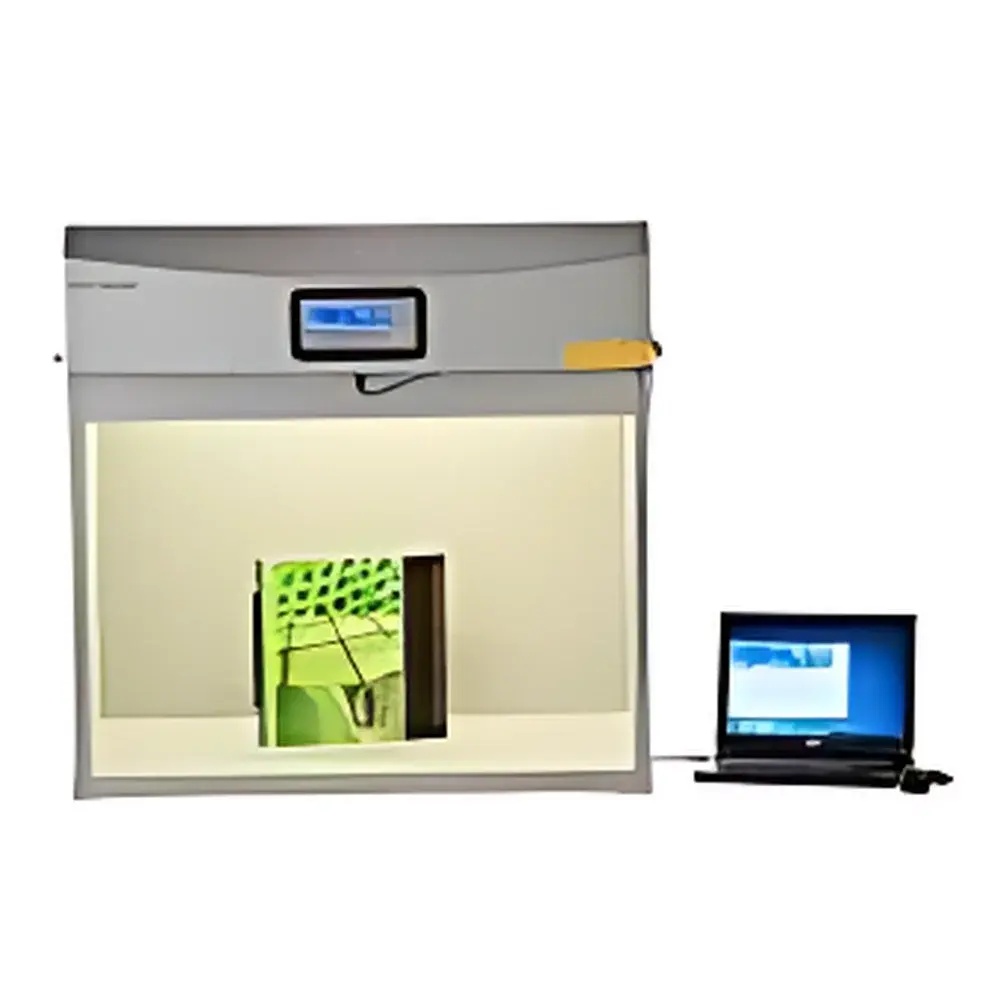
X-Rite SpectraLight QC Standard Light Source Color Matching Cabinet
| Brand | X-Rite |
|---|---|
| Origin | USA |
| Model | SpectraLight QC |
| Light Sources | D65, A, CWF, U30, TL83, TL84, UV |
| Illuminance Control | Closed-loop digital lux regulation with integrated photometric sensor |
| UV Output | Factory-calibrated and user-adjustable |
| Compliance | ASTM D1729, ASTM E308, ISO 3664:2009, ISO 9001, AATCC Evaluation Procedure 1 |
| Illuminance Range | 500–2000 lx (adjustable per standard) |
| Stability | <30 sec thermal stabilization between sources |
| Calibration | NIST-traceable factory calibration for visible and UV channels |
Overview
The X-Rite SpectraLight QC Standard Light Source Color Matching Cabinet is an engineering-grade optical evaluation system designed for precise, repeatable, and standards-compliant color assessment across global manufacturing, quality control, and R&D environments. Built upon a closed-loop photometric architecture, it employs high-fidelity spectral light engines—each individually calibrated against NIST-traceable references—to replicate critical standardized illuminants including D65 (daylight), A (incandescent), CWF (cool white fluorescent), U30, TL83, TL84, and ultraviolet (UV). Unlike open-loop competitive cabinets, the SpectraLight QC integrates real-time photodiode sensors within the light path to continuously monitor and dynamically regulate irradiance (lux) at the sample plane. This ensures compliance with ISO 3664:2009 viewing conditions, where illuminance uniformity (±10% across 90% of viewing area), chromaticity tolerance (Δuv ≤ 0.005), and temporal stability (<0.5% drift over 30 minutes) are mandatory for visual and instrumental color matching.
Key Features
- Closed-loop digital lux regulation: Integrated photometric sensors provide continuous feedback to maintain target illuminance (500–2000 lx) independent of lamp aging or ambient temperature fluctuations.
- Sub-30-second source switching: Eliminates traditional 3–4 minute warm-up delays via active thermal management and voltage ramping algorithms—enabling rapid comparison across D65, A, TL84, and UV in sequence without perceptible lag.
- Factory-traceable UV calibration: Each unit undergoes individual spectral radiometric characterization in the 365 nm UV-A band; output is adjustable via front-panel interface while retaining full audit trail for GLP/GMP documentation.
- ASTM/ISO-compliant viewing geometry: 45°/0° illumination/viewing configuration with matte-black interior finish (reflectance <2%), non-reflective sample stage, and edge-diffused light distribution meeting ISO 3664 Annex B requirements.
- Dual-mode operation: Supports both manual single-source selection and programmable multi-source sequences (e.g., D65 → TL84 → UV) with timed dwell intervals for standardized metamerism evaluation.
- Embedded illuminance meter: Direct readout of actual lux values at sample plane—calibrated to ASTM E308 spectral weighting functions—enabling on-the-fly verification against textile, paint, or packaging industry specifications.
Sample Compatibility & Compliance
The SpectraLight QC accommodates samples up to 30 × 30 cm with vertical or horizontal orientation, supporting rigid substrates, flexible films, textiles, printed materials, and translucent specimens. Its optical design conforms to ISO 3664:2009 Class 1 requirements for graphic arts and ISO 9001-certified production environments. The cabinet satisfies ASTM D1729 (color matching under controlled lighting), ASTM E308 (instrumental colorimetry), and AATCC EP1 (evaluation of colorfastness and metamerism). All light sources are certified to meet CIE S 002:2018 spectral power distribution tolerances, and UV output complies with ISO 105-B02 for fluorescent whitening agent assessment. Full traceability documentation—including calibration certificates, spectral irradiance reports, and sensor linearity validation—is supplied with each unit.
Software & Data Management
While the SpectraLight QC operates as a standalone hardware platform, it integrates seamlessly with X-Rite’s Color iQC and Color iMatch software suites via RS-232 or USB virtual COM port. Instrument readings—including lux values, source activation timestamps, UV intensity (% of max), and operator ID—are logged with ISO/IEC 17025-compliant metadata. Audit trails support FDA 21 CFR Part 11 requirements when paired with validated software configurations, enabling electronic signatures, change history, and secure export of CSV or XML-formatted reports. Firmware updates are delivered through X-Rite’s authenticated portal, ensuring continued alignment with evolving ISO and ASTM revisions.
Applications
This cabinet serves as a foundational tool in industries where spectral sensitivity and inter-observer agreement are mission-critical: textile dye lot approval (AATCC TM150), automotive interior trim validation (SAE J1740), pharmaceutical blister packaging inspection (USP ), print proofing workflows (GRACoL/FOGRA), and cosmetic formulation development. It is routinely deployed in third-party testing labs accredited to ISO/IEC 17025, where its NIST-traceable calibration and documented uncertainty budgets (<±1.2% k=2 for D65 lux) satisfy accreditation body requirements for measurement validity.
FAQ
Is the SpectraLight QC compliant with ISO 3664:2009 for graphic arts viewing conditions?
Yes—its spectral irradiance, uniformity, and illuminance stability meet all Class 1 criteria defined in ISO 3664:2009 Annex B.
Can UV intensity be adjusted during routine operation?
Yes—user-adjustable UV output (0–100% in 1% increments) is enabled via front-panel controls and retains full factory calibration traceability.
Does the system require annual recalibration?
X-Rite recommends biennial recalibration using certified reference lamps and spectroradiometers; however, built-in sensor drift compensation extends calibration interval integrity beyond 24 months under typical lab use.
How is illuminance verified across different light sources?
Each source activates its dedicated photometric channel; lux values are displayed in real time and logged with timestamped metadata for QA record retention.
What documentation is provided for regulatory audits?
NIST-traceable calibration certificate, spectral power distribution reports, ISO/IEC 17025 test records, and firmware version audit logs are included in the delivery package.




