
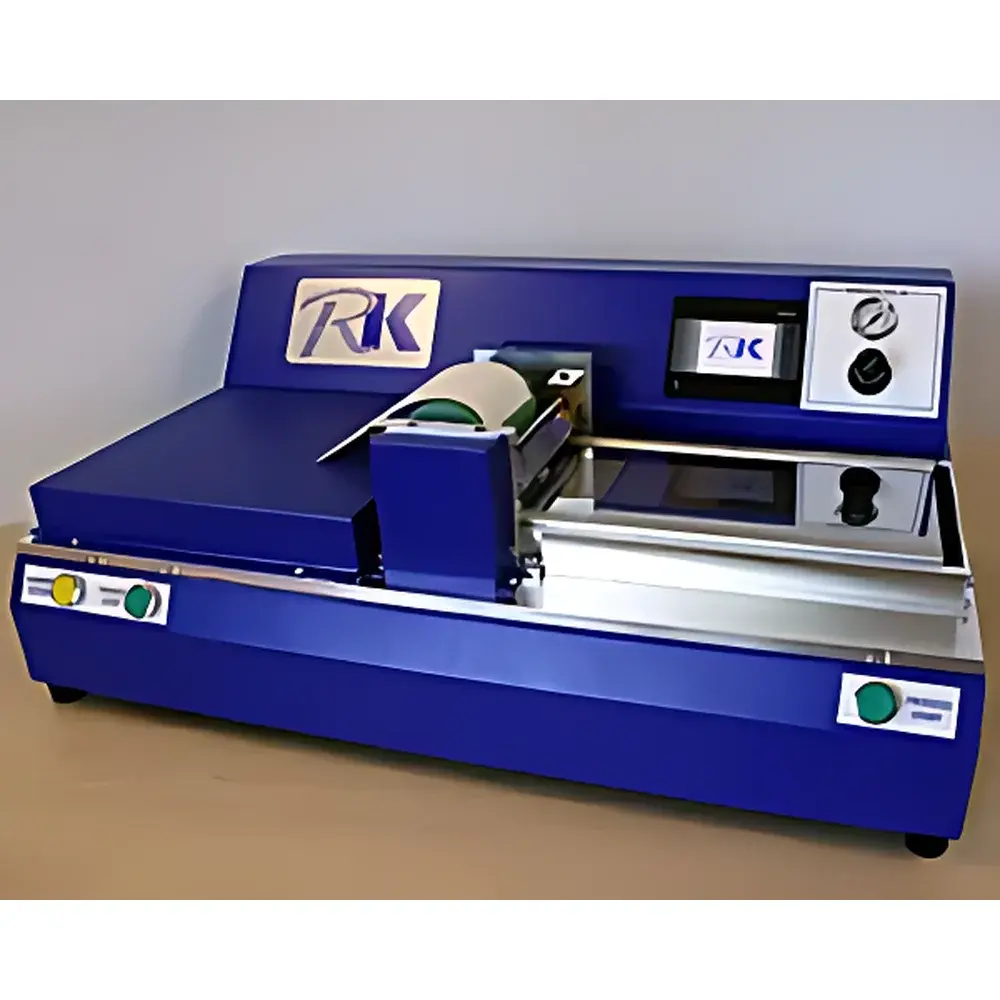
RK GP100 High-Speed Gravure Proofing Press
| Brand | RK |
|---|---|
| Origin | United Kingdom |
| Manufacturer Type | Authorized Distributor |
| Origin Category | Imported |
| Model | GP100 |
| Pricing | Available Upon Request |
Overview
The RK GP100 High-Speed Gravure Proofing Press is a precision-engineered laboratory-scale gravure printing system designed for R&D laboratories, ink formulation centers, and quality assurance departments in the packaging, coatings, and functional printing industries. It operates on the fundamental principle of gravure printing—where ink is metered from an engraved cylinder (intaglio plate) onto a substrate via doctor blade control and rubber impression roller transfer. Unlike offset or flexographic proofing systems, the GP100 replicates true gravure mechanics at variable speeds up to 100 m/min, enabling accurate simulation of production-line print behavior—including ink film thickness, dot gain, tone reproduction, and substrate interaction—under controlled, repeatable conditions.
Key Features
- Microprocessor-based control system with integrated servo drive architecture for precise speed regulation (1–100 m/min, continuously adjustable)
- Pneumatically actuated impression roller with adjustable nip pressure for consistent contact across flexible and rigid substrates
- Quick-release doctor blade assembly facilitating rapid disassembly, solvent cleaning, and blade replacement without tooling
- Modular engraved cylinder mounting system compatible with standard electronic engraving plates (max. 160 × 95 mm engraving area)
- Robust cast-iron frame and precision-ground roller bearings ensuring mechanical stability and long-term repeatability
- Integrated safety interlocks compliant with EN ISO 13857 and CE machinery directive requirements
Sample Compatibility & Compliance
The GP100 accommodates a broad range of substrates—including PET, BOPP, PE, paper, metallized films, and coated board—with thicknesses from 12 µm to 300 µm. Its low-inertia impression roller and adaptive nip geometry support both high-tension web handling and static sheet feeding modes. All operational parameters—including line screen (40–80 l/cm), engraving depth profiles, and ink rheology settings—are documented per test run to support GLP-compliant reporting. The system meets ASTM D724 (Surface Wettability), ISO 12647-1 (Process Standard for Offset Lithography—adapted for gravure validation), and supports traceability workflows aligned with ISO/IEC 17025 accreditation requirements for testing laboratories.
Software & Data Management
While the GP100 operates via embedded firmware rather than PC-hosted software, it features non-volatile memory storage for up to 99 user-defined print protocols—including speed setpoints, dwell time, blade angle presets, and substrate-specific calibration offsets. Each protocol stores timestamped metadata (date/time, operator ID, batch reference) to enable audit-ready documentation. Optional RS-232 or USB-C serial interface enables integration with LIMS or MES platforms for automated data logging. All parameter changes are logged with version-stamped history, satisfying FDA 21 CFR Part 11 requirements when paired with validated third-party electronic record systems.
Applications
- Ink formulation validation: Quantifying pigment dispersion stability, solvent evaporation rate effects, and rheological response under shear
- Color matching & digital proofing: Generating physical samples for spectral verification against spectrophotometric color targets (e.g., CIELAB ΔE ≤ 0.5)
- Substrate compatibility testing: Assessing ink adhesion, drying behavior, and surface energy interactions across laminated, corona-treated, or plasma-activated films
- Gravure plate evaluation: Verifying engraving fidelity, cell volume consistency, and tone reproduction accuracy across wedge-type test patterns (1+4, double-8, solid-area, and stepped-density plates)
- Process window analysis: Mapping optimal speed/pressure/blade-angle combinations for new ink-substrate pairings prior to press trials
FAQ
What engraved plate formats are supported by the GP100?
Standard electronic engraving plates with mechanical registration holes; maximum engraving area is 160 mm × 95 mm. Custom plate carriers available upon request for non-standard geometries.
Is the GP100 suitable for aqueous or UV-curable inks?
Yes—provided appropriate solvent-resistant seals, blade materials (e.g., tungsten carbide), and cleaning protocols are implemented per ink chemistry. Compatibility must be verified case-by-case with material safety data sheets.
Can print uniformity be validated across the full width of the engraved area?
Yes—using standardized ISO 13660-based micro-densitometry or calibrated optical profilometry on printed test wedges to assess lateral consistency of ink transfer.
Does the system include calibration certification?
Each unit ships with a factory-verified speed calibration certificate traceable to UKAS-accredited standards; annual recalibration services are available through RK’s European service network.
What maintenance intervals are recommended for long-term repeatability?
Doctor blade inspection every 200 operating hours; impression roller surface hardness verification annually; servo encoder alignment check every 1,000 hours or per ISO 13374 condition monitoring guidelines.






