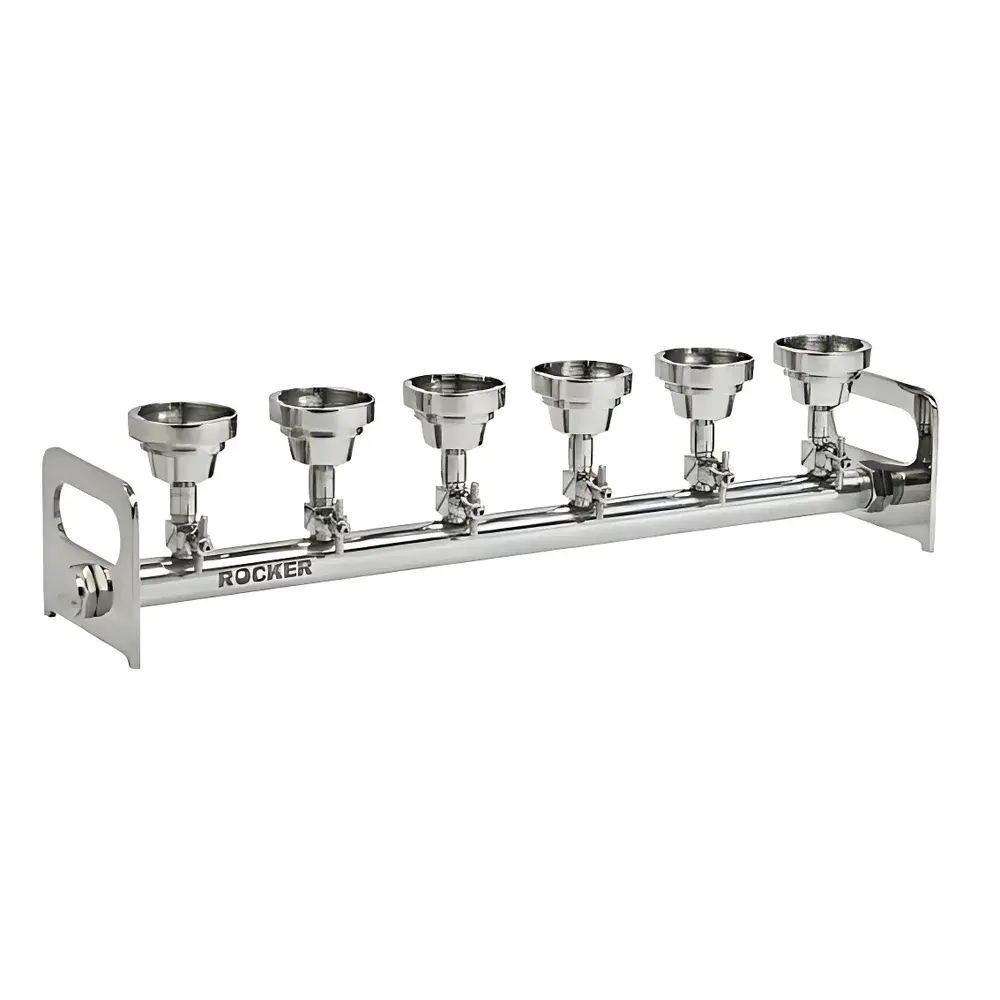
ROCKER BioVac 600 Stainless Steel 6-Position Vacuum Filtration Manifold
| Brand | ROCKER |
|---|---|
| Origin | Taiwan |
| Model | BioVac 600 |
| Construction Material | Fully SUS316 Stainless Steel |
| Number of Positions | 6 (Individually Controllable) |
| Maximum Pressure Rating | 3000 psi |
| Compatible Filter Cup Capacities | 500 mL, 750 mL, 1000 mL |
| Compatible Membrane Diameters | 47 mm and 50 mm |
| Effective Filtration Area per Position | 9.6 cm² |
| Tubing Inner Diameter Compatibility | 8 mm (5/16 in.) |
| Valve & Structural Components | All-SUS316 |
| Sterilization Compatibility | Autoclave, Dry Heat, Flame, and Steam Sterilization |
| Warranty | 2-Year Parts Coverage |
Overview
The ROCKER BioVac 600 Stainless Steel 6-Position Vacuum Filtration Manifold is an engineered solution for high-integrity, repeatable vacuum-driven filtration in regulated life science and industrial laboratory environments. Designed around Couette-flow–optimized vacuum distribution and precision-machined SUS316 stainless steel architecture, the manifold operates on a fundamental principle of differential pressure-driven liquid phase separation across microporous membranes. Its all-metal construction eliminates polymer leaching, adsorption artifacts, or dimensional drift under thermal or chemical stress—critical for microbiological assays, pharmaceutical process validation, and analytical sample preparation where material compatibility and extractables control are mandated by USP , ISO 10993, and FDA 21 CFR Part 11-compliant workflows.
Key Features
- Fully welded and electropolished SUS316 stainless steel construction across all structural, fluidic, and actuation components—including manifold body, individual isolation valves, filter funnels, support plates, gasket seats, and hose barb fittings—ensuring long-term resistance to chloride-induced pitting, acidic/alkaline reagents, and organic solvents.
- Patented rotary-lock coupling mechanism (TW Patent No. M381450) enables tool-free, leak-tight engagement between filter cups and manifold ports in under two seconds per position, eliminating clamp hardware, torque variability, and O-ring misalignment risks.
- Six independently operable stainless steel needle valves allow sequential or parallel filtration across heterogeneous sample sets without cross-contamination or pressure bleed between channels.
- Rated for continuous operation at up to 3000 psi (207 bar) positive pressure during backflush or integrity testing—supporting ASTM F838-22 bacterial retention validation and ISO 13408-2 pre-use post-sterilization integrity test (PUPSIT) protocols.
- Optimized flow path geometry minimizes dead volume (<0.8 mL per port) and ensures uniform vacuum distribution across all six positions, validated via calibrated digital manometer mapping under variable load conditions.
Sample Compatibility & Compliance
The BioVac 600 accommodates standard 47 mm and 50 mm diameter membrane filters—including mixed cellulose ester (MCE), polyethersulfone (PES), nylon, PVDF, and track-etched polycarbonate—across three interchangeable cup sizes (500 mL, 750 mL, and 1000 mL). Each cup features a precision-ground sealing surface and integrated SUS316 filter support plate with 9.6 cm² effective filtration area. The system complies with ISO 7218:2017 for microbiological examination of food and animal feeding stuffs, ASTM D1193 Type II water purity requirements for rinse steps, and EU GMP Annex 1 (2022) provisions for aseptic filtration equipment qualification. All wetted surfaces meet ASME BPE-2022 surface finish specifications (Ra ≤ 0.4 µm) and are fully autoclavable at 121°C for 30 minutes without degradation.
Software & Data Management
While the BioVac 600 is a manually operated, non-electronic manifold, its mechanical design supports full integration into electronic lab notebook (ELN) and quality management system (QMS) workflows. Each unit carries a serialized laser-engraved UID traceable to manufacturing batch, material certifications (EN 10204 3.1), and sterilization cycle logs. Optional accessories—including calibrated vacuum gauges, inline pressure transducers, and programmable vacuum controllers—enable GLP/GMP-compliant data capture when interfaced with validated SCADA or LIMS platforms. Audit trail generation, user access control, and electronic signature functionality are maintained at the host system level per 21 CFR Part 11 requirements.
Applications
- Membrane filtration-based microbial enumeration (e.g., EPA Method 1603, ISO 9308-1) for drinking water, wastewater, and pharmaceutical water systems.
- Clarification and particulate removal in bioprocess intermediate streams prior to HPLC or LC-MS analysis.
- Pre-concentration of environmental air or liquid samples for subsequent ICP-MS or GC-MS quantification.
- Validation of sterile filtration processes using bubble point, diffusive flow, and pressure hold tests per PDA Technical Report No. 26 and ISO 13408-2.
- Routine QC testing of raw materials, excipients, and final drug product solutions in cGMP manufacturing suites.
FAQ
Is the BioVac 600 compatible with aggressive solvents such as acetone or chloroform?
Yes—SUS316 stainless steel exhibits excellent resistance to halogenated hydrocarbons, ketones, and alcohols; however, prolonged exposure to concentrated hydrochloric or hydrofluoric acid is not recommended.
Can the manifold be used under positive pressure for backflushing or integrity testing?
Yes—its 3000 psi pressure rating permits safe execution of forward-flow and pressure hold integrity tests per ASTM F838 and ISO 13408-2 guidelines.
Does ROCKER provide material certification and surface finish documentation?
Yes—each shipment includes EN 10204 3.1 mill test reports, Ra surface roughness verification, and weld seam inspection records upon request.
Are replacement valves and gaskets available as spare parts?
Yes—all consumable and wear components—including SUS316 isolation valves, fluorosilicone gaskets, and filter support plates—are stocked and supplied with full traceability documentation.
What is the recommended maintenance interval for long-term reliability?
Visual inspection and functional valve cycling are advised after every 50 sterilization cycles; full disassembly and passivation are recommended annually or after 500 operating hours.