
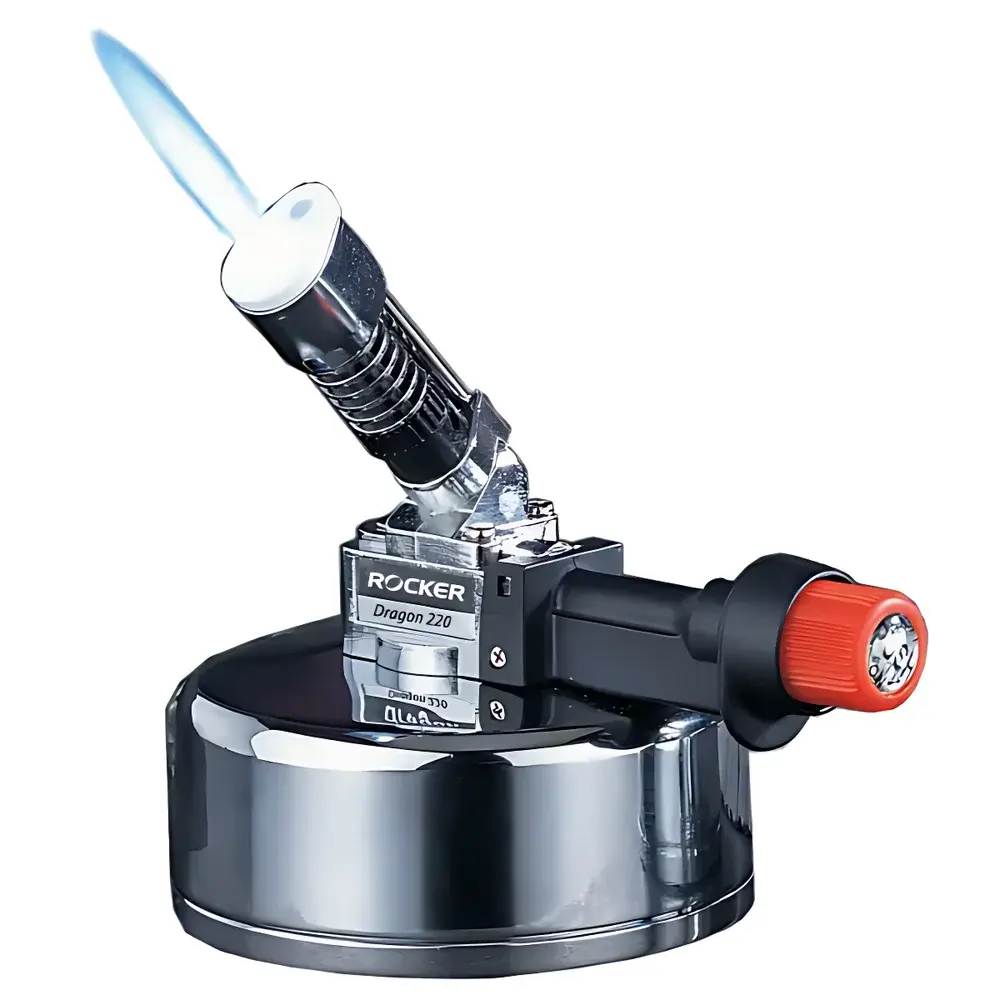
ROCKER Dragon220 Electronic Ignition Bunsen Burner
| Brand | ROCKER |
|---|---|
| Origin | Taiwan |
| Manufacturer Authorization Status | Authorized Distributor |
| Domestic Production Category | Yes |
| Model | Dragon220 |
| Fuel Type | Butane |
| Gas Consumption | 35 g/hr |
| Maximum Flame Temperature | 1300°C |
| Fuel Capacity | 35 g |
| Continuous Operation Time | 60 min |
| Dimensions (L×W×H) | 8 × 12 × 9 cm |
| Net Weight | 425 g |
| Safety Certification | CE Marked |
Overview
The ROCKER Dragon220 Electronic Ignition Bunsen Burner is a precision-engineered, portable laboratory-grade combustion device designed for consistent thermal output in controlled benchtop environments. Unlike traditional friction-ignition burners, the Dragon220 employs a piezoelectric ignition system that generates a reliable spark on demand—eliminating flint wear, inconsistent ignition, and manual match-based hazards. Its core function relies on the controlled premixing of butane gas with ambient air within an optimized venturi-style mixing tube, enabling stoichiometric combustion and stable blue-flame operation. This design supports reproducible heating profiles essential for sterilization, glassworking, sample preparation, and small-scale thermal processing tasks where open-flame reliability and operator safety are paramount.
Key Features
- Piezoelectric ignition system: Single-press activation ensures immediate, repeatable flame initiation without external ignition sources or consumable flints.
- Stable combustion architecture: Precision-calibrated air intake and gas flow path maintain consistent fuel–air ratio across operating duration, minimizing flame flicker or flashback under normal ventilation conditions.
- Thermal performance: Capable of sustaining a maximum flame temperature of 1300°C for up to 60 minutes per full fuel charge (35 g butane), supporting high-intensity thermal applications including loop sterilization and localized metal annealing.
- Robust mechanical design: Die-cast aluminum base provides low center of gravity and torsional rigidity; non-slip rubber feet enhance stability on laboratory benches during extended use.
- Compact ergonomic form factor: Dimensions of 8 × 12 × 9 cm and net weight of 425 g enable easy storage, transport, and integration into mobile lab carts or field-deployable setups.
- CE-marked compliance: Conforms to EU Directive 2014/35/EU (Low Voltage Directive) and relevant EN standards for electrical safety and mechanical integrity in laboratory equipment.
Sample Compatibility & Compliance
The Dragon220 is intended for use with commercially available butane canisters meeting ISO 8573-1 purity Class 2 specifications (oil-free, particulate-free, dew point ≤ −40°C). It is not compatible with propane, natural gas, or mixed hydrocarbon fuels. As a Class I, Group IIA, T4-rated device per IEC 60079-0, it is unsuitable for use in classified hazardous locations. The burner complies with general laboratory safety requirements outlined in ANSI Z358.1 (emergency equipment proximity) and aligns with institutional biosafety level (BSL-1/BSL-2) protocols for non-contained flame use. No regulatory submission (e.g., FDA 510(k), CE medical device classification) applies, as it falls outside medical device or diagnostic instrumentation scope.
Software & Data Management
The Dragon220 is a fully mechanical–electrical device with no embedded firmware, connectivity interfaces, or digital control systems. Consequently, it does not require software installation, calibration databases, audit trails, or electronic record retention. All operational parameters—including ignition timing, flame height adjustment, and gas flow modulation—are manually controlled via integrated brass valves. This analog architecture eliminates cybersecurity concerns, firmware update dependencies, and 21 CFR Part 11 compliance obligations, making it suitable for GLP/GMP environments where traceability is maintained through procedural documentation rather than electronic logs.
Applications
- Microbiological loop and needle sterilization prior to streaking or inoculation in BSL-1/BSL-2 laboratories.
- Localized heating of glass capillaries, Pasteur pipettes, or borosilicate tubing during fabrication or sealing procedures.
- Small-scale soldering, brazing, or thermal bending of metal and ceramic components in prototyping workflows.
- Controlled charring or ashing of organic residues in gravimetric analysis preparation.
- Field-based food safety testing requiring rapid, portable heat sources for microbial media preparation or utensil disinfection.
FAQ
What type of butane fuel is recommended for optimal performance?
ROCKER specifies use of ultra-pure, triple-filtered butane (≥99.9% purity) with no added odorants or propellants. Industrial-grade butane meeting ISO 8573-1 Class 2 is strongly advised to prevent nozzle clogging and ensure long-term valve integrity.
Can the Dragon220 be used with propane or other LPG variants?
No. The internal orifice geometry, pressure regulation, and air–fuel mixing ratio are calibrated exclusively for butane vapor pressure (≈2.1 bar at 20°C). Propane use may cause unstable combustion, excessive sooting, or safety valve activation.
Is flame temperature adjustable?
Yes—via the integrated air shutter and gas flow valve. Rotating the air collar adjusts primary air entrainment; turning the main valve controls butane delivery rate. A fully open air shutter with moderate gas flow yields the hottest, non-luminous blue flame (~1300°C); reduced air produces a cooler, luminous yellow flame suitable for gentle warming.
How often should the burner tip be cleaned?
Inspect and clean the jet orifice weekly using a 0.3 mm stainless steel cleaning wire if operating continuously in dusty or high-humidity environments. Carbon buildup or particulate blockage will manifest as irregular flame shape or difficulty igniting.
Does the Dragon220 require periodic recalibration?
No. As a purely mechanical device with no sensors or feedback loops, it does not undergo calibration drift. Performance verification consists solely of functional checks: consistent ignition, stable flame morphology, and absence of gas leakage at all connection points.



