
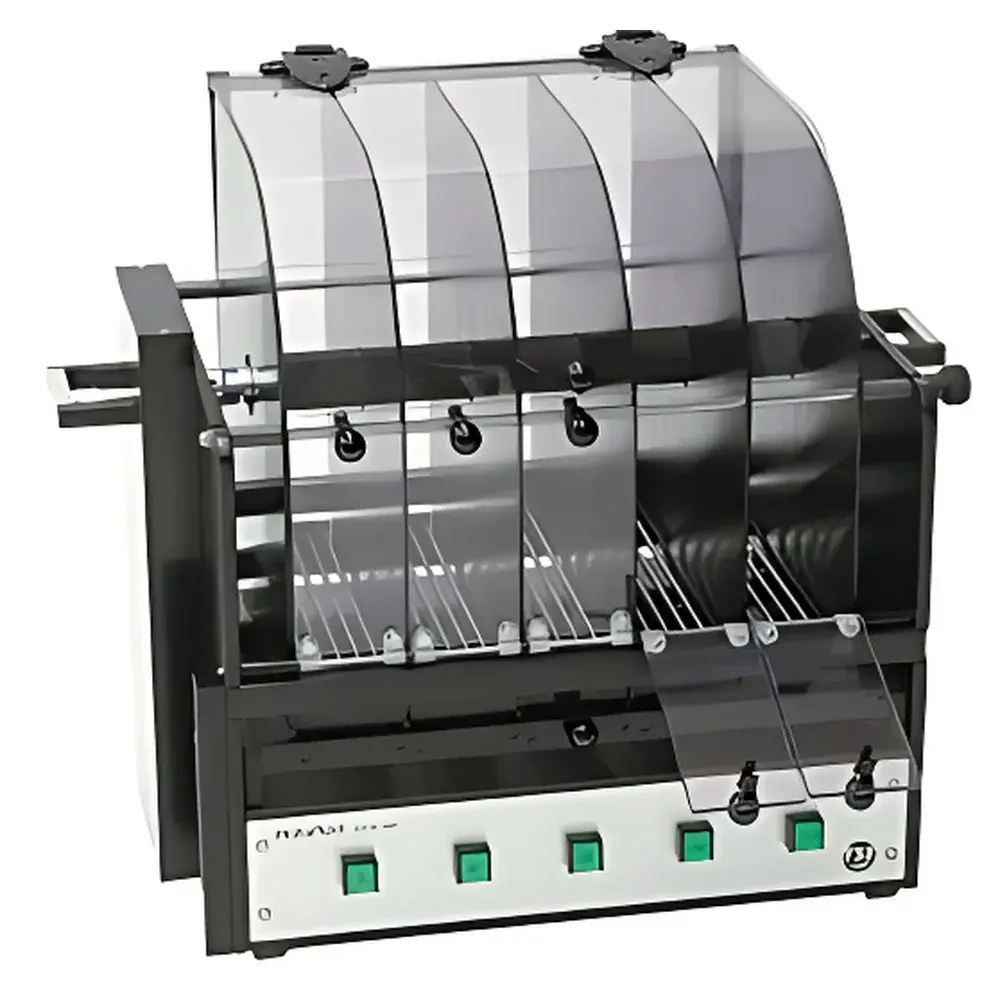
RotaRod Advanced by TSE Systems
| Brand | TSE Systems |
|---|---|
| Origin | Germany |
| Model | RotaRod Advanced |
| Animal Capacity | Up to 5 mice or 4 rats (configurable) |
| Speed Range | 1–60 rpm (constant, accelerating, or decelerating) |
| Control | Independent optical beam detection per lane |
| Motor Control | Electronically regulated DC motor |
| Software | Windows-based protocol editor with up to 100-step programmable speed profiles |
| Data Export | CSV/Excel-compatible output |
| Optional Modules | Foot shock unit, elevated drum configuration |
| Reversibility | Programmable bidirectional rotation |
| Compliance | Designed for GLP-compliant behavioral phenotyping workflows |
Overview
The RotaRod Advanced by TSE Systems is a precision-engineered, modular rotarod apparatus designed for quantitative assessment of motor coordination, balance, endurance, and neuromuscular function in rodent models. Based on the principle of forced locomotion on a rotating drum, the system measures latency-to-fall — a validated, objective endpoint widely adopted in preclinical neuroscience, pharmacology, and translational disease modeling (e.g., Parkinson’s, Huntington’s, cerebellar ataxia, muscular dystrophy, and aging-related motor decline). Unlike fixed-speed platforms, the RotaRod Advanced implements dynamic, user-defined angular acceleration profiles, enabling graded challenge paradigms that increase sensitivity to subtle inter-animal differences in motor learning, fatigue resistance, and sensorimotor integration. Its architecture supports both acute and longitudinal study designs under standardized, repeatable conditions aligned with international behavioral testing guidelines (e.g., NIH Behavioral Assessment Core recommendations and FELASA standards for rodent phenotyping).
Key Features
- Independent optical beam detection per lane ensures precise, contactless fall detection without mechanical interference or animal stress artifacts.
- Electronically controlled DC motor delivers stable, low-vibration rotation across the full 1–60 rpm range, with programmable acceleration/deceleration rates (0.1–10 rpm/s) and dwell times.
- Modular drum configurations: Standard 5-lane mouse drum (diameter 30 mm), 4-lane rat drum (75 mm), and optional 3-lane oversized drum (90 mm) for obese or geriatric rats requiring greater foot clearance and reduced peripheral strain.
- Full bidirectional rotation control: Each speed step can be assigned clockwise or counterclockwise direction, supporting asymmetric motor asymmetry studies and habituation protocols.
- Integrated control unit with PCI/USB interface card enables real-time synchronization with external devices (e.g., EMG, video tracking, or electrophysiology systems).
- Programmable 100-step speed protocol editor allows construction of complex, multi-phase test sequences — including ramped acceleration, plateau phases, stepwise increments, and deceleration recovery segments — all stored and recalled with timestamped metadata.
Sample Compatibility & Compliance
The RotaRod Advanced accommodates C57BL/6, BALB/c, CD-1, and Sprague-Dawley strains across standard weight ranges (18–35 g mice; 200–500 g rats). Drum surface texture (grooved silicone rubber) provides consistent traction while minimizing paw slippage artifacts. All hardware and firmware comply with CE marking requirements for laboratory equipment (2014/30/EU EMC Directive and 2014/35/EU LVD). The system supports audit-ready data integrity practices: software enforces user authentication, session logging, and immutable protocol versioning — facilitating alignment with GLP documentation standards and internal SOPs for behavioral core facilities. Optional foot shock module (0.05–1.5 mA, adjustable pulse width) is calibrated per IEC 60601-2-57 for biomedical stimulation devices.
Software & Data Management
The included Windows-based RotaRod Control Software (v4.x) provides a graphical protocol builder, live monitoring dashboard, and automated result compilation. Each trial generates a structured dataset containing latency-to-fall, total revolutions, average/peak speed at fall, direction sequence, and beam-break event timestamps. All raw data are saved in vendor-neutral CSV format with ISO 8601 timestamps and UTF-8 encoding, ensuring compatibility with Python (Pandas), R, MATLAB, and commercial statistical platforms (GraphPad Prism, SAS). Audit trail functionality records operator ID, protocol name, calibration date, and software version for each run — meeting traceability requirements under FDA 21 CFR Part 11 when paired with institutional electronic signature policies.
Applications
- Neurodegenerative disease modeling: Quantifying progressive motor deficits in α-synuclein or tau transgenic mice.
- Drug efficacy screening: Evaluating dopaminergic, GABAergic, or neurotrophic compounds in acute or chronic dosing regimens.
- Genetic phenotyping: High-throughput characterization of knockout/knock-in lines for motor circuit development.
- Aging research: Longitudinal tracking of age-dependent coordination loss in senescence-accelerated mouse models (SAM-P8).
- Toxicology: Detecting early-onset ataxia following subchronic exposure to neurotoxicants (e.g., MPTP, rotenone, organophosphates).
- Rehabilitation science: Assessing functional recovery post-spinal cord injury or peripheral nerve crush.
FAQ
What is the maximum number of animals that can be tested simultaneously?
Up to five mice or four standard adult rats. Optional 3-lane oversized drum configuration supports three large or aged rats with enhanced stability.
Is calibration required before each experiment?
Yes — daily verification of drum diameter, rotational speed accuracy (±0.5 rpm), and optical beam alignment is recommended using TSE-provided calibration templates and NIST-traceable tachometer validation.
Can the system integrate with third-party video tracking software?
Yes — via TTL trigger output and synchronized frame-stamp export, enabling pixel-accurate alignment with EthoVision XT, ANY-maze, or custom OpenCV pipelines.
Does the software support automated pass/fail criteria based on latency thresholds?
Yes — customizable binary classification rules can be applied during batch analysis, generating summary statistics per cohort with confidence intervals and ANOVA-ready export.
Is remote operation supported for biosafety level 2 (BSL-2) or ABSL-2 housing rooms?
Yes — the control unit supports Ethernet-based remote access through institutional VLANs, with role-based permissions and encrypted data transmission (TLS 1.2+).
Related Products





