
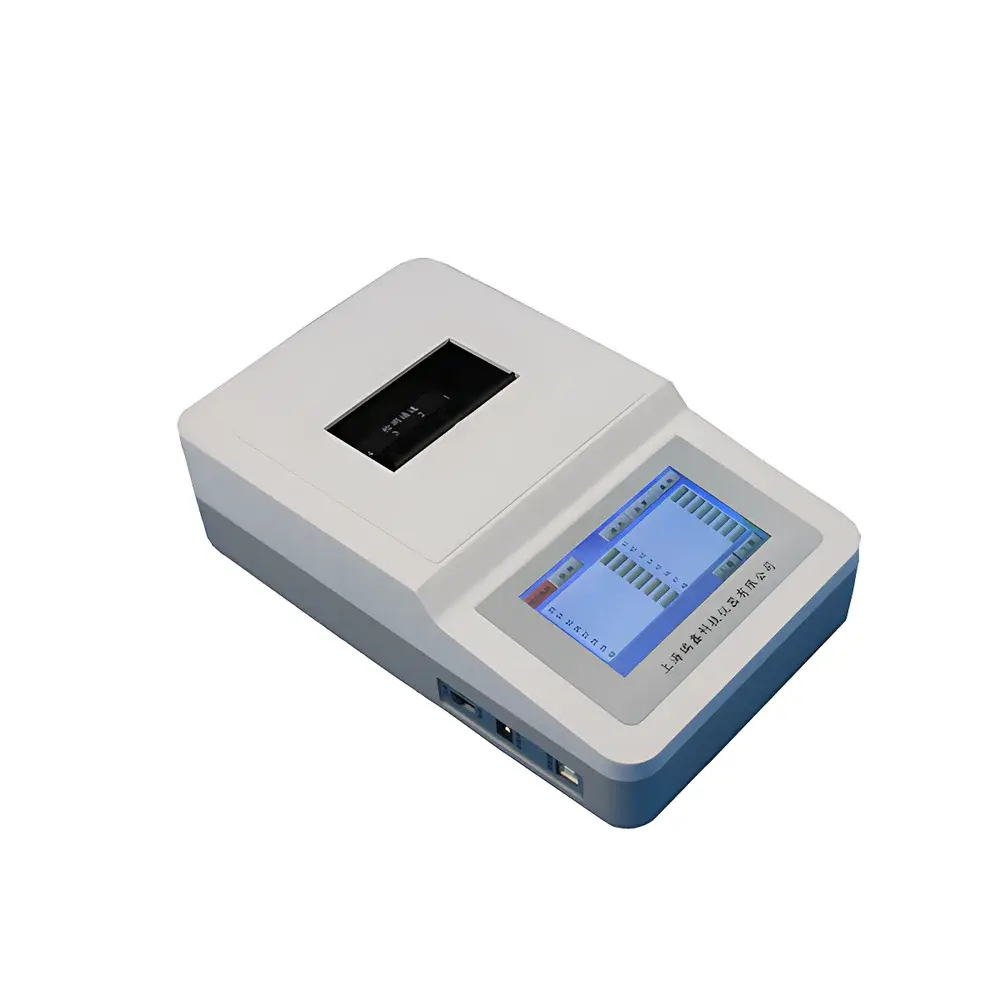
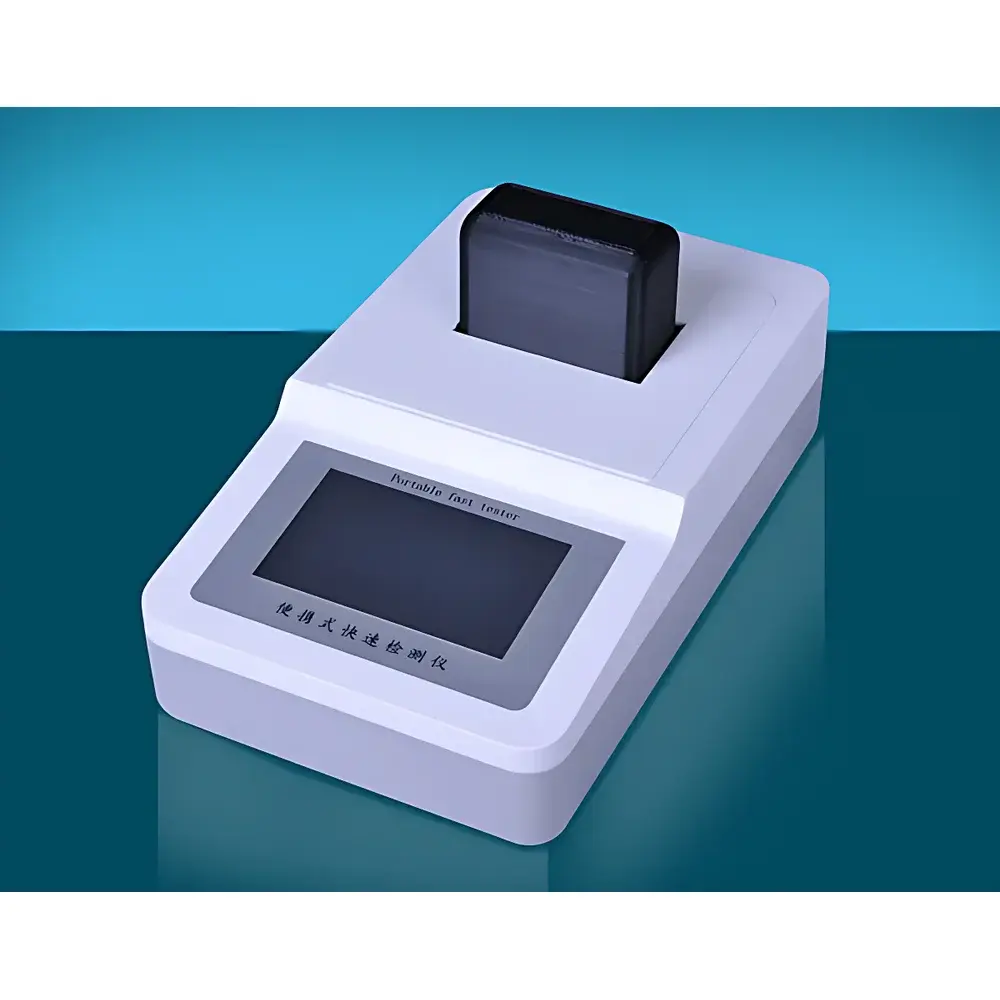
Ruixin SZ-XD402 Portable Residual Chlorine and Chlorine Dioxide Analyzer
| Brand | Ruixin |
|---|---|
| Origin | Shanghai, China |
| Model | SZ-XD402 |
| Instrument Type | Portable |
| Measurement Principle | DPD Colorimetric Spectrophotometry |
| Measurable Parameters | Residual Chlorine, Total Chlorine, Chlorine Dioxide, Ozone, Dissolved Oxygen |
| Range | 0.05–5.00 mg/L (Cl₂, ClO₂, O₃, DO) |
| Accuracy | ±3% FS |
| Repeatability | ±0.05 mg/L |
| Resolution | 0.01 mg/L |
| LOD | 0.05 mg/L |
| Absorbance Range | 0.000–4.000 (Resolution: 0.001) |
| Transmittance Range | 0.00–100.00% (Resolution: 0.01%) |
| Photometric Accuracy | ±2.0% T |
| Photometric Repeatability | ≤0.2% T |
| Stability | ≤0.3% T (3 min) |
| Display | 4.5-inch color TFT touch LCD |
| Connectivity | USB interface |
| Power Supply | AC 220 V / DC 5 V / Rechargeable Li-ion battery |
Overview
The Ruixin SZ-XD402 Portable Residual Chlorine and Chlorine Dioxide Analyzer is a field-deployable, multi-parameter spectrophotometric instrument engineered for quantitative determination of disinfectant residuals in water matrices. It operates on the standardized N,N-diethyl-p-phenylenediamine (DPD) colorimetric method—recognized by ISO 7393-2, APHA Standard Methods 4500-Cl G, and EPA Method 334.0—ensuring traceable, regulatory-compliant measurements across diverse water types. Designed for operational continuity in resource-constrained or mobile environments, the SZ-XD402 delivers laboratory-grade photometric performance without requiring benchtop infrastructure. Its optical architecture employs a stabilized LED light source with narrow-band interference filters, minimizing spectral drift and enabling high reproducibility under variable ambient conditions. The analyzer targets routine compliance monitoring at water treatment plants, distribution system checkpoints, swimming pool facilities, aquaculture sites, and emergency response deployments where rapid, on-site quantification of oxidant residuals is critical to public health protection.
Key Features
- 4.5-inch high-resolution color TFT touchscreen with full Chinese GUI—enabling intuitive navigation, parameter selection, and real-time data visualization without external software dependency.
- Integrated embedded thermal printer for immediate hard-copy reporting—supporting GLP-aligned documentation with timestamp, sample ID, operator name, and measured concentration values.
- Pre-loaded calibration curves for five key parameters: free chlorine, total chlorine, chlorine dioxide, ozone, and dissolved oxygen—each optimized per ASTM D1253 and ISO 7393-2 protocols to minimize matrix interference.
- Multi-power operation mode: supports AC 220 V mains, DC 5 V external adapter, and internal rechargeable lithium-ion battery—providing ≥8 hours of continuous field use per charge.
- Onboard data management: automatic storage of ≥1000 test records with searchable metadata (date/time, parameter, concentration, user ID), exportable via USB to CSV or PDF formats.
- Digital connectivity suite: USB 2.0 interface enables bidirectional communication with LIMS, SCADA systems, or centralized QA/QC dashboards—facilitating remote calibration verification and audit-ready data traceability.
Sample Compatibility & Compliance
The SZ-XD402 is validated for use with potable water, wastewater effluent, surface water, seawater (with salinity compensation), and recirculated recreational water. Sample handling requires no filtration or pretreatment for typical applications; turbidity up to 5 NTU does not significantly affect DPD-based readings due to built-in path-length correction algorithms. All measurement protocols align with international regulatory frameworks: ISO 7393-2 (chlorine), ISO 10634 (chlorine dioxide), ISO 15705 (ozone), and APHA 4500-O G (dissolved oxygen). The instrument’s photometric accuracy (±2.0% transmittance) and repeatability (≤0.2% T) meet minimum performance criteria outlined in US EPA Guidance for Field Instruments Used in Drinking Water Monitoring (EPA 815-R-17-001). While not FDA 21 CFR Part 11-certified out-of-box, its audit trail functionality—including immutable timestamps and operator logins—supports validation pathways for GMP/GLP environments.
Software & Data Management
The embedded firmware provides native support for calibration curve generation, blank subtraction, and concentration interpolation using polynomial regression models. All calibration events—including date, standard concentrations, absorbance values, and R² coefficients—are logged automatically. Data export via USB follows ISO/IEC 17025-compliant formatting: each record includes measurement uncertainty estimation based on repeatability and LOD-derived confidence intervals. Optional PC software (available upon request) enables advanced functions: batch calibration validation, trend analysis across sampling campaigns, and automated report generation compliant with ISO 17025 clause 7.8.2. No cloud upload or third-party telemetry is enabled by default—ensuring data sovereignty and alignment with EU GDPR and NIST SP 800-53 controls.
Applications
- Drinking water utilities: verification of residual chlorine decay profiles across distribution networks and booster station compliance checks.
- Wastewater treatment plants: post-disinfection validation of chlorine dioxide efficacy against Cryptosporidium oocysts per USEPA LT2ESWTR requirements.
- Aquaculture operations: real-time ozone monitoring in recirculating aquaculture systems (RAS) to prevent oxidative stress in sensitive species.
- Swimming pool & spa management: daily verification of free chlorine and combined chlorine levels per CDC Model Aquatic Health Code (MAHC) thresholds.
- Emergency response teams: rapid assessment of disinfectant residuals during disaster recovery—e.g., post-flooding well water re-chlorination verification.
- Environmental laboratories: field screening prior to confirmatory HPLC or amperometric analysis—reducing lab turnaround time and consumables cost.
FAQ
What standards does the SZ-XD402 comply with for chlorine measurement?
It adheres to ISO 7393-2, APHA Standard Methods 4500-Cl G, and EPA Method 334.0 for free and total chlorine determination.
Can the instrument measure chlorine dioxide in seawater?
Yes—its DPD chemistry has been validated for chloride ion concentrations up to 20,000 mg/L, with minimal interference from bromide when using the manufacturer-recommended quenching protocol.
Is calibration traceable to NIST standards?
Calibration standards are supplied with certificate of analysis referencing NIST-traceable reference materials (SRM 2800, SRM 3121a); users must perform initial calibration using these certified solutions.
Does the device support user-defined calibration curves?
Yes—the firmware allows import of custom polynomial or linear equations via USB, provided they conform to IUPAC-recommended absorbance-concentration linearity constraints.
How is data integrity maintained during power interruption?
All measurements in progress are auto-saved to non-volatile memory within 100 ms of power loss; no data corruption occurs during battery switchover or AC dropout.
Related Products







